How to Calculate Unknown Sides of a Right Triangle
TL;DR
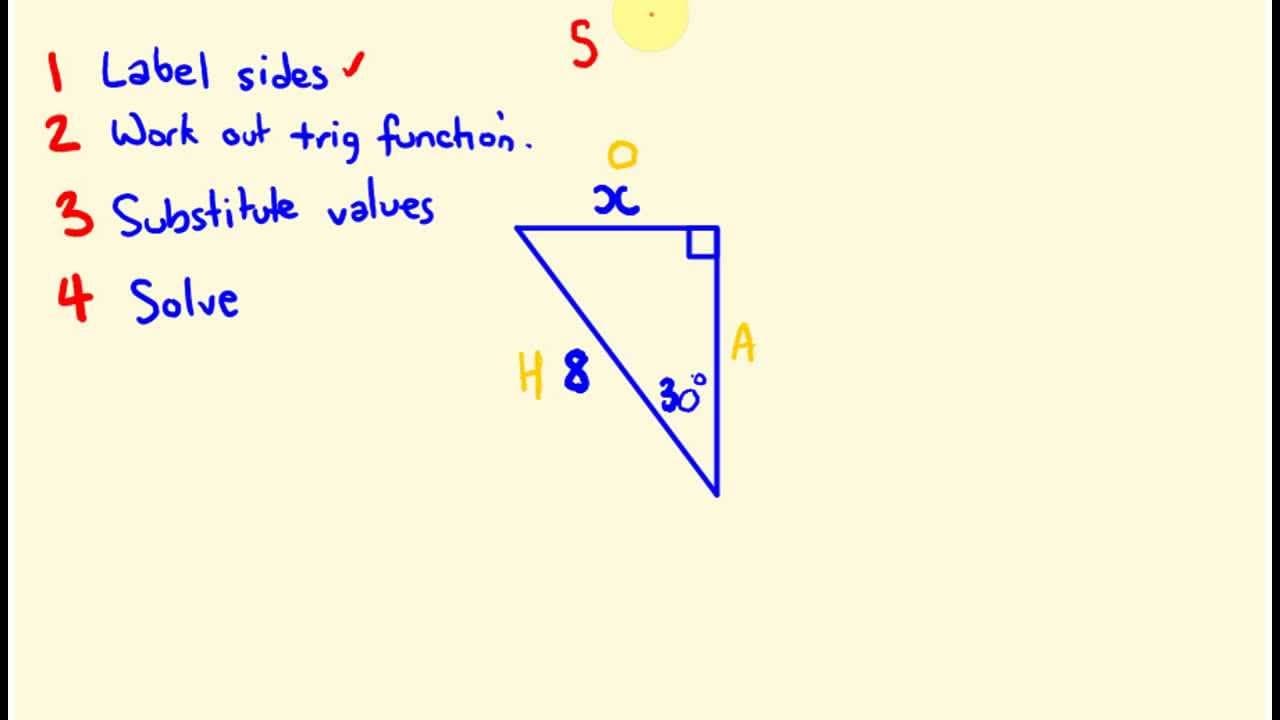
To calculate an unknown side of a right triangle, identify the hypotenuse, opposite, and adjacent sides. Use the appropriate trigonometric function — sine, cosine, or tangent — based on the sides involved, substitute the known values, and solve the equation. For example, with a 30-degree angle and a hypotenuse of 8, you can find the opposite side using sine: x = sin(30°) * 8 = 4.
Transcript
good day and welcome to the tech math channel uh what we're going to be having a look at in this video is we're looking at using trigonometry we're looking at in the last video um and using this trigonometry to solve for unknown sides okay work out unknown sides so first off uh let's just go give a quick recap what we had a look at last video we ha... Read More
Key Insights
- 🔺 Trigonometry involves using the relationships between angles and sides in right-angle triangles.
- 🙃 There are three trigonometric functions: sine, cosine, and tangent, each used for specific combinations of sides.
- 🙃 Labeling the sides and selecting the correct trigonometric function are crucial steps in solving for unknown sides.
- 🙃 Using mnemonics can help remember the relationships between sides and trigonometric functions.
- 🙃 Multiplying both sides of an equation by the same value helps in isolating the unknown variable.
- 😄 Scientific calculators often have built-in trigonometric functions for ease of calculation.
- 🔺 Solving for unknown sides in right-angle triangles involves substituting known values and solving the resulting equation.
Install to Summarize YouTube Videos and Get Transcripts
Explore YouTube Video Summarizer or Get YouTube Transcript Extractor
Questions & Answers
Q: What are the sin, cos, and tan formulas (ratios) in trigonometry?
Sine equals opposite over hypotenuse, cosine equals adjacent over hypotenuse, and tangent equals opposite over adjacent. Which one you use depends on which two sides of the right-angle triangle you are working with. These three ratios let you connect an angle to the lengths of the sides.
Q: How do you calculate an unknown side using sin, cos, or tan?
Follow four steps: label the sides (hypotenuse, opposite, adjacent), work out which trigonometric function fits the two sides involved, substitute the known values, then solve the equation. For example, sin(30) = x/8 becomes x = sin(30) x 8. Typing 30, sin (which gives 0.5), times 8 gives x = 4.
Q: How do you decide whether to use sine, cosine, or tangent?
Look at which two sides the problem involves relative to the angle Theta. Use sine when you have the opposite and hypotenuse, cosine when you have the adjacent and hypotenuse, and tangent when you have the opposite and adjacent. Matching the function to the sides is the key step before substituting values.
Q: What are the different names of the sides in a right-angle triangle?
The long side across from the right angle is the hypotenuse. The side directly across from the angle Theta is the opposite, and the remaining side next to Theta is the adjacent. These are shortened to h, o, and a when labeling the triangle.
Q: What mnemonic helps you remember the trigonometry ratios?
The video uses "some old hags can't always hack their old age." It encodes that sine goes with opposite and hypotenuse, cosine with adjacent and hypotenuse, and tangent with opposite and adjacent, so you can recall which sides each function uses.
Q: How do you isolate the unknown side X in the equation?
When the unknown is on top of a fraction, like sin(30) = x/8, multiply both sides by the bottom number to get X by itself, giving x = sin(30) x 8. A helpful check is that in a form like this number equals another divided by a third, you find the top by multiplying the other two together.
Q: Do you need a scientific calculator to find sin, cos, and tan?
Yes, you use a scientific calculator, which has dedicated sin, cos, and tan buttons. On the computer's built-in calculator you switch it to Scientific mode under View to see those three buttons, then enter the angle and press the function, for example 30 then sin gives 0.5.
Q: Can you show a worked example of finding an unknown side?
Given a right-angle triangle with a 30 degree angle, a hypotenuse of 8, and an unknown opposite side X, you use sine because it involves the opposite and hypotenuse. So sin(30) = x/8, which rearranges to x = sin(30) x 8 = 0.5 x 8 = 4.
Summary & Key Takeaways
-
The video introduces the names of different sides in a right-angle triangle: hypotenuse, opposite, and adjacent.
-
It explains the three trigonometric functions: sine, cosine, and tangent and when to use them based on the given sides.
-
The video provides step-by-step instructions on how to solve for unknown sides by labeling the sides, choosing the appropriate trigonometric function, substituting values, and solving equations.
Read in Other Languages (beta)
Share This Summary 📚
Summarize YouTube Videos and Get Video Transcripts with 1-Click
Try YouTube Summary with ChatGPT & Claude or YouTube Transcript Generator
Explore More Summaries from tecmath 📚


Summarize YouTube Videos and Get Video Transcripts with 1-Click
Try YouTube Summary with ChatGPT & Claude or YouTube Transcript Generator