How Does The Nucleus Hold Together?
TL;DR
The strong nuclear force binds atomic nuclei via mesons.
Transcript
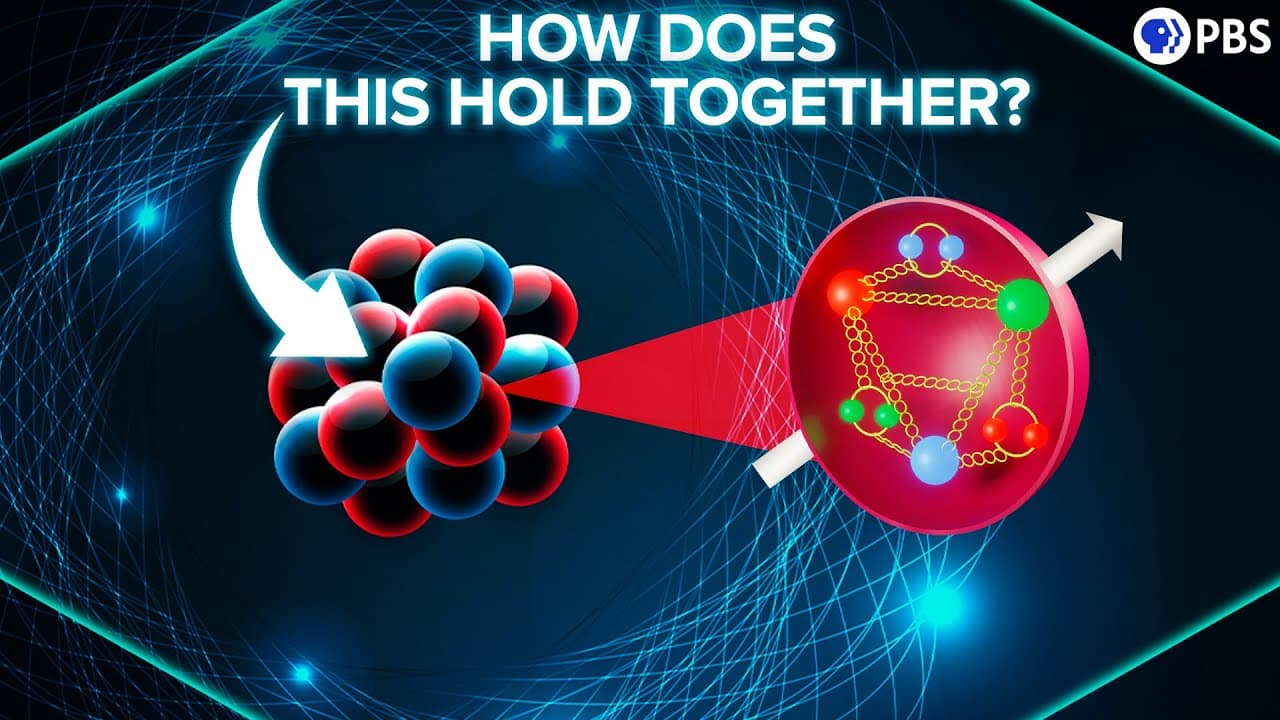
Thank you to Rocket Money for supporting PBS. Two protons next to each other in an atomic nucleus are repelling each other electromagnetically with enough force to lift a medium-sized labradoodle off the ground. Release this energy and you have, well, you have a nuclear explosion. Just as well there's an even stronger force than the electromagn... Read More
Key Insights
- The electromagnetic force between protons in a nucleus is strong enough to cause repulsion, but the strong nuclear force overcomes this to hold the nucleus together.
- Quantum chromodynamics describes the strong force, which binds quarks into protons and neutrons, and is mediated by gluons, not directly by mesons.
- Hideki Yukawa theorized the existence of mesons as exchange particles for the strong nuclear force, predicting their mass and charge characteristics.
- Yukawa's theory initially failed to explain beta decay, leading to the discovery of both the strong and weak nuclear forces.
- Mesons, such as pions, are involved in the strong nuclear force by allowing nucleons to exchange energy and momentum through virtual particles.
- The discovery of mesons and baryons led to the identification of the Particle Zoo, which was later explained by quark combinations.
- Gluons mediate the strong force among quarks, while mesons act as quasi-particles to mediate the residual strong nuclear force between nucleons.
- The strong nuclear force is essential for the existence of complex atoms, chemistry, and life, as it allows atomic nuclei to remain stable.
Install to Summarize YouTube Videos and Get Transcripts
Explore YouTube Video Summarizer or Get YouTube Transcript Extractor
Questions & Answers
Q: What role do mesons play in the strong nuclear force?
Mesons act as exchange particles in the strong nuclear force, allowing nucleons to share energy and momentum. They facilitate the residual strong force that binds protons and neutrons in the nucleus, despite not being the primary mediators of the strong force, which is handled by gluons among quarks.
Q: How did Hideki Yukawa contribute to the understanding of nuclear forces?
Hideki Yukawa proposed the existence of mesons as exchange particles for the strong nuclear force, predicting their mass and charge properties. His work laid the groundwork for understanding how nucleons are held together in atomic nuclei, leading to the discovery of both the strong and weak nuclear forces.
Q: What is the significance of the Particle Zoo in particle physics?
The Particle Zoo refers to the diverse array of mesons and baryons discovered, which initially puzzled scientists. This was later explained by quark theory, revealing that these particles are combinations of quarks. The Particle Zoo highlighted the complexity of subatomic particles and advanced the understanding of particle interactions.
Q: How do gluons mediate the strong force among quarks?
Gluons are massless particles that carry color charge, mediating the strong force among quarks. They facilitate the binding of quarks within protons and neutrons, enabling quarks to change color charge through gluon exchange. This interaction is crucial for the stability of nucleons and the integrity of atomic nuclei.
Q: What is the difference between the strong force and the strong nuclear force?
The strong force refers to the fundamental interaction that binds quarks within protons and neutrons, mediated by gluons. The strong nuclear force, on the other hand, is the residual force that holds nucleons together in the nucleus, mediated by mesons like pions, acting as virtual particles to exchange energy.
Q: Why was Yukawa's initial theory on beta decay incorrect?
Yukawa initially hypothesized that beta decay was mediated by electrons exchanged between nucleons, which was incorrect. His insight that forces should be mediated by particles was novel, but it led to the realization that beta decay involves a separate, weaker nuclear force, now known as the weak force.
Q: How do virtual particles like mesons exist according to quantum mechanics?
Virtual particles, such as mesons, exist briefly due to the Heisenberg uncertainty principle, which allows temporary energy fluctuations. These particles can 'borrow' energy to exist momentarily, facilitating interactions like the strong nuclear force, before returning the energy, thus not violating conservation laws.
Q: What is the role of quarks in the composition of mesons and baryons?
Quarks are the fundamental constituents of mesons and baryons. Mesons are composed of a quark-antiquark pair, while baryons consist of three quarks. The combinations of quarks, governed by the strong force, determine the properties of these particles, explaining the diversity observed in the Particle Zoo.
Summary & Key Takeaways
-
The strong nuclear force is responsible for binding atomic nuclei, overcoming the electromagnetic repulsion between protons. This force is mediated by mesons, which are virtual particles that allow nucleons to exchange energy and momentum. Yukawa's theory, which predicted mesons, was crucial in understanding this fundamental force.
-
Quantum chromodynamics explains the strong force that holds quarks within protons and neutrons, mediated by gluons. However, the residual strong nuclear force between nucleons is mediated by mesons, such as pions, which are essential for the stability of atomic nuclei and the existence of complex matter.
-
The discovery of mesons and baryons expanded the understanding of subatomic particles, leading to the concept of the Particle Zoo. This was later clarified by quark theory, which explained the combinations of quarks that form mesons and baryons, highlighting the complexity and intricacy of particle physics.
Read in Other Languages (beta)
Share This Summary 📚
Summarize YouTube Videos and Get Video Transcripts with 1-Click
Try YouTube Summary with ChatGPT & Claude or YouTube Transcript Generator
Explore More Summaries from PBS Space Time 📚
Summarize YouTube Videos and Get Video Transcripts with 1-Click
Try YouTube Summary with ChatGPT & Claude or YouTube Transcript Generator