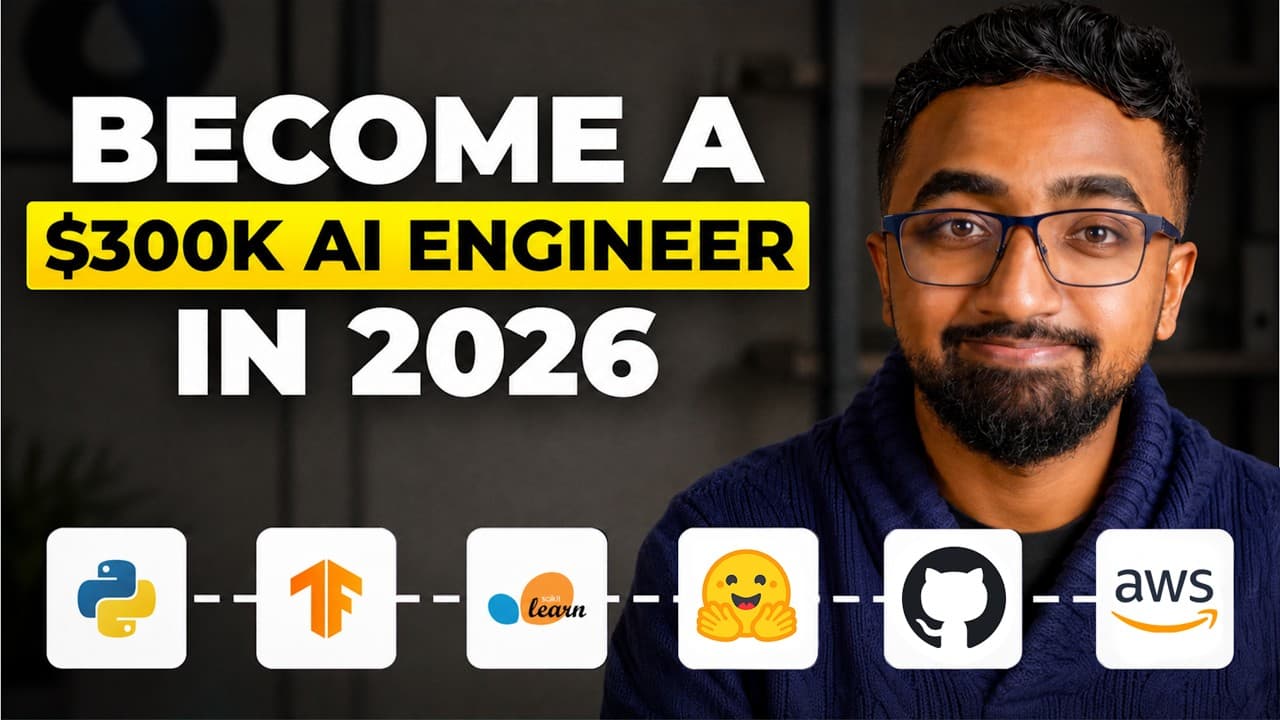
How to land a $300K AI engineer job in 2026?
TL;DR
The path to a high paying AI engineer role rests on a four level stack: foundations, harnessing AI models, shipping AI systems, and deployment governance. Start with Python, SQL, and API architecture, then practice with AI APIs and local models, build end to end projects, and master deployment to stand out in the job market.
Transcript
AI engineers are making over $300,000 every single year. And especially at top tech companies, that number could get even crazier going over $1 million. [music] And so, if you want to become that rich AI engineer, this is the video for you. If you're new here, hi. My name is Sajad. I got my master's in AI and computer science from Georgia Tech when... Read More
Key Insights
- Foundations are essential and include mastering Python because most AI tools speak Python first, avoiding tutorial hell by building projects rather than endless watching.
- SQL is critical because data drives AI models, with core commands like SELECT, WHERE, and JOIN forming the basis of data manipulation in real world tasks.
- API architecture is like an ATM for data access; learning to interact with external services via APIs is a core AI engineering skill.
- CAM framework helps structure AI work: Context engineering shapes how models operate, AI APIs provide access to models, and models training involves running your own models.
- Practical model use begins with hands on projects; start small with Python code reading text, sending to OpenAI API, and expanding to translation or extraction tasks.
- M and A in CAM stand for Models and Agents; running your own models (Hugging Face) and using agents to automate tasks are critical to scaling.
- Level three emphasizes Retrieval Augmented Generation (RAG) to integrate private company data with AI outputs, enabling accurate, data grounded responses.
- Deployment and governance are essential for reliability and compliance, including Docker, AWS/GCP for hosting, and evaluation frameworks like Deep Eval to monitor hallucinations and quality.
Install to Summarize YouTube Videos and Get Transcripts
Explore YouTube Video Summarizer or Get YouTube Transcript Extractor
Questions & Answers
Q: How can I start building as an aspiring AI engineer with no experience?
Begin with foundational skills: learn Python as the language most AI tools use, then learn SQL to access and shape data, and finally master API architecture to interact with external services. Practice by building small projects that use Python to call APIs, process results, and iterate, which turns learning into tangible capability and builds a portfolio.
Q: What is the CAM framework and how do I apply it?
CAM stands for Context engineering, AI APIs, and Models. Start by designing a strong context for your AI tasks, then practice with APIs to interact with models like OpenAI or Anthropic, and finally experiment by running your own models (for example on Hugging Face). This sequence helps you build repeatable, scalable AI solutions.
Q: Why is RAG important in AI engineering and how do I implement it?
RAG, or Retrieval Augmented Generation, lets your AI system access private or updated data beyond the model’s training. Implement it by chunking your data, creating embeddings stored in a vector database, retrieving relevant chunks in responses, and augmenting prompts with that context before generation, enabling accurate, data grounded outputs.
Q: What role do agents play in building AI systems?
Agents act as autonomous workers that can handle complex tasks end to end, such as reading documentation, coding, reviewing, and testing. They can be coordinated via a model context protocol, allowing connections to tools like GitHub or Slack to automate development workflows and collaboration.
Q: How important is deployment and which tools should I learn?
Deployment is essential to bring projects to real users. Learn Docker to containerize applications, and gain familiarity with cloud platforms like AWS or GCP to host services securely. Demonstrating deployment knowledge greatly increases hiring prospects as it shows you can deliver working systems.
Q: What is the recommended path to practical AI projects and credentials?
Use hands on tracks such as DataCamp’s AI Engineer for Developers and Python/SQL fundamentals to build end to end projects that map to the stack described in the video. Completing these tracks and earning associated certifications can improve credibility on resumes and LinkedIn.
Q: How can I leverage DataCamp resources for AI engineering?
DataCamp offers tracks that align with the four level stack: Python, SQL, API usage, and AI engineer development. Their learning paths emphasize hands on coding in the browser and culminate in relevant credentials, which helps you prove end to end capability from fundamentals to deployment.
Q: What is the core progression to reach a 300K AI engineer salary by 2026?
Progress through four levels: foundations (Python, SQL, APIs), harnessing AI models with context motor and APIs, shipping end to end AI projects including RAG and agents, and finally deployment and governance to ensure reliability and compliance. This structured path, reinforced by practical projects and credentialing, aligns with high paying roles.
Summary & Key Takeaways
-
This video outlines a four level AI engineer stack starting with foundational skills like Python, SQL and API architecture, moving through model harnessing with CAM, and ending with end to end project shipping, deployment, and governance to secure high paying roles.
-
It emphasizes hands on practice using DataCamp tracks that map to the stack, including Python, SQL, and AI engineer developer tracks, plus practical projects and credentialing to validate skills on LinkedIn.
-
The overall message is that progression through foundations, model work, deployment, and governance, aided by hands on projects and practical credentials, can lead to a $300K AI engineer job by 2026.
Read in Other Languages (beta)
Share This Summary 📚
Summarize YouTube Videos and Get Video Transcripts with 1-Click
Try YouTube Summary with ChatGPT & Claude or YouTube Transcript Generator
Explore More Summaries from Sajjaad Khader 📚



Summarize YouTube Videos and Get Video Transcripts with 1-Click
Try YouTube Summary with ChatGPT & Claude or YouTube Transcript Generator