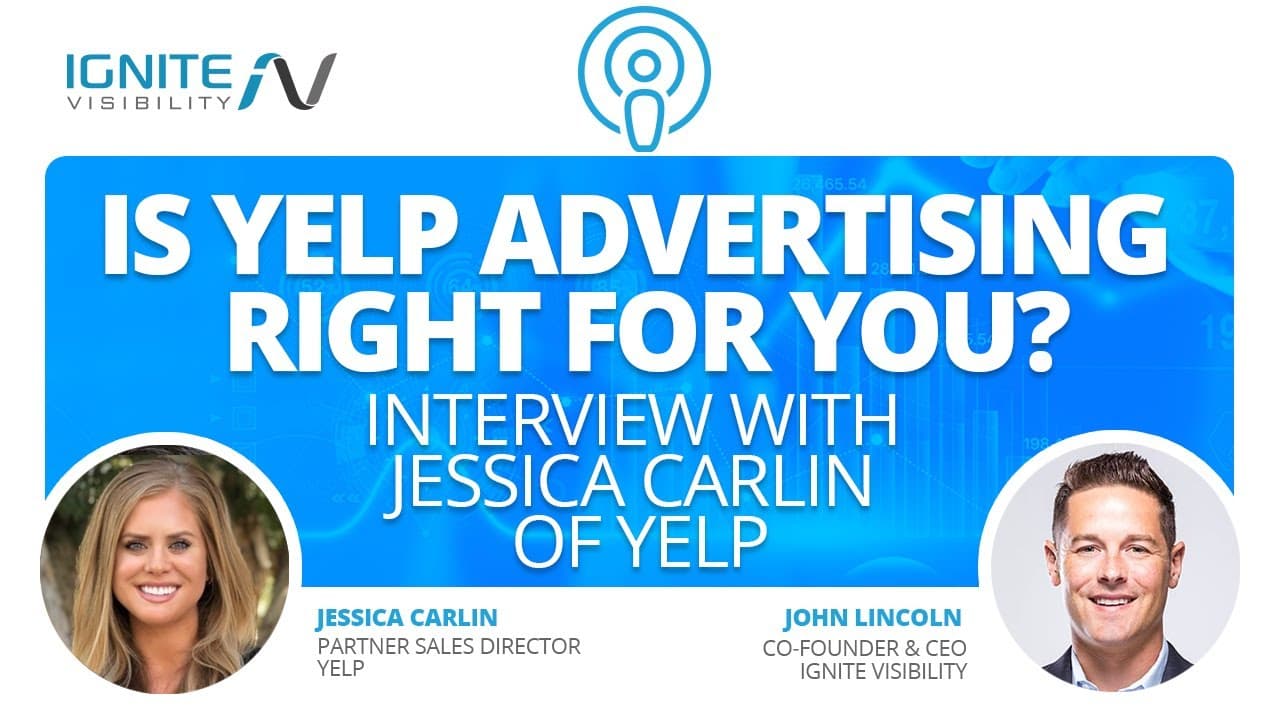
Jessica Carlin on Who Should Use Yelp Advertising
TL;DR
Yelp advertising is worth considering when a local market shows enough relevant search volume to justify greater exposure. Yelp functions as a business directory, uses category-based advertising, and supports negative keyword and custom location targeting. Local and multi-location businesses should evaluate market data, search demand, service relevance, and Yelp’s role across Google results and integrations before allocating budget.
Transcript
okay everybody welcome to another ignite visibility university today i am so excited because we have yelp with us specifically jessica carlin partner sales director at yelp who is somebody who has come and presented at the ignite visibility office before and did a fantastic job jessica i am so happy to have you here how are you doing today i'm wond... Read More
Key Insights
- Yelp is a business directory that helps consumers find specific products or services in their local markets. Reviews are part of the platform, but describing Yelp only as a review site overlooks its core role as a modern local business directory.
- The suitability of Yelp advertising depends more on local search demand than on a single preferred business category. A company should examine whether enough people search Yelp for its offering within the relevant service area before deciding to purchase additional exposure.
- Market data can support a Yelp advertising decision by showing recent search activity for a service within a defined area. Agency partners can request inventory reports and market information, then use those findings to determine whether a client should discuss paid advertising.
- Home services were Jessica Carlin’s preferred vertical at the time of the interview because searches within that category had increased after COVID affected daily life. She connected that growth to people spending more time at home and completing household projects.
- Yelp can contribute to an omnichannel local marketing strategy because Yelp pages may appear prominently in Google results for local business queries. A consumer can therefore begin a search on Google and subsequently reach Yelp while evaluating nearby service providers.
- Yelp powers local business information beyond its own website and application. The interview identifies Yelp as Apple’s default directory for Apple Maps, a provider of local business content for Yahoo, and the service powering local searches conducted through Alexa.
- Yelp advertising is category-based rather than keyword-based. A business targets searches associated with its assigned parent category, so an Italian restaurant may receive exposure across related searches for foods such as pizza, pasta, and breadsticks.
- Negative keyword targeting allows advertisers to block services or products that are irrelevant, unavailable, or less attractive financially. This control is useful when a broad parent category includes jobs that a business does not perform or does not want to fund with advertising.
Install to Summarize YouTube Videos and Get Transcripts
Explore YouTube Video Summarizer or Get YouTube Transcript Extractor
Questions & Answers
Q: How do I know if Yelp advertising is right for my business?
Yelp advertising may be appropriate if your business depends on customers finding a product or service within a local market. The central test is whether Yelp has enough relevant search volume in your service area to justify paying for greater exposure. Review market and inventory data first, then consider your locations, offered services, and broader marketing mix before allocating advertising budget.
Q: What type of business performs best with Yelp advertising?
The interview says businesses across many categories can perform well on Yelp when they have a meaningful local presence. Market conditions matter more than choosing one universally successful vertical because Yelp usage varies by location. Home services were highlighted as a particularly attractive category at the time, but every advertiser should confirm demand for its own category and service area.
Q: Why is Yelp described as a business directory instead of only a review site?
Yelp is described as a business directory because consumers visit it when they know they need a specific local service or product and want to identify suitable providers. Reviews contribute to their evaluation, but the platform’s broader function is connecting local demand with business listings. Jessica Carlin compares that role to a modern version of the Yellow Pages.
Q: How should a business evaluate local demand on Yelp?
A business should examine recent Yelp search activity for its category within the area it actually serves. Yelp advertising partners can request inventory reports and market data that quantify relevant searches in a service area. That evidence helps an agency or business decide whether sufficient consumer demand exists to warrant a conversation about paid exposure rather than relying on assumptions about Yelp’s popularity.
Q: How does Yelp fit into an omnichannel marketing strategy?
Yelp supports an omnichannel strategy by reaching consumers both on Yelp and through other services that display or surface its local business information. Yelp pages can appear prominently when someone performs a local query on Google. The interview also identifies integrations with Apple Maps, Yahoo, and Alexa, giving local businesses visibility across several points in a consumer’s search process.
Q: How does targeting work in Yelp advertising?
Yelp uses category-based advertising rather than a keyword-based model. A business is assigned to a relevant parent category, and its advertising can appear across searches that fall within that category. For example, an Italian restaurant can be eligible for related food searches without selecting each individual dish as a target keyword. This structure follows how consumers search Yelp for businesses.
Q: What is negative keyword targeting on Yelp?
Negative keyword targeting lets an advertiser block searches for products or services that should not consume its advertising budget. A plumbing company might cover most work within the broad plumbing category while declining certain jobs or finding some jobs less profitable. The advertiser can exclude those unwanted queries even though they remain associated with the company’s broader parent category on Yelp.
Q: How can Yelp advertisers control which locations they target?
Yelp historically allowed ads to target searches within a radius around a business. Home service businesses could instead select up to six ZIP codes, cities, or neighborhoods, which Jessica Carlin described as limiting. Custom location targeting was introduced to provide additional geographic control, helping advertisers focus exposure more precisely than the earlier radius or limited-area options allowed.
Summary & Key Takeaways
-
Yelp is presented as a local business directory rather than merely a review website. Consumers use it when they already need a particular product or service in their area. Businesses across categories can benefit, but advertisers should first verify that their target market generates enough relevant Yelp searches to justify increased exposure.
-
Yelp can support an omnichannel marketing strategy because its local business content appears beyond Yelp’s own platform. Yelp pages can rank prominently in Google, while Yelp also powers local business information for Apple Maps, Yahoo, and Alexa. This distribution can make Yelp relevant even when a consumer begins searching somewhere else.
-
Yelp advertising targets business categories instead of individual keywords. An Italian restaurant, for example, can appear for searches associated with Italian food. Negative keyword targeting lets advertisers block irrelevant or lower-return queries, while custom location targeting provides more control than relying only on a radius or a limited selection of locations.
Read in Other Languages (beta)
Share This Summary 📚
Summarize YouTube Videos and Get Video Transcripts with 1-Click
Try YouTube Summary with ChatGPT & Claude or YouTube Transcript Generator
Explore More Summaries from IgniteVisibility 📚
Summarize YouTube Videos and Get Video Transcripts with 1-Click
Try YouTube Summary with ChatGPT & Claude or YouTube Transcript Generator