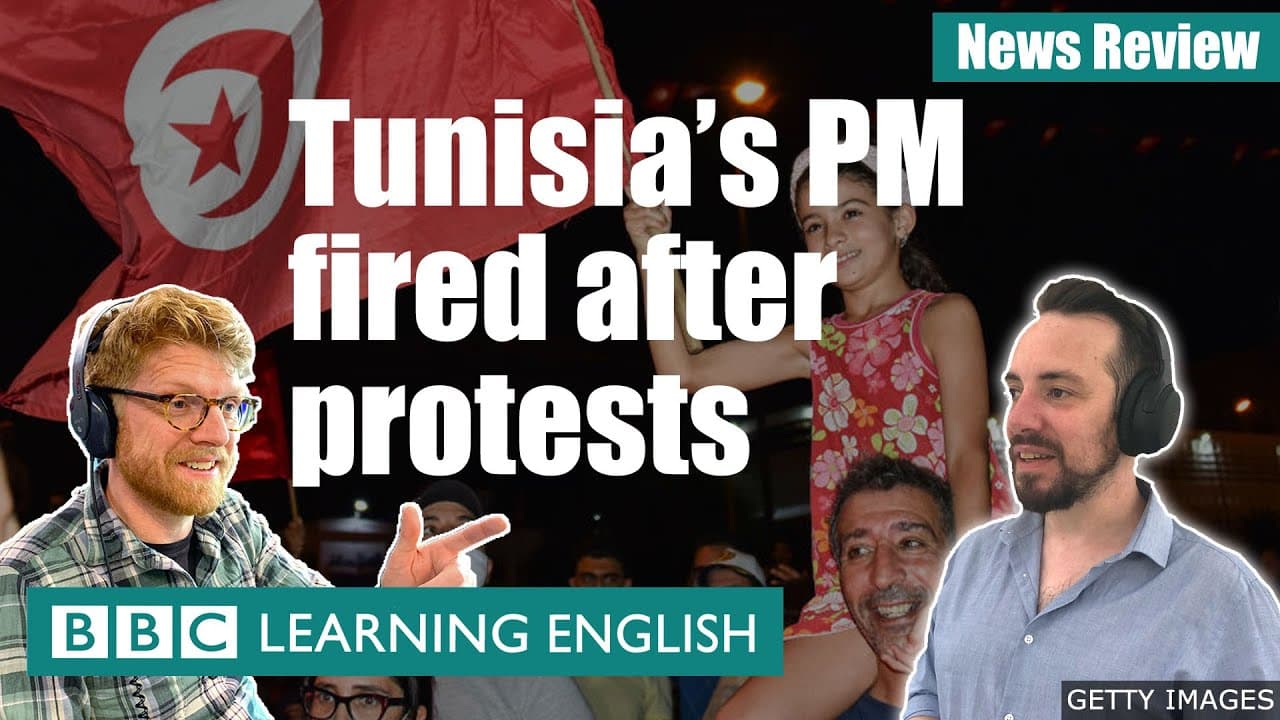
Tunisia's prime minister fired after protests: BBC News Review
TL;DR
Tunisia's PM dismissed amidst protests over Covid response.
Transcript
Protests in Tunisia: the prime minister is removed from office after violent protests about the government's handling of Covid-19. This is News Review from BBC Learning English. I'm Neil. Joining me is Roy. Hello Roy. Hi Neil and hello everyone. If you would like to learn more about the vocabulary around this story, all you need to do is head to ou... Read More
Key Insights
- The Tunisian president dismissed the prime minister following violent protests about the government's Covid-19 response and economic issues.
- The term 'dismissing' is a formal way to describe removing someone from their position, often used in official contexts.
- 'Woes' refers to significant problems or issues, often used in the context of countries or governments facing economic or social challenges.
- 'Ousts' implies forcibly removing someone from a position of power or authority, often against their will.
- The language used to describe the dismissal of the Tunisian prime minister suggests a formal and serious action taken by the president.
- The protests in Tunisia were fueled by dissatisfaction with the government's handling of the Covid-19 crisis and the country's economic struggles.
- The vocabulary discussed includes 'dismissing,' 'woes,' and 'ousts,' providing useful language for discussing political and social issues.
- The situation in Tunisia highlights the impact of government actions on public sentiment and the potential for unrest when citizens feel their concerns are not addressed.
Install to Summarize YouTube Videos and Get Transcripts
Explore YouTube Video Summarizer or Get YouTube Transcript Extractor
Questions & Answers
Q: What prompted the Tunisian president to dismiss the prime minister?
The Tunisian president dismissed the prime minister following violent protests across the country. The protests were largely in response to the government's handling of a significant increase in Covid-19 cases and general dissatisfaction with the country's economic situation. The president's decision was seen as an attempt to address these issues and restore order.
Q: What does the term 'dismissing' mean in the context of the news story?
In the context of the news story, 'dismissing' refers to the formal removal of someone from their position. It is a term often used in official settings to indicate that an individual, such as the prime minister, has been relieved of their duties. This action is typically taken by someone in a higher position of authority, like the president.
Q: How is the word 'woes' used in the context of the Tunisian protests?
In the context of the Tunisian protests, 'woes' refers to the significant problems and issues facing the country, particularly related to economic challenges and the government's handling of the Covid-19 crisis. The term conveys the seriousness of the situation and the deep concerns of the citizens that led to the protests.
Q: What does 'ousts' imply about the removal of the Tunisian prime minister?
The use of the word 'ousts' implies that the removal of the Tunisian prime minister was done forcibly and against his will. It suggests a dramatic and significant action taken by the president to remove the prime minister from his position of authority, often in response to public pressure and unrest.
Q: What are the broader implications of the protests in Tunisia?
The protests in Tunisia highlight the broader implications of government actions on public sentiment. When citizens feel that their concerns, such as the handling of the Covid-19 crisis and economic issues, are not being addressed, it can lead to widespread unrest. This situation underscores the importance of responsive governance and the potential for political change when public dissatisfaction reaches a tipping point.
Q: How does the vocabulary discussed help in understanding political events?
The vocabulary discussed, including terms like 'dismissing,' 'woes,' and 'ousts,' provides a framework for understanding political events. These words help describe the actions taken by authorities, the challenges faced by governments, and the dynamics of power. They are essential for articulating the complexities of political situations and the impact on society.
Q: What role did economic issues play in the Tunisian protests?
Economic issues played a significant role in the Tunisian protests. The public's dissatisfaction with the government's handling of the economy, alongside the Covid-19 crisis, fueled the unrest. Economic challenges, such as high unemployment and inflation, exacerbated the public's grievances, leading to demands for change and accountability from the government.
Q: Why is the language used in the news story significant?
The language used in the news story is significant because it conveys the seriousness and formality of the actions taken by the Tunisian president. Words like 'dismissing,' 'woes,' and 'ousts' highlight the gravity of the situation and the decisive measures implemented. This choice of language helps readers understand the political context and the implications for the country.
Summary & Key Takeaways
-
The Tunisian president dismissed the prime minister after violent protests erupted over the government's handling of Covid-19 and economic issues. The action was seen as a formal and decisive move to address the public's grievances.
-
Key vocabulary from the story includes 'dismissing,' 'woes,' and 'ousts,' which describe the removal of officials, significant problems, and forcible removal from positions, respectively. These terms are useful for discussing political events.
-
The protests in Tunisia reflect widespread dissatisfaction with the government's response to the Covid-19 crisis and economic challenges, leading to significant political changes and highlighting the importance of addressing public concerns.
Read in Other Languages (beta)
Share This Summary 📚
Summarize YouTube Videos and Get Video Transcripts with 1-Click
Try YouTube Summary with ChatGPT & Claude or YouTube Transcript Generator
Explore More Summaries from BBC Learning English 📚



Summarize YouTube Videos and Get Video Transcripts with 1-Click
Try YouTube Summary with ChatGPT & Claude or YouTube Transcript Generator