What Does the Idiom 'Green-Eyed Monster' Mean?
TL;DR
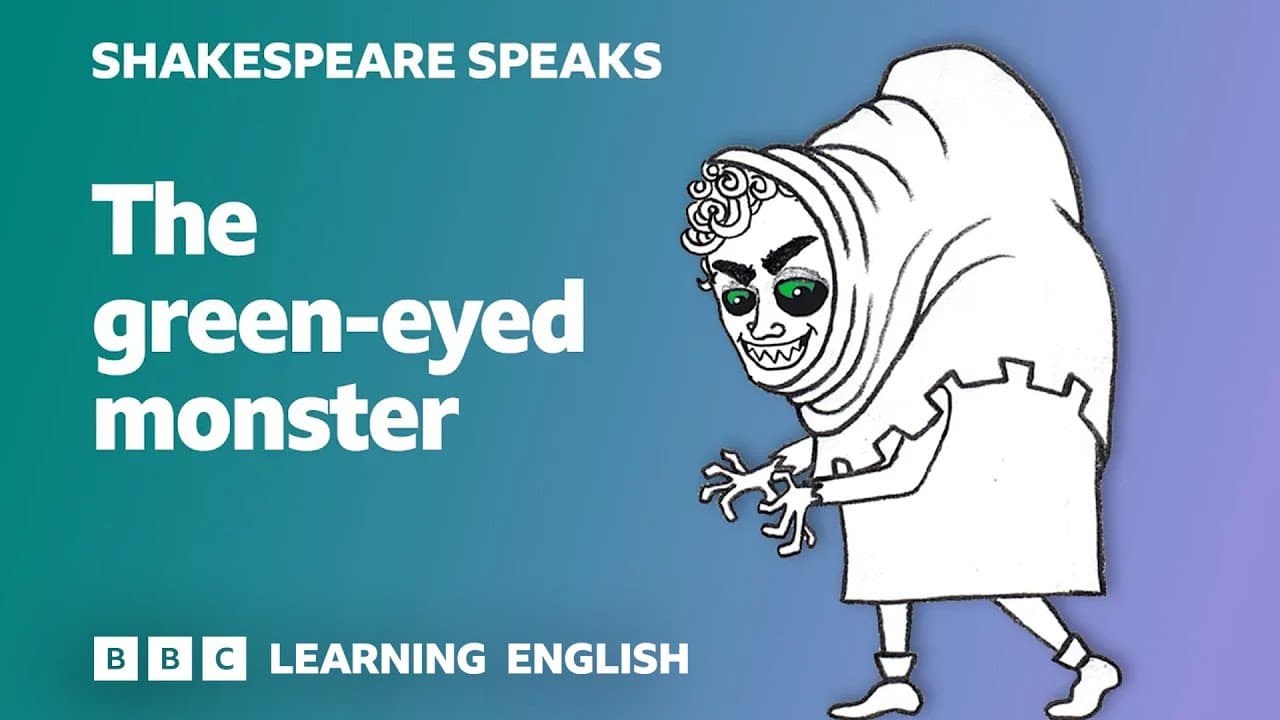
The idiom 'green-eyed monster' refers to jealousy, famously used by Shakespeare in Othello to caution against its dangers. Jealousy can consume individuals, leading to irrational and destructive behavior, as demonstrated in a discussion between Shakespeare and his friend about the consequences of jealousy in relationships. Understanding and using this idiom can enrich one's English language skills.
Transcript
It was late afternoon. William Shakespeare has just arrived at his favourite pub, The Duck and Whistle. His actor friend Thomas Swann is already there. Mr Will. Can you do something about that Mr Thomas? He's been drinking and shouting all afternoon. If you can't shut him up, I'm going to throw him out. I'm a wonderful husband. I give the woman eve... Read More
Key Insights
- The term 'green-eyed monster' refers to jealousy, a concept popularized by Shakespeare in his play Othello, where Iago warns Othello about its dangers.
- Jealousy is depicted as a consuming force that can lead individuals to irrational and destructive behavior, as illustrated by Thomas Swann's actions.
- The barmaid at The Duck and Whistle highlights how jealousy can cloud judgment and lead to misunderstandings and conflict in relationships.
- The narrative draws parallels between historical and contemporary uses of the idiom, showing its relevance in modern language and relationships.
- Shakespeare's use of the phrase in Othello serves as a cautionary tale about the destructive potential of jealousy when left unchecked.
- The video encourages viewers to learn and use English idioms, such as 'green-eyed monster,' to enhance their language skills and understanding.
- The content provides additional resources for teachers, including lesson plans and worksheets, to facilitate learning about Shakespearean idioms.
- The video is part of a series by BBC Learning English and The Open University, aimed at educating viewers about English idioms through Shakespeare's works.
Install to Summarize YouTube Videos and Get Transcripts
Explore YouTube Video Summarizer or Get YouTube Transcript Extractor
Questions & Answers
Q: What does the 'green-eyed monster' refer to in Shakespeare's play?
In Shakespeare's play Othello, the 'green-eyed monster' is a metaphor for jealousy. It is used by the character Iago to warn Othello about the destructive nature of jealousy, suggesting that it mocks the person it consumes. This phrase highlights jealousy as a powerful and dangerous emotion.
Q: How does jealousy manifest in the narrative involving Thomas Swann?
In the narrative, Thomas Swann is consumed by jealousy after hearing rumors about his wife's fidelity. His irrational thoughts and threats demonstrate how jealousy can lead to destructive behavior and cloud judgment, illustrating the idiom 'green-eyed monster' in action.
Q: How is the idiom 'green-eyed monster' relevant today?
The idiom 'green-eyed monster' remains relevant today as it describes the universal experience of jealousy in relationships. It is used to convey how jealousy can lead to insecurity and irrational actions, as seen in both historical and contemporary contexts mentioned in the video.
Q: What educational resources are provided in the video?
The video offers educational resources for teachers, including a free lesson plan and worksheet available for download. These resources are designed to help teach students about English idioms, particularly those originating from Shakespeare's works, enhancing their language learning experience.
Q: How does the video connect Shakespeare's works to modern English learning?
The video connects Shakespeare's works to modern English learning by using his idioms, such as 'green-eyed monster,' to teach language skills. By exploring the historical context and illustrating its contemporary relevance, the video encourages learners to incorporate these expressions into their vocabulary.
Q: What is the significance of the setting in the narrative?
The setting, The Duck and Whistle pub, serves as a backdrop for the interaction between Shakespeare and Thomas Swann. It provides a casual environment where the theme of jealousy can be explored in a relatable manner, linking Shakespearean themes to everyday situations.
Q: What role does the barmaid play in the narrative?
The barmaid acts as an observer and commentator on Thomas Swann's jealous behavior. Her interactions with Shakespeare provide insights into the destructive nature of jealousy and serve to highlight the relevance of the 'green-eyed monster' idiom in understanding human emotions.
Q: How does the video encourage language skill development?
The video encourages language skill development by introducing viewers to English idioms, explaining their meanings, and providing context through Shakespeare's works. It motivates learners to use these expressions in their communication, making their language skills more nuanced and expressive.
Summary & Key Takeaways
-
In this video, the idiom 'green-eyed monster' is explored through a scene involving William Shakespeare and his friend Thomas Swann. The term, which signifies jealousy, is explained with references to Shakespeare's play Othello, where it leads to tragic outcomes.
-
The narrative demonstrates how jealousy can cause irrational behavior, as seen in Thomas Swann's reaction to rumors about his wife. The video connects this historical context to modern-day examples, illustrating the idiom's enduring relevance.
-
Viewers are encouraged to learn and use English idioms to enrich their language skills. The video offers additional resources for teachers, and it's part of a larger educational series by BBC Learning English and The Open University.
Read in Other Languages (beta)
Share This Summary 📚
Summarize YouTube Videos and Get Video Transcripts with 1-Click
Try YouTube Summary with ChatGPT & Claude or YouTube Transcript Generator
Explore More Summaries from BBC Learning English 📚
Summarize YouTube Videos and Get Video Transcripts with 1-Click
Try YouTube Summary with ChatGPT & Claude or YouTube Transcript Generator