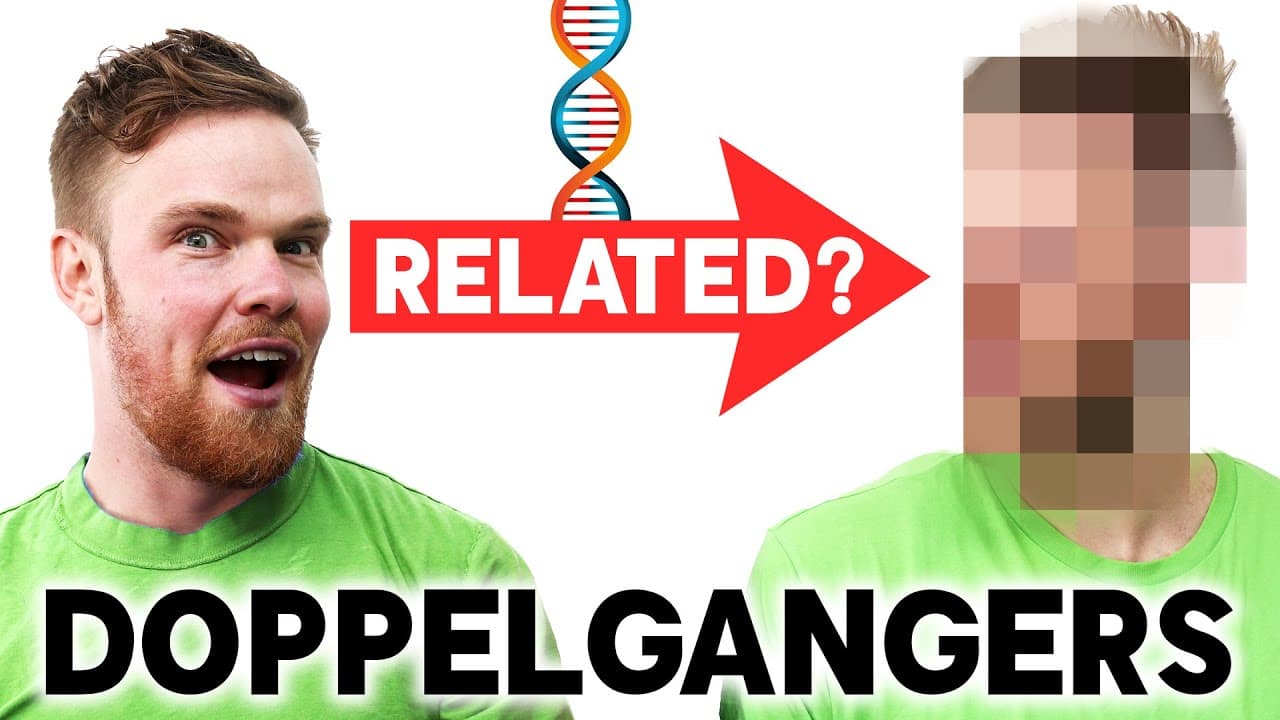
I Found My DOPPELGANGER and Tested His DNA
TL;DR
Doppelgangers can be mistaken for each other because fast facial-recognition neurons use appearance and context but lack perfect attention to detail. The hosts compare ASAP Science’s Mitch with Scott Hoying of Pentatonix and Superfruit, then use Circle DNA to investigate whether they are related. The test promises 99.9 analytical accuracy and more than 500 reports across over 20 categories. Read on to see how cognition and DNA testing shape their investigation.
Transcript
is there someone out there that looks exactly like you known as your doppelganger you may have one i know that i do things to the internet his name is scott hoying you may recognize him from pentatonix or from superfruit and people have been saying that we look the same for years found out that this guy from asap science is not scott from pentatoni... Read More
Key Insights
- 😀 Neurons dedicated to facial recognition in the brain facilitate the identification of familiar faces based on contexts, appearances, and behaviors.
- 🥺 The phenomenon of doppelgangers arises due to similarities in appearances, behaviors, and context, leading the brain to mistake one person for another.
- 😀 Facial recognition neurons prioritize speed over detail, resulting in occasional mistakes and confusion when identifying similar faces.
- 🏆 DNA tests, like Circle DNA, offer comprehensive insights into genetic relatedness, ancestry, and other genetic traits.
- ❓ Doppelgangers may not be genetically related, but they can still share similar appearances and behaviors.
- 😘 The probability of having an exact doppelganger is statistically low, but the chance of resembling someone closely is much higher.
- 🖐️ Context plays a crucial role in how doppelgangers are recognized, with specific contexts triggering the brain's identification process.
Install to Summarize YouTube Videos and Get Transcripts
Explore YouTube Video Summarizer or Get YouTube Transcript Extractor
Questions & Answers
Q: Why do doppelgangers look like the same person to us?
The brain has facial-recognition neurons that fire quickly when people see faces. Because these neurons prioritize speed and can lack attention to detail, similar-looking people encountered in similar contexts may be mistaken for each other.
Q: Who is the doppelganger featured in the DNA test?
The featured doppelganger is Scott Hoying, whom viewers may recognize from Pentatonix or Superfruit. People had said for years that he and the ASAP Science host looked alike, prompting them to meet in Los Angeles.
Q: Why do people confuse the ASAP Science host with Scott Hoying?
They look similar and often appear in overlapping contexts: both make TikTok videos, have worked on YouTube, and are gay. Those cues can lead the brain to predict that the person on screen is Scott even when it is the ASAP Science host.
Q: How are doppelgangers connected to cognition and consciousness?
The transcript explains that the brain continuously matches faces to identities without conscious effort. It also says consciousness relies heavily on predictions based on prior context, while the senses help confirm what the brain already expects.
Q: Do doppelgangers have to be genetically related?
No, the transcript explicitly says people do not necessarily have to be related to be doppelgangers. The Circle DNA test was used to investigate whether Scott and the host were related, but the provided excerpt does not reveal the final ancestry result.
Q: How is the Circle DNA test completed?
First, the user activates the kit and provides a saliva sample. The sample is then returned to the laboratory, with results said to be ready within 18 business days.
Q: What information does the Circle DNA test provide?
The test covers how genetics relates to ancestry, diet, and fitness. According to the transcript, it provides more than 500 reports across over 20 categories.
Q: What traits did Scott and the host compare before reviewing ancestry?
They planned to compare diet, physical traits, and genetic traits before ending with ancestry and possible relatedness. Their discussion included taste sensitivity, thrill-seeking, and appetite control.
Summary & Key Takeaways
-
The phenomenon of doppelgangers is related to facial recognition neurons in the brain that fire when seeing similar faces, leading to confusion and mistaking identities.
-
Doppelgangers are not necessarily relatives, but rather individuals who share similar contexts, appearances, and behaviors.
-
Circle DNA, a comprehensive DNA testing kit, is used to determine if two individuals are related and explores other genetic traits and ancestry information.
Read in Other Languages (beta)
Share This Summary 📚
Summarize YouTube Videos and Get Video Transcripts with 1-Click
Try YouTube Summary with ChatGPT & Claude or YouTube Transcript Generator
Explore More Summaries from AsapSCIENCE 📚
Summarize YouTube Videos and Get Video Transcripts with 1-Click
Try YouTube Summary with ChatGPT & Claude or YouTube Transcript Generator