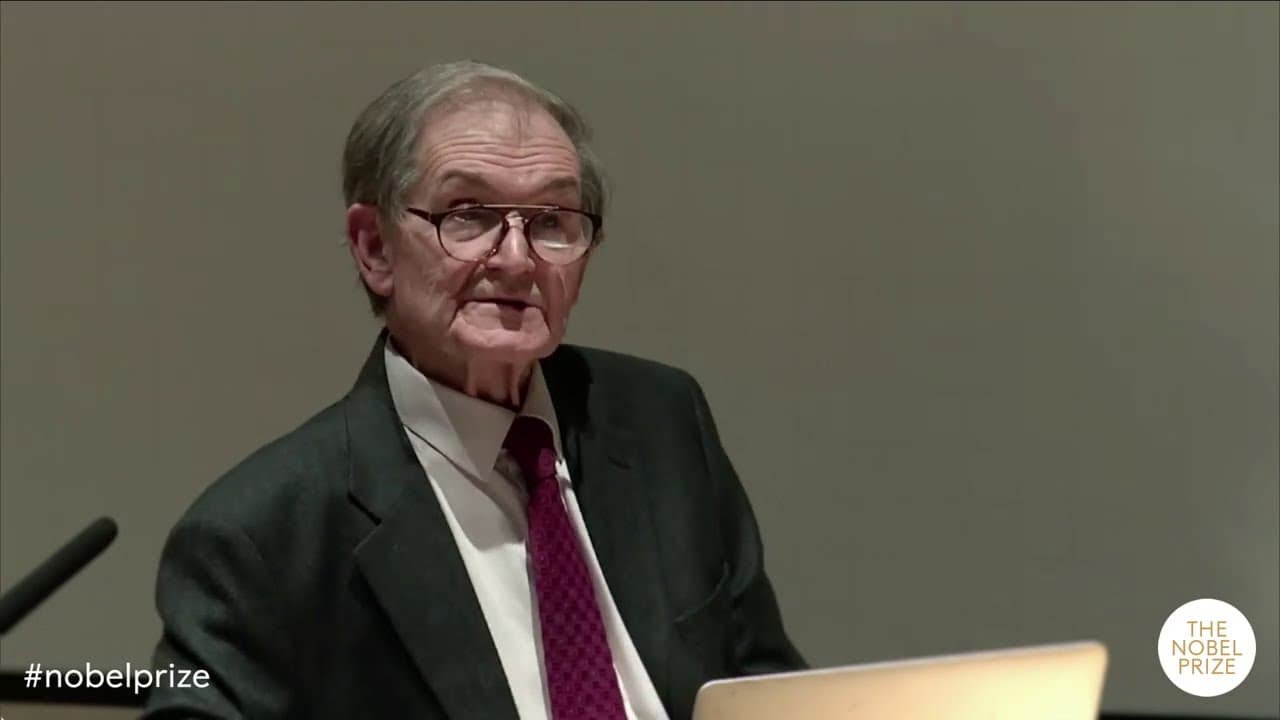
Nobel Lecture: Roger Penrose, Nobel Prize in Physics 2020
TL;DR
Roger Penrose's Nobel lecture explores the formation and nature of black holes, challenging early 20th-century skepticism about their existence. He demonstrates that black holes are a robust prediction of general relativity, regardless of mass geometry. His work, alongside that of Reinhard Genzel and Andrea Ghez, has provided firm evidence for black holes, transforming our understanding of these cosmic phenomena.
Transcript
this year's nobel prize in physics celebrates one of the great triumphs of mankind's thinking and exploration the formation of black holes was predicted on theoretical grounds these are objects that by definition cannot be observed directly astronomers took up the challenge and thanks to great innovations and by pushing the boundaries of technology... Read More
Key Insights
- Black holes were initially predicted on theoretical grounds and cannot be observed directly.
- Roger Penrose used mathematical tools to show black holes are a robust prediction of general relativity.
- Penrose's work demonstrated that black holes form regardless of mass geometry, challenging early skepticism.
- Reinhard Genzel and Andrea Ghez provided evidence of a supermassive black hole at the Milky Way's center.
- Penrose's singularity theorems show that singularities are inevitable in black hole formation.
- The lecture discusses the concept of space-time and its representation using light cones.
- Penrose's insights are foundational in understanding the universe's structure and black holes' role.
- The lecture touches on the implications of black holes and singularities for cosmology and physics.
Install to Summarize YouTube Videos and Get Transcripts
Explore YouTube Video Summarizer or Get YouTube Transcript Extractor
Questions & Answers
Q: How do black holes form according to general relativity?
Black holes form as a robust prediction of general relativity, as demonstrated by Roger Penrose. His work showed that gravitational collapse leads to the formation of singularities, regardless of the mass's initial geometry. This challenges the earlier belief that imperfections would prevent black hole formation, proving that singularities are inevitable in such collapses.
Q: What evidence supports the existence of black holes?
Observational evidence for black holes comes from the work of Reinhard Genzel and Andrea Ghez, who studied the orbits of stars around the center of the Milky Way. Their precise measurements revealed the presence of an invisible object with a mass over 4 million times that of the Sun, consistent with a supermassive black hole, confirming theoretical predictions.
Q: What are space-time singularities?
Space-time singularities are points where gravitational forces cause matter to have infinite density and zero volume, leading to undefined physical laws. Roger Penrose's singularity theorems demonstrate that such singularities are inevitable in the formation of black holes, providing a deeper understanding of the universe's structure and the nature of gravitational collapse.
Q: How did Roger Penrose contribute to the understanding of black holes?
Roger Penrose contributed significantly to black hole understanding by using mathematical tools to demonstrate that their formation is a robust prediction of general relativity. His singularity theorems showed that gravitational collapse leads to singularities, challenging early skepticism and providing a theoretical foundation for black holes' existence.
Q: What role did the concept of space-time play in Penrose's work?
The concept of space-time, introduced by Hermann Minkowski, was central to Penrose's work. He used the idea of light cones to represent space-time and study the behavior of light rays and singularities. This framework allowed him to explore the geometry of black holes and the nature of gravitational collapse, advancing our understanding of these phenomena.
Q: What challenges did early physicists face regarding black holes?
Early physicists, including Albert Einstein, were skeptical about black holes, believing that perfect symmetry was required for their formation. They thought natural imperfections would prevent such objects from forming. Roger Penrose's work challenged this view by demonstrating that singularities are inevitable in gravitational collapse, regardless of initial conditions.
Q: How do Penrose's singularity theorems impact cosmology?
Penrose's singularity theorems have a profound impact on cosmology by providing a theoretical basis for understanding the universe's structure and the nature of black holes. They show that singularities are an inevitable result of gravitational collapse, offering insights into the origins and fate of the universe and challenging previous assumptions about cosmic phenomena.
Q: What mathematical tools did Penrose use in his research?
Penrose employed advanced mathematical tools, including two-component spinors and the concept of light cones, to study the geometry of space-time and the behavior of singularities. These tools allowed him to explore the conditions under which black holes form and to develop his singularity theorems, which have become foundational in the study of cosmology and gravitational physics.
Summary
This year's Nobel Prize in Physics celebrates the discovery and understanding of black holes. Astronomers were able to provide firm evidence for the existence of black holes, which are regions of space-time where gravity is so strong that even light is trapped. The three Nobel laureates, Roger Penrose, Reinhard Genzel, and Andrea Ghez, made significant contributions to our understanding of black holes using mathematical tools, observational work, and theoretical predictions.
Questions & Answers
Q: What do black holes represent in the universe?
Black holes are regions of space-time where gravity is so strong that nothing, not even light, can escape its gravitational pull. They are formed from the collapse of massive stars and have been a topic of fascination for scientists and the general public.
Q: How did scientists initially view the possibility of black holes?
Initially, many physicists were skeptical about the existence of black holes. They believed that the formation of black holes would require perfect symmetry and unphysically ideal conditions, making them unlikely to occur in the real universe. Albert Einstein himself was a notable skeptic of black holes.
Q: How did Roger Penrose contribute to our understanding of black holes?
Roger Penrose, one of the Nobel laureates, used ingenious mathematical tools to demonstrate that the formation of black holes is a robust prediction of Einstein's theory of general relativity. Regardless of the mass's geometry being pulled gravitationally, Penrose showed that black holes can form in various scenarios.
Q: What did Reinhard Genzel and Andrea Ghez discover about black holes?
Reinhard Genzel and Andrea Ghez shared the other half of the Nobel Prize for their detective work examining the orbits of stars around the Milky Way's center. Through their precise observations, they provided strong evidence for the existence of a supermassive black hole at the galactic center, which harbors over 4 million times the mass of our sun.
Q: How did Herman Minkowski contribute to our understanding of space-time?
In 1908, Herman Minkowski introduced the idea of space-time, a four-dimensional space that encapsulates Einstein's theory of special relativity. Initially, Einstein was not fond of this idea, but he eventually incorporated it into his generalized theory of relativity, making space-time a fundamental concept in modern physics.
Q: How did Roger Penrose investigate the nature of singularities in black holes?
Penrose utilized mathematical tools and concepts from spinors, which he learned from physicist Paul Dirac, to study the curvature and behavior of black holes. He developed the concept of trapped surfaces, which are surfaces where light rays converge on both sides, indicating the presence of a singularity. Penrose's work proved that singularities were unavoidable in general circumstances, contributing significantly to our understanding of black holes.
Q: What is the significance of trapped surfaces in black holes?
Trapped surfaces are crucial in understanding the formation and behavior of black holes. They indicate the presence of singularities, where the density becomes infinite and the space-time curvature becomes infinitely strong. Trapped surfaces provided a criterion to determine the point of no return, leading to the formation of black holes.
Q: How does the theory of inflation in cosmology affect our understanding of black holes?
The theory of inflation, which suggests an exponential expansion of the universe in its early stages, plays a role in our understanding of the origin and behavior of black holes. It helps explain the smoothness and uniformity observed in the cosmic microwave background radiation. However, Penrose raises the question of whether inflation can explain the clumping and asymmetry observed in supermassive black holes.
Q: How does the concept of conformal geometry relate to the structure of the universe?
Conformal geometry is a mathematical framework where angles are preserved but sizes can be stretched or compressed. Penrose suggests that the structure of the universe can be represented using conformal geometry, specifically regarding the nature of infinity and the behavior of massless particles. Conformal invariance allows for the possibility of a continuous universe beyond the boundaries of our current eon and the previous eon.
Q: What evidence supports the possibility of events from the previous eon being observed in our current eon?
According to Penrose's theory, there may be signals or remnants of events from the previous eon that could be observed in our current eon. For example, the collision of supermassive black holes in the previous eon could emit gravitational waves that pass through to our eon, potentially leaving an observable signature in the cosmic microwave background radiation. Additionally, the evaporation of supermassive black holes in the previous eon may also leave an imprint that can be detected.
Takeaways
This year's Nobel laureates in Physics, Roger Penrose, Reinhard Genzel, and Andrea Ghez, have made groundbreaking contributions to our understanding of black holes. Penrose's mathematical work demonstrated the robustness of black hole formation in the context of general relativity. Genzel and Ghez's observational work provided strong evidence for the existence of a supermassive black hole at the center of our galaxy. These achievements have expanded our knowledge of the universe and reshaped our understanding of gravity and space-time. The concept of conformal geometry and the possibility of events from previous eons being observed in our current eon open up new avenues for exploration and deeper insights into the nature of the universe.
Summary & Key Takeaways
-
Roger Penrose's lecture delves into the theoretical underpinnings and observational evidence for black holes, highlighting their inevitability as predicted by general relativity. He addresses early skepticism, demonstrating that black holes form regardless of the geometry of collapsing matter, which was pivotal in earning him the Nobel Prize.
-
The lecture also covers the groundbreaking work of Reinhard Genzel and Andrea Ghez, who provided observational evidence for a supermassive black hole at the center of the Milky Way. This finding, alongside Penrose's theoretical contributions, has transformed our understanding of black holes and their role in the universe.
-
Penrose explains the concept of space-time singularities and the mathematical frameworks used to study them. His work on singularity theorems has been foundational in the field of cosmology, offering insights into the universe's structure and the nature of gravitational collapse.
Read in Other Languages (beta)
Share This Summary 📚
Summarize YouTube Videos and Get Video Transcripts with 1-Click
Try YouTube Summary with ChatGPT & Claude or YouTube Transcript Generator
Explore More Summaries from Nobel Prize 📚
Summarize YouTube Videos and Get Video Transcripts with 1-Click
Try YouTube Summary with ChatGPT & Claude or YouTube Transcript Generator