Does Space Emerge From A Holographic Boundary?
TL;DR
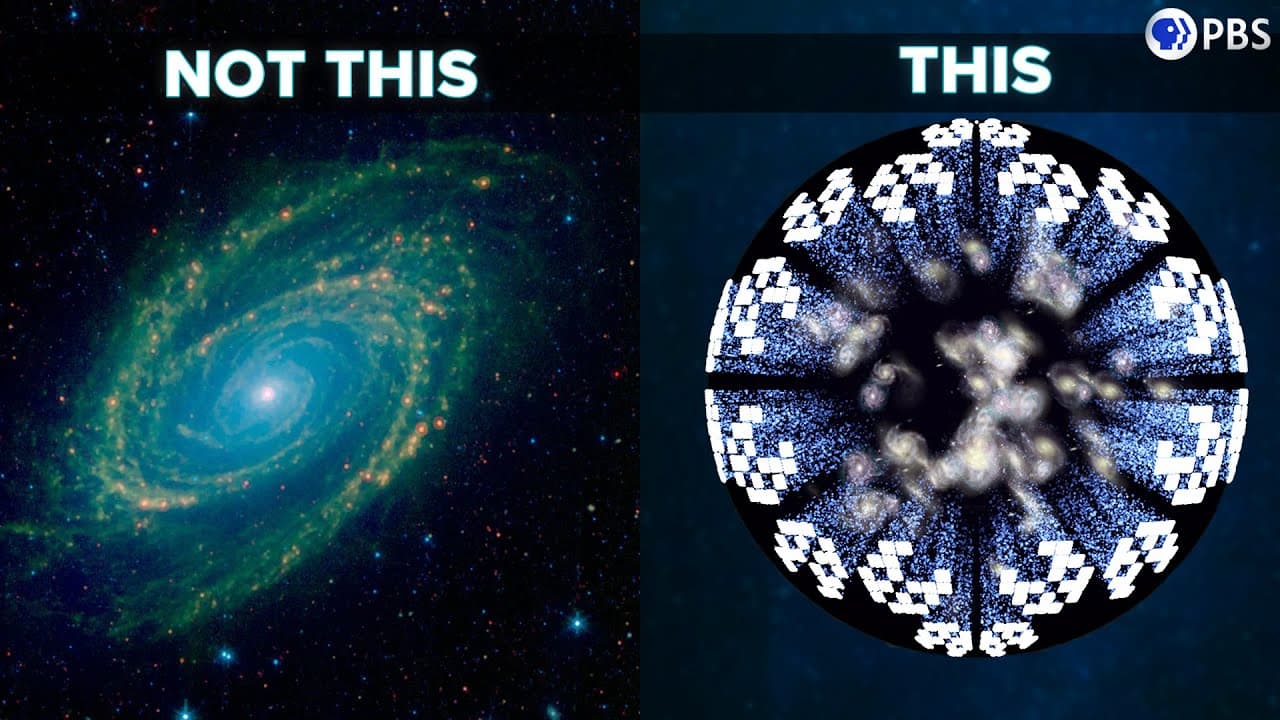
The universe may be a holographic projection from a distant boundary.
Transcript
Before we get started, just letting you know we have some limited time only Solar Eclipse merch for sale at the merch store. I’ll tell you know more at the end of the episode. Space seems pretty fundamental. To build a universe, surely you need something to build it on or in. Many, maybe most physicists now think that the fabric of space emerges fr... Read More
Key Insights
- The holographic principle suggests that our 3-D universe might be a projection from an infinitely distant 2-D boundary, challenging the fundamental nature of space.
- The concept of emergent space questions whether space is a fundamental element or an emergent phenomenon, with historical roots in Leibnitz's ideas and modern theories like loop quantum gravity.
- Black hole thermodynamics, pioneered by Hawking and Bekenstein, revealed that black holes have entropy, leading to the discovery that information density relates to surface area, not volume.
- The Bekenstein bound posits that the maximum information density of a space is proportional to its surface area, influencing the development of the holographic principle.
- The AdS/CFT correspondence, introduced by Maldacena, provides a concrete example of holographic emergence, using conformal field theory to describe the universe's boundary.
- Conformal field theories allow for scale-invariant interactions, enabling a 3-D space to emerge from a 2-D boundary through nested scales of patterns.
- Dualities in physics, where different mathematical descriptions explain the same phenomenon, raise questions about the fundamental nature of the holographic duality.
- The future exploration of holographic emergence will involve understanding gravity's role and the potential for quantum entanglement to knit the fabric of space.
Install to Summarize YouTube Videos and Get Transcripts
Explore YouTube Video Summarizer or Get YouTube Transcript Extractor
Questions & Answers
Q: What is the holographic principle?
The holographic principle is a theoretical proposition suggesting that our three-dimensional universe is a projection from a two-dimensional boundary. This idea implies that all the information contained within our universe can be encoded on its boundary, challenging the traditional view of space as a fundamental construct.
Q: How does black hole thermodynamics relate to the holographic principle?
Black hole thermodynamics, developed by Hawking and Bekenstein, revealed that black holes possess entropy, which is proportional to their surface area. This surprising discovery laid the groundwork for the holographic principle by demonstrating that information density is related to surface area, not volume, leading to the idea that our universe's information could be encoded on a lower-dimensional boundary.
Q: What is the AdS/CFT correspondence?
The AdS/CFT correspondence, introduced by Juan Maldacena, is a theoretical framework that provides a concrete example of holographic emergence. It describes how a lower-dimensional boundary, governed by a conformal field theory (CFT), can encode the information of a higher-dimensional space, known as anti-de Sitter (AdS) space, illustrating how the universe might emerge from its boundary.
Q: How does conformal field theory contribute to holographic emergence?
Conformal field theory (CFT) contributes to holographic emergence by allowing for scale-invariant interactions on the boundary of a space. This means that patterns of different scales on the boundary can interact in the same way, enabling a 3-D space to emerge from a 2-D boundary through nested scales of patterns, each representing different levels of detail.
Q: What are dualities in physics?
Dualities in physics refer to situations where two seemingly different mathematical descriptions explain the same physical phenomenon. These dualities often appear mutually incompatible, yet they provide equivalent insights into the nature of reality. The concept of duality raises questions about the fundamental nature of theories, such as whether the holographic duality is a true or approximate representation of reality.
Q: Is the holographic duality a true or approximate duality?
The nature of the holographic duality, whether it is true or approximate, remains an open question. A true duality would mean that the boundary and the bulk are equally real and mutually emergent, while an approximate duality would suggest that one side, possibly the boundary, is more fundamental. The AdS/CFT duality is still under investigation to determine its exact nature.
Q: What role does quantum entanglement play in space emergence?
Quantum entanglement may play a crucial role in the emergence of space by potentially knitting together the fabric of space at various scales. This concept suggests that the interconnectedness of quantum entities could contribute to the structure and dynamics of space, offering a deeper understanding of how space might emerge from a lower-dimensional boundary.
Q: What future topics will be explored regarding holographic emergence?
Future explorations of holographic emergence will include understanding how gravity can emerge from entropic forces on a holographic boundary, as proposed by Eric Verlinde. Additionally, researchers will investigate the role of quantum entanglement in space emergence and seek a concrete holographic description for our universe, potentially considering holographic boundaries at finite distances or in the far future.
Summary & Key Takeaways
-
The episode explores the holographic principle, suggesting our universe is a 3-D projection from a 2-D boundary. This idea challenges traditional notions of space's fundamental nature, drawing from black hole thermodynamics and the Bekenstein bound, which relates information density to surface area rather than volume.
-
The AdS/CFT correspondence provides a framework for understanding holographic emergence, with conformal field theories allowing scale-invariant interactions. This enables a 3-D space to emerge from a 2-D boundary through nested scales of patterns, illustrating the complexity of space emergence.
-
Dualities in physics, where different mathematical descriptions explain the same phenomenon, highlight the mysterious nature of reality. The episode questions whether our universe's holographic duality is true or approximate, impacting our understanding of space's emergence and fundamental nature.
Read in Other Languages (beta)
Share This Summary 📚
Summarize YouTube Videos and Get Video Transcripts with 1-Click
Try YouTube Summary with ChatGPT & Claude or YouTube Transcript Generator
Explore More Summaries from PBS Space Time 📚
Summarize YouTube Videos and Get Video Transcripts with 1-Click
Try YouTube Summary with ChatGPT & Claude or YouTube Transcript Generator