How to Analyze Air Quality Data for Bogotá
TL;DR
To analyze air quality data for Bogotá, start by exploring the dataset through statistical summaries and visualizations like histograms and box plots. Key points include identifying missing data, understanding the distribution of pollutants such as PM 2.5, and performing exploratory data analysis to uncover correlations and challenges in the dataset.
Transcript
in this video I'll walk you through the first part of the data exploration notebook for the Bogota air quality project here you'll be looking at some summary statistics and visualizations about the data to get a better sense of the characteristics of the data set itself plus any challenges that you might face in running analyzes over the set okay s... Read More
Key Insights
- 👱 The Bogota air quality data set is obtained from the city's air quality monitoring network, rmcab.
- 🎟️ The dataset contains significant missing data, with 10 to 20% missing values across various columns.
- 😘 PM 2.5 values at most stations tend to be lower, which is positive for air quality but presents challenges for accurate predictions.
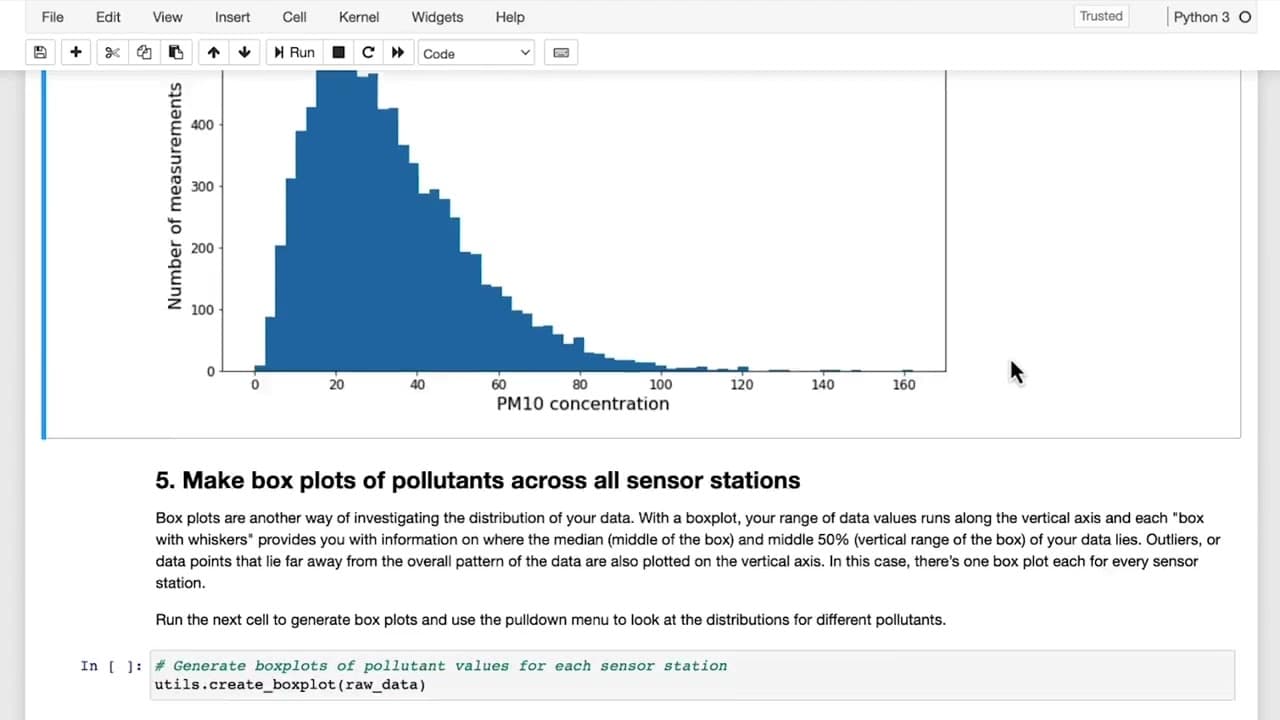
- 🧡 Visualizations like histograms and box plots help understand the distribution and range of pollutant values.
- ❓ Exploratory data analysis is crucial for understanding the dataset's characteristics and determining potential correlations between pollutants.
Install to Summarize YouTube Videos and Get Transcripts
Explore YouTube Video Summarizer or Get YouTube Transcript Extractor
Questions & Answers
Q: Where does the data for the Bogota air quality project come from?
The data for the Bogota air quality project comes from the air quality monitoring network in Bogota, specifically the rmcab.
Q: How can I access the data from the Bogota air quality project?
You can access the data by visiting the website hosted by the city of Bogota and exploring their mapping application. From there, you can also download the data if needed.
Q: What is the significance of missing data in the dataset?
The dataset has significant missing data, with 10 to 20% of the data missing across various columns. This suggests that some sensors were unable to produce readings for certain pollutants. Handling missing values will be a challenge in the analysis.
Q: How can visualizations like histograms and box plots help in data exploration?
Histograms provide a visual representation of the distribution of values, allowing us to understand the range and frequency of pollutant values. Box plots show the median and range of the data, providing insight into the distribution of values across different stations.
Summary & Key Takeaways
-
The video introduces the Bogota air quality project and provides a link to the website with additional details about the air quality monitoring network.
-
It demonstrates how to import necessary packages and read the dataset, checking for missing data.
-
The video showcases the use of histograms and box plots to analyze the distribution and range of PM 2.5 values across different stations and pollutants.
Read in Other Languages (beta)
Share This Summary 📚
Summarize YouTube Videos and Get Video Transcripts with 1-Click
Try YouTube Summary with ChatGPT & Claude or YouTube Transcript Generator
Explore More Summaries from DeepLearningAI 📚






Summarize YouTube Videos and Get Video Transcripts with 1-Click
Try YouTube Summary with ChatGPT & Claude or YouTube Transcript Generator