How Are Humanoid Robots Becoming More Human?
TL;DR
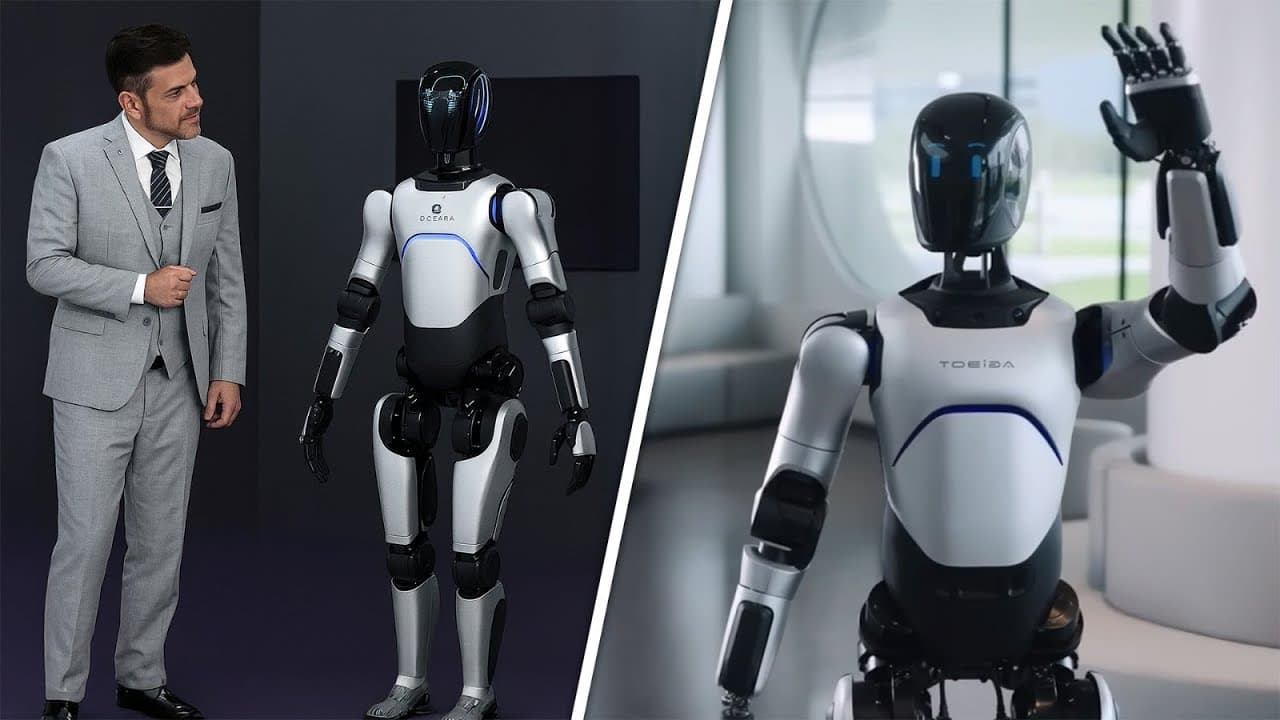
AgiBot's A2 combines real-time conversation, business knowledge retrieval, noise filtering, human-like gestures, and autonomous navigation for public-facing work. XPENG's IRON uses imitation learning and flexible hardware to reproduce human movement, while Toyota's WalkMe applies legged robotics to personal mobility by climbing stairs, adapting to uneven terrain, and keeping its occupant stable.
Transcript
So, Agabot just dropped a new humanoid that actually talks, moves, and reacts like a real person. Not in a flashy demo, but in real world environments. At the same time, Xpang showed off its bare metal robot literally dancing after learning the routine in just 2 hours. And we finally got an answer to why that robot came with a pair of breasts, whil... Read More
Key Insights
- AgiBot's A2 is a human-proportioned service robot measuring 169 cm tall and weighing 69 kg. Its clean contours and ergonomic design are intended to make face-to-face interaction feel more natural in public and commercial environments.
- The A2's conversational system is built around large language models, full-duplex voice interaction, and retrieval augmented generation. Businesses can connect custom knowledge bases so the robot can retrieve relevant information and answer visitors like a trained employee.
- The A2's perception system can filter up to 96% of background noise and uses face recognition and lip reading to achieve a stated 99% wake-up accuracy, supporting interactions in crowded places such as airports, malls, and exhibition halls.
- The A2's mobility system combines 3D SLAM mapping, vector flux control, reinforcement learning, custom joints, six HD cameras, and a 360-degree LAR array. It is designed to navigate complex spaces, avoid obstacles, and adjust movement paths in real time.
- XPENG's IRON learned a dance routine in two hours using comprehensive imitation learning based on human dance data. The company contrasted this approach with reinforcement learning, which previously took weeks and had difficulty generalizing movements.
- IRON's natural-looking movement comes from a human-like spine, a flexible waist, and 82 degrees of freedom. These features coordinate the torso, hips, upper body, and lower body, producing bends, twists, and sways that resemble human motion.
- XPENG's humanoid design strategy is based on physical compatibility and emotional response. The company argues that human-shaped robots can use spaces designed for people, while customizable body forms, skin softness, hair, and clothing may influence comfort and trust.
- Toyota's WalkMe is a four-legged mobility-chair concept built for stairs and uneven terrain. Sensors, actuators, LAR, radar, weight sensing, and automatic stabilization coordinate its legs while helping keep the occupant balanced on slopes and other difficult surfaces.
Install to Summarize YouTube Videos and Get Transcripts
Explore YouTube Video Summarizer or Get YouTube Transcript Extractor
Questions & Answers
Q: How does the AgiBot A2 communicate with people?
The AgiBot A2 uses large language models and full-duplex voice interaction to conduct real-time conversations instead of waiting for rigid, line-by-line exchanges. Retrieval augmented generation lets a business connect its own knowledge base, allowing the robot to retrieve relevant company information. It also uses face recognition, lip reading, and noise filtering to understand people in crowded environments.
Q: What makes the AgiBot A2 suitable for public spaces?
The AgiBot A2 combines conversational ability with autonomous movement, obstacle detection, safety monitoring, and business-specific knowledge retrieval. It can filter up to 96% of background noise and has a stated 99% wake-up accuracy through face recognition and lip reading. Its intended settings include exhibition halls, hotel lobbies, supermarkets, fashion shows, airports, and malls.
Q: How does the AgiBot A2 navigate complex environments?
The AgiBot A2 uses a 3D SLAM mapping system called HIMUS together with a vector flux control algorithm for level four autonomous movement. Its RTMF control system applies reinforcement learning to predict paths and adjust motion in real time. Six HD cameras, a 360-degree LAR array, redundant controls, and three monitoring layers support obstacle avoidance and safe movement.
Q: How long can the AgiBot A2 operate on one charge?
The AgiBot A2 runs for around two hours on one charge. Its batteries support quick replacement, so an operator can swap a depleted battery instead of leaving the robot inactive for a long charging period. The robot also has a multifunctional standby station for charging and transport, and it can be controlled remotely through a phone or laptop.
Q: How did XPENG's IRON learn to dance so quickly?
XPENG said IRON learned its dance routine in two hours through a comprehensive imitation learning method. Human dance data was fed directly into the AI so the robot could reproduce the movements and adapt them dynamically. The company said its earlier reinforcement learning approach required weeks of training and still struggled to generalize movements across situations.
Q: Why does XPENG's IRON move so much like a human?
IRON uses a human-like spine that adds flexibility at the waist, allowing its upper and lower body to move together. When the torso bends or twists, the hips can sway in a coordinated way. The robot also has 82 degrees of freedom, which supports detailed motion and helps its exposed mechanical frame perform movements with unusually human-like posture and precision.
Q: Why did XPENG give IRON a feminine body shape?
XPENG said it chose a humanoid form because environments are built for people, and robots with hands and human proportions can operate within them more efficiently than quadruped designs. The company is also studying how appearance affects comfort, trust, and emotional reactions. It envisions customizable body type, height, skin softness, hair length, clothing, and breast size.
Q: How does Toyota's WalkMe mobility chair climb stairs?
Toyota's WalkMe uses four legs equipped with multiple sensors and actuators that bend and adapt to terrain in real time. Its front legs analyze stair height and pull the chair forward, while the rear legs push and stabilize it. LAR, radar, weight sensors, and automatic stabilization help detect obstacles and keep the occupant balanced while moving over stairs, slopes, or uneven paths.
Summary & Key Takeaways
-
AgiBot designed the A2 as a practical public-facing humanoid for exhibition halls, hotels, supermarkets, and similar businesses. It combines full-duplex speech, custom knowledge retrieval, noise filtering, face recognition, lip reading, gesture generation, autonomous navigation, remote control, replaceable batteries, multiple cameras, and a 360-degree LAR array.
-
XPENG demonstrated the exposed mechanical version of IRON dancing after learning the routine in two hours through comprehensive imitation learning. Its human-like spine, flexible waist, 82 degrees of freedom, dexterous hands, solid-state battery, and multimodal AI systems are intended to support natural movement and a closed loop from perception to action.
-
Toyota's WalkMe concept replaces wheelchair-style wheels with four sensor-equipped legs inspired by goats and crabs. It is designed to carry people with limited mobility across stairs, slopes, and uneven paths while maintaining balance. Voice controls, manual handles, all-day battery operation, thermal monitoring, and retractable legs support practical use.
Read in Other Languages (beta)
Share This Summary 📚
Summarize YouTube Videos and Get Video Transcripts with 1-Click
Try YouTube Summary with ChatGPT & Claude or YouTube Transcript Generator
Explore More Summaries from AI Revolution 📚






Summarize YouTube Videos and Get Video Transcripts with 1-Click
Try YouTube Summary with ChatGPT & Claude or YouTube Transcript Generator