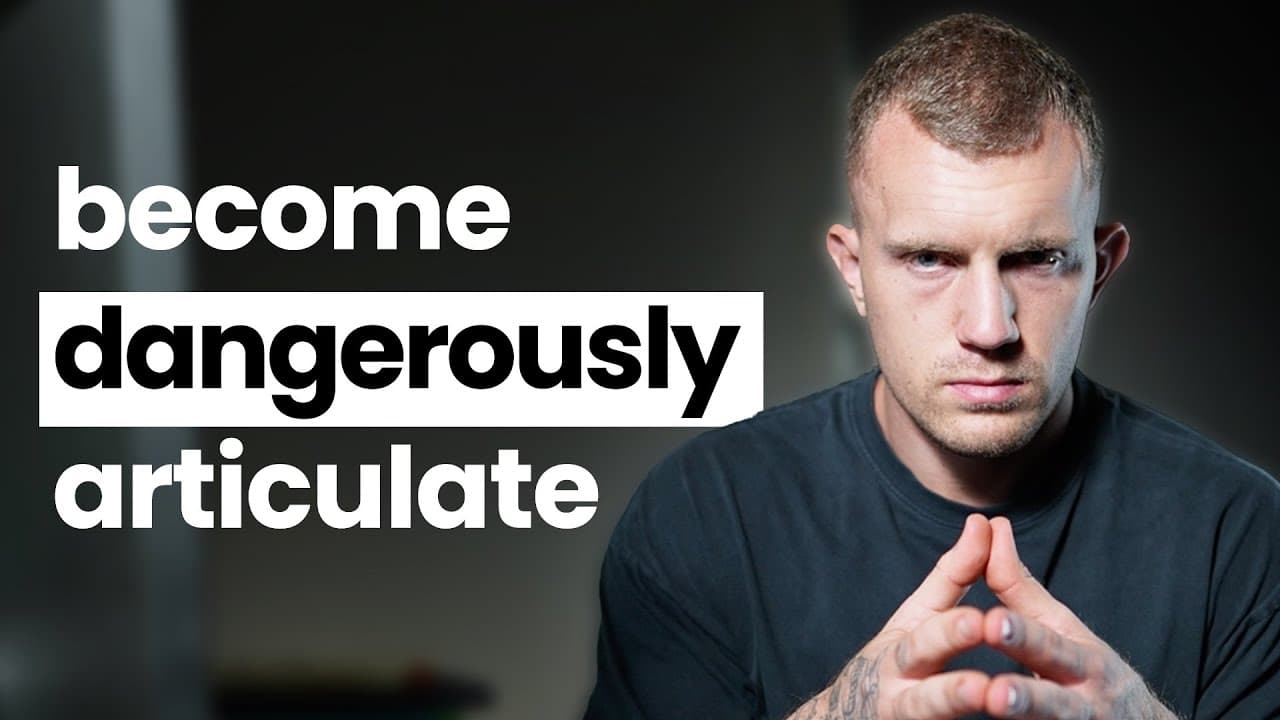
How to Articulate Your Thoughts More Intelligently
TL;DR
Articulate speaking starts with a pool of 8 to 10 big ideas you have already refined hundreds of times, so you always have a starting point when asked a question. The best podcast guests do not answer directly; they lead with their strongest related idea, stated confidently, then expand with supporting points. Repetition is required, not a flaw, because important ideas deserve repeating.
Transcript
When I was young, I was always drawn to people that sounded intelligent. People like Alan Watts, Jordan Peterson, Daniel Stockton Berger or other individuals who could explain deep ideas in an exciting yet palatable way. Most of the time I didn't understand what they were saying, either because I was too young and dumb, or they were just overcompli... Read More
Key Insights
- Articulation is a trained capability, not inherent intelligence. Being a smart kid who is good at taking tests is very different from being good at stringing together coherent thoughts and articulating them to another person, which is a separate skill.
- An inner album of greatest hits is the prerequisite for speaking well: a pool of 8 to 10 of your biggest ideas that can be connected to almost any topic, giving you a starting point you have already thought through hundreds of times.
- Ideas require time to dissect and explore before they can be articulated. Expecting a mind blowing idea to arrive on the spot is not how ideas work; they have to become a part of you first.
- A body of work is the precondition for natural articulation. Jordan Peterson is known for captivating articulation because he has a body of work, and without one that keeps growing and being refined there is significant work to do first.
- Repetition is required, not a weakness. You must write or speak thousands of times until your best ideas are obvious by nature, because the most important ideas deserve to be repeated and repetition is how they get refined.
- The musician analogy explains why consistency works: people listen to a favorite artist because most of their music shares a specific sound, and an EDM artist switching to country would produce a horrible first track that the audience would reject.
- The best speakers do not answer a host's question directly. Instead of stalling with 'good question, let me think about this,' they state the best idea related to the question with confidence and then expand with a few supporting points.
- Leading with a validated idea creates a clippable moment. Alex Hormozi's second most viral tweet, that the single greatest skill is the ability to stay in a great mood in the absence of things to be in a great mood about, has 105,000 likes and compounds when reclipped.
Install to Summarize YouTube Videos and Get Transcripts
Explore YouTube Video Summarizer or Get YouTube Transcript Extractor
Questions & Answers
Q: How do you become more articulate when speaking?
Start by building an inner album of greatest hits: a pool of 8 to 10 of your biggest ideas that can be connected to almost any topic. When it is time to write or speak in any situation, you already have a starting point you have thought through hundreds of times, rather than trying to invent something mind blowing on the spot. Beyond that, three methods are presented, ordered beginner to advanced: the micro story, the pyramid principle, and cross domain synthesis.
Q: What is the inner album of greatest hits?
It is a curated pool of 8 to 10 of your biggest ideas that can be connected to almost any topic. After writing two books, hundreds of newsletters, hundreds of YouTube videos and thousands of social posts, it becomes obvious which ideas are the most valuable, which ones led to the most DMs from people saying an idea changed their life. Those ideas illustrate the value a brand provides and are the ones new listeners should hear first.
Q: Why is repeating yourself necessary to be articulate?
The biggest mental hurdle described is not wanting to sound repetitive, which causes the mind to go blank on stage or on a podcast and forces something out just to avoid an awkward pause. The counter is that you must write or speak thousands of times until your best ideas are obvious by nature. The most important ideas deserve to be repeated, and repetition is the only way to refine them.
Q: How do the best podcast guests answer questions?
They do not answer the host's question directly, and they do not stall with lines like 'well, good question, let me think about this for a bit.' Instead they speak the best idea that relates to the question with confidence, then expand on it with a few supporting points. This keeps the listener engaged, which makes the podcast perform better and leads to more podcast invitations, compounding success.
Q: What is a clippable moment on a podcast and why does it matter?
A clippable moment happens when an idea you state has already gone viral or been validated elsewhere, so when it is clipped and posted on social media it goes viral again. The example given is Alex Hormozi choosing to say his second most viral tweet on a podcast: the single greatest skill you can develop is the ability to stay in a great mood in the absence of things to be in a great mood about. That tweet has 105,000 likes, so the decision to say it pays back tenfold.
Q: Why does having a body of work matter for articulation?
Jordan Peterson is cited as being known for captivating articulation, and looking at his output makes the reason obvious: he has a body of work. If you want to articulate yourself and do not have a body of work that continues to be refined and to grow, there is a lot of work to do before you can be naturally articulate. Ideas require time to dissect and explore, and they have to become a part of you.
Q: What can writing teach you beyond putting words on a page?
Writing teaches you how to think, how to learn, and how to inspire people to care about what you do, which is why it is recommended as a starting point when you do not know what to learn. Writing is described as much more than just putting letters on a page. The suggestion is not to start writing, since you already write every day in texts and emails, but to start writing intentionally.
Q: Do you need polished grammar to be an effective writer?
No. The stance taken is not caring about grammar, not caring about sounding clever most of the time, and not minding run on sentences or imperfect phrasing. Paying too much attention to being clever actually makes articulation suffer. Unpolished writing is described as a way to stand out against AI, and millions of people subscribed because they found value in that writing regardless of polish.
Summary & Key Takeaways
-
Being articulate is not inherited intelligence. Being good at tests differs from stringing together coherent thoughts and explaining them to someone else. After six years of writing and speaking, millions of people subscribed across social accounts, a newsletter and YouTube, and that success is attributed to articulating valuable ideas in a way people are drawn to.
-
The foundation is an inner album of greatest hits: 8 to 10 big ideas that connect to almost any topic. After two books, hundreds of newsletters, hundreds of YouTube videos and thousands of social posts, it becomes obvious which ideas are most valuable, which ones generated DMs saying they changed someone's life.
-
The best podcast guests do not answer the host's question directly or stall with 'good question, let me think.' They state the best idea related to the question with confidence, then expand with supporting points. This keeps listeners engaged and produces clippable moments that can go viral again on social media.
Read in Other Languages (beta)
Share This Summary 📚
Summarize YouTube Videos and Get Video Transcripts with 1-Click
Try YouTube Summary with ChatGPT & Claude or YouTube Transcript Generator
Explore More Summaries from Dan Koe 📚

Summarize YouTube Videos and Get Video Transcripts with 1-Click
Try YouTube Summary with ChatGPT & Claude or YouTube Transcript Generator