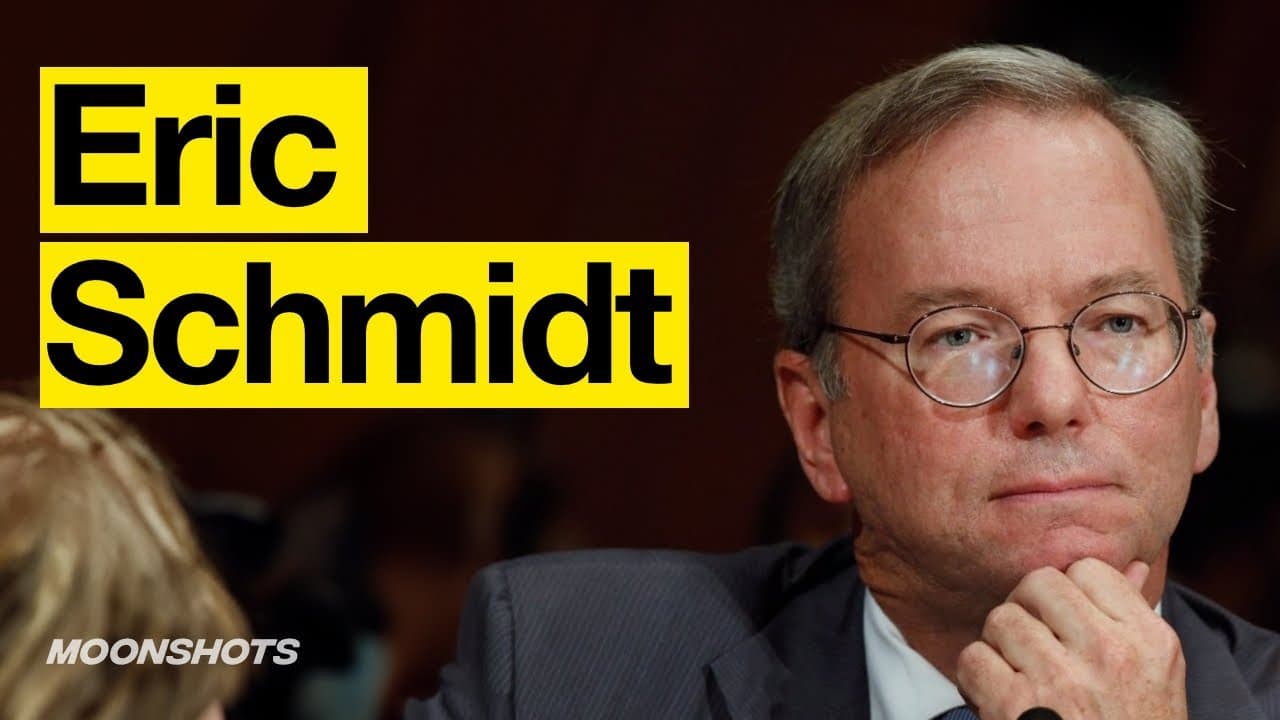
What Are the Consequences of A.I.? Ex-Google CEO Eric Schmidt | EP #7
TL;DR
AI could transform biology by estimating complex functions, exposing patterns, and helping scientists investigate causal relationships in digitized biological data. Eric Schmidt connects that scientific potential to a wider transformation involving accelerated decisions, United States and China competition, nuclear deterrence, and engagement systems that amplify outrage. His claim that no complete digital cell model was available reveals how much remains unresolved, making the underlying opportunities and risks worth examining closely.
Transcript
15 years ago we embarked on an experiment in social media which I didn't you know pay that much attention to we were busy doing our own Facebook beat us so forth and so on that model which was a linear feed right made sense to me today's model which is an amped up AI feed to engage to increase engagement and make you outraged right is not what was ... Read More
Key Insights
- Outrage changes the feed: Schmidt distinguishes the original linear social media model from an AI-amplified feed designed to increase engagement. His criticism focuses on the behavioral objective embedded in the newer system, particularly its capacity to provoke outrage. The transformation therefore concerns both algorithmic capability and the incentives determining what those algorithms prioritize.
- Original intentions can drift: Schmidt says the engagement-maximizing model was not what was on the program 10 years earlier. That observation shows how a technology can develop into something materially different from its initial conception. The consequences emerge gradually as optimization goals, platform behavior, and user responses reshape the system after its original design.
- Leadership spans several institutions: Schmidt’s biography reaches beyond his best-known Google position. The introduction identifies earlier work at Novell, Sun, and Xerox PARC, followed by leadership at Google and Alphabet and technical advice through 2020. It also places him in university, research, medical, defense innovation, and national security organizations.
- Philanthropy begins with people: Schmidt Futures does not begin by restricting support to a single field. Its stated approach is to identify exceptional people globally and connect their abilities with hard, consequential problems. Talent discovery and support become practical mechanisms for addressing challenges across disciplines, serving others, and expanding the number of capable people working on urgent issues.
- Scale requires a clear formula: Schmidt describes the core formula as applying the smartest talent to the hardest problems. The opportunity exists because the world has many hard problems and also many capable people distributed globally. The remaining challenge is solving the matching and support problem well enough for that talent to produce meaningful results.
- Career transitions expand contribution: Schmidt’s chapter-based view rejects the idea that one defining position must organize an entire life. Moving into a new chapter can enable unfamiliar learning, new relationships, and different forms of service. His transition from major technology leadership toward policy, philanthropy, national security, and biology provides the example within the discussion.
- Digitization makes biology computable: Biological processes begin as physical and difficult-to-model phenomena, but measurement can convert aspects of them into digital information. Once represented computationally, those processes become more accessible to algorithmic analysis. Schmidt argues that accelerating this conversion can help researchers analyze patterns, investigate mechanisms, and focus experiments more effectively.
- AI estimates difficult functions: Schmidt identifies estimation as a central scientific capability of AI. Some biological functions are not naturally computable through conventional methods, but AI can approximate their behavior from available information. Researchers can then inspect the resulting patterns, identify correlations, and test whether particular inputs are responsible for observed biological outcomes.
- Patterns are not final explanations: AI can expose relationships in biological information, but scientists still need to investigate whether those relationships are causal. The system helps narrow attention toward promising connections rather than completing the scientific process by itself. Human inquiry remains necessary to determine which inputs produce outcomes and which apparent patterns are only correlations.
- The cell remains unresolved: The discussion notes that a complete digital model of the cell was not available despite biology’s long research history. Schmidt treats that absence as evidence of major gaps in mechanistic understanding. Computational methods may help close those gaps by organizing measurements and supporting more targeted investigation, but the missing model also limits present simulation.
- AI becomes biology’s formal tool: Schmidt compares AI’s prospective role in biology with mathematics’ role in physics. The analogy presents AI as a foundational method for approximating, organizing, and testing relationships that conventional calculation cannot fully derive. It does not imply that biology is already explained, since the discussion explicitly identifies unresolved cellular mechanisms.
- Speed creates strategic pressure: More capable algorithms can compress the time available for governments, companies, and individuals to interpret events and decide how to respond. The conversation connects this acceleration with nuclear deterrence and competition between the United States and China. AI leadership therefore becomes a public-policy and national-security concern, not solely a scientific or commercial achievement.
Install to Summarize YouTube Videos and Get Transcripts
Explore YouTube Video Summarizer or Get YouTube Transcript Extractor
Questions & Answers
Q: How will AI transform biology and global power?
AI can transform biology by estimating complex functions, analyzing digitized biological information, and revealing patterns that scientists can investigate. This helps researchers identify correlations and test whether particular biological inputs cause specific outcomes. At the geopolitical level, increasingly capable algorithms can compress decision timelines and intensify competition between the United States and China. The same acceleration connects scientific progress with public policy, technological leadership, and nuclear deterrence.
Q: How can AI expand scientific knowledge of biology?
AI can estimate biological functions that are not naturally computable and detect patterns within measured information. Scientists can use those approximations to identify correlations that might otherwise remain difficult to see. They must then investigate whether a relationship is causal by testing whether a particular input produces a particular outcome. AI expands knowledge by directing human attention and experimentation, not by turning every detected pattern into an explanation automatically.
Q: Why does biology need better digital models?
Digital models can make physical biological processes easier to analyze, compare, and simulate computationally. Schmidt notes that a complete digital model of the cell was not available in the discussion, despite the long history of biological research. That absence signals unresolved questions about how cellular mechanisms work together. Converting more measurable biology into digital representations can help researchers organize evidence and pursue those gaps more precisely.
Q: What does AI is to biology as mathematics is to physics mean?
The analogy means AI could become a foundational analytical tool for describing biological relationships. It can approximate complex functions, organize measured information, and reveal patterns for researchers to examine. This is useful because biology includes processes that cannot be fully handled through straightforward conventional calculation. The comparison does not claim that AI already explains biology, since major gaps such as the missing complete digital cell model remain.
Q: How should people approach major career transitions?
Schmidt recommends viewing life as a sequence of chapters rather than remaining attached to one permanent role. A new chapter creates room to study unfamiliar subjects, build relationships, and pursue work that an earlier position made difficult. His own path moved from technology leadership and advising toward public policy, philanthropy, national security, and synthetic biology. The chapter framework matters because fear of transition can prevent people from finding new ways to contribute.
Q: What is Schmidt Futures’ approach to solving difficult problems?
Schmidt Futures focuses on matching exceptional people with hard, consequential problems. Schmidt says the world has both many difficult problems and substantial smart talent distributed globally. The organization therefore emphasizes identifying and supporting capable people across disciplines instead of limiting itself to one technical area. This approach works by treating talent discovery, resources, and problem selection as parts of the same formula.
Q: Why are AI-driven social media feeds a concern?
Schmidt says newer AI feeds can be optimized to increase engagement and make users outraged. That differs from the earlier linear feed, which presented information in a simpler sequence and made sense to him at the time. The concern arises because the optimization objective can influence which material receives attention and how users react to it. He also stresses that this engagement-amplifying model was not the system originally envisioned years earlier.
Q: What risks accompany faster AI development?
Faster AI can shorten the time available to understand events, evaluate options, and make consequential decisions. The discussion places these compressed timelines alongside geopolitical competition, nuclear deterrence, and algorithms that digitize more of the world. Governments, companies, and individuals can all face pressure as technical systems become more capable and operate more quickly. These connections make AI development a security and governance problem as well as a technical opportunity.
Summary & Key Takeaways
-
Questioning engagement-driven feeds: The conversation opens by contrasting the linear social media feed envisioned about 15 years earlier with a newer AI-amplified model. Eric Schmidt says the earlier format made sense to him, while the newer system seeks greater engagement and can make users outraged. This shift illustrates a broader concern running through the discussion: algorithms do not merely organize information, they can alter behavior, public attention, and the social consequences of digital platforms.
-
Introducing Eric Schmidt’s record: The interview, recorded at the Abundance 360 executive summit in April 2022, presents Schmidt as a technologist, philanthropist, entrepreneur, investor, and thinker. His career includes serving as Google’s CEO and chairman from 2001 to 2011, remaining chairman through 2015, and becoming Alphabet’s executive chairman from 2015 to 2018. The introduction also highlights his later work spanning technical advice, public policy, national security, philanthropy, and biotechnology.
-
Treating life as chapters: Schmidt describes a meaningful life as a sequence of chapters rather than one permanent identity or achievement. After demanding leadership and advisory roles, he moved toward public policy, philanthropy, synthetic biology, and other difficult problems. He argues that people often fear the next chapter, even though accepting transition creates opportunities to learn unfamiliar subjects, build new relationships, and contribute in ways that were not possible within an earlier role.
-
Applying talent to problems: Schmidt Futures, co-founded in 2017, is described through a straightforward formula: put the smartest talent on the hardest problems. Schmidt emphasizes that exceptional people exist around the world and that many difficult problems remain available for them to address. In 2019, he and his wife Wendy announced a billion-dollar philanthropic commitment to identify and support talent across disciplines and around the globe, with the aim of serving others and addressing pressing issues.
-
Connecting AI, biology, and power: The later discussion treats biology as increasingly computational when physical processes can be measured and represented digitally. Schmidt compares AI’s potential role in biology with mathematics in physics, because AI can estimate functions that are not naturally computable and reveal patterns for scientists to test. The conversation then widens to quantum simulation, compressed decision timelines, nuclear deterrence, increasingly capable algorithms, and competition between the United States and China for technological leadership.
Read in Other Languages (beta)
Share This Summary 📚
Summarize YouTube Videos and Get Video Transcripts with 1-Click
Try YouTube Summary with ChatGPT & Claude or YouTube Transcript Generator
Explore More Summaries from Peter H. Diamandis 📚
Summarize YouTube Videos and Get Video Transcripts with 1-Click
Try YouTube Summary with ChatGPT & Claude or YouTube Transcript Generator