What Are Classical Information Retrieval Techniques?
TL;DR
Classical information retrieval (IR) techniques, such as the term-document matrix, TF-IDF, and BM25, are essential for analyzing document relevance. The term-document matrix represents the frequency of terms in documents, while TF-IDF enhances relevance scoring by considering term frequency and document frequency. BM25 further refines this by incorporating adjusted IDF values and hyperparameters for better scoring.
Transcript
welcome back everyone this is part two in our series on information retrieval we're going to briefly review classical IR approaches it will be a brief overview because our focus in this course is on neural information retrieval but I did want to cover these classical ideas because they're very powerful and classical IR systems could very well be im... Read More
Key Insights
- 🍉 Classical IR approaches utilize the term-document matrix to analyze document relevance based on term frequency.
- 🍉 The TF-IDF approach enhances the term-document matrix analysis by considering both term frequency and inverse document frequency.
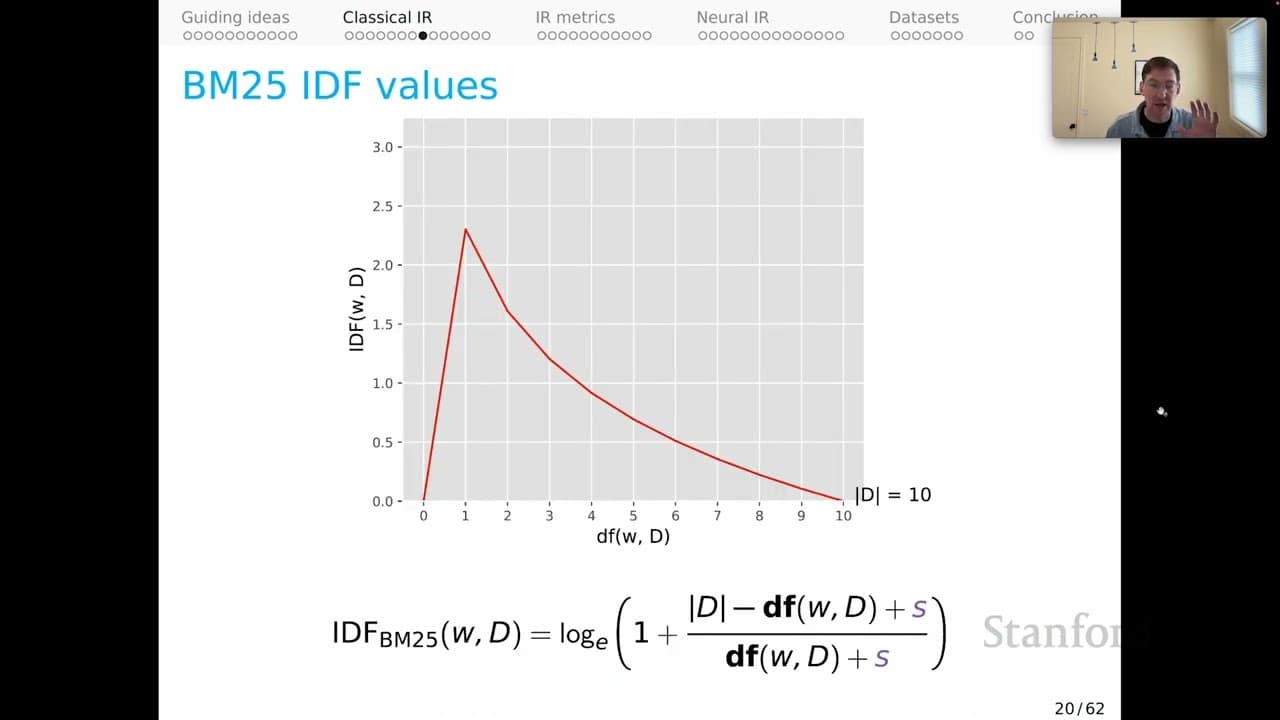
- 🥠 The BM25 algorithm further improves on TF-IDF by incorporating adjusted IDF values, scoring functions, and hyperparameters to fine-tune relevance scoring.
- 😒 Classical IR models offer scalability and robustness, making them suitable for use alongside neural IR models as re-rankers of results.
- 📜 Potential areas for further exploration in classical IR include query and document expansion, phrase-level search, term dependence, different document fields, link analysis, and learning to rank functions.
Install to Summarize YouTube Videos and Get Transcripts
Explore YouTube Video Summarizer or Get YouTube Transcript Extractor
Questions & Answers
Q: What is the term-document matrix and how does it encode information about document relevance?
The term-document matrix is a matrix where rows represent terms, columns represent documents, and cells record the frequency of each term in each document. By analyzing this matrix, we can identify which documents are relevant to specific query terms based on their frequency.
Q: How does the TF-IDF approach enhance the term-document matrix analysis?
TF-IDF combines term frequency (TF) and inverse document frequency (IDF) values to determine relevance. TF measures the relative frequency of a term in a document, while IDF measures the informativeness of a term based on its occurrence in the corpus. Multiplying TF and IDF values provides a more informative measure of relevance.
Q: What is the BM25 algorithm and how does it improve on TF-IDF?
BM25, or Best Match 25, is an improved version of TF-IDF. It utilizes adjusted IDF values to handle undefined cases, scoring functions, and hyperparameters like K and B. BM25 penalizes long documents, flattens out high-frequency terms, and allows for finer control over relevance scoring.
Q: What are some potential limitations or areas for further exploration in classical IR?
Some potential areas for further exploration in classical IR include query and document expansion, phrase-level search, consideration of term dependence, analysis of different document fields, incorporation of link analysis, and learning to rank functions. Elasticsearch, Pi Sereni, and Prime QA are useful tools for implementing classical IR models.
Summary & Key Takeaways
-
Classical IR systems utilize the term-document matrix, which encodes information about the relevance of documents to query terms.
-
The TF-IDF approach is commonly used to analyze the term-document matrix by calculating term frequency, document frequency, and inverse document frequency values.
-
The BM25 algorithm is an enhanced version of TF-IDF that considers adjusted IDF values, scoring functions, and hyperparameters to improve relevance scoring.
Read in Other Languages (beta)
Share This Summary 📚
Summarize YouTube Videos and Get Video Transcripts with 1-Click
Try YouTube Summary with ChatGPT & Claude or YouTube Transcript Generator
Explore More Summaries from Stanford Online 📚
Summarize YouTube Videos and Get Video Transcripts with 1-Click
Try YouTube Summary with ChatGPT & Claude or YouTube Transcript Generator