What Are Rotation and Torque? Physics 101 and AP Physics 1 Review with Dianna Cowern
TL;DR
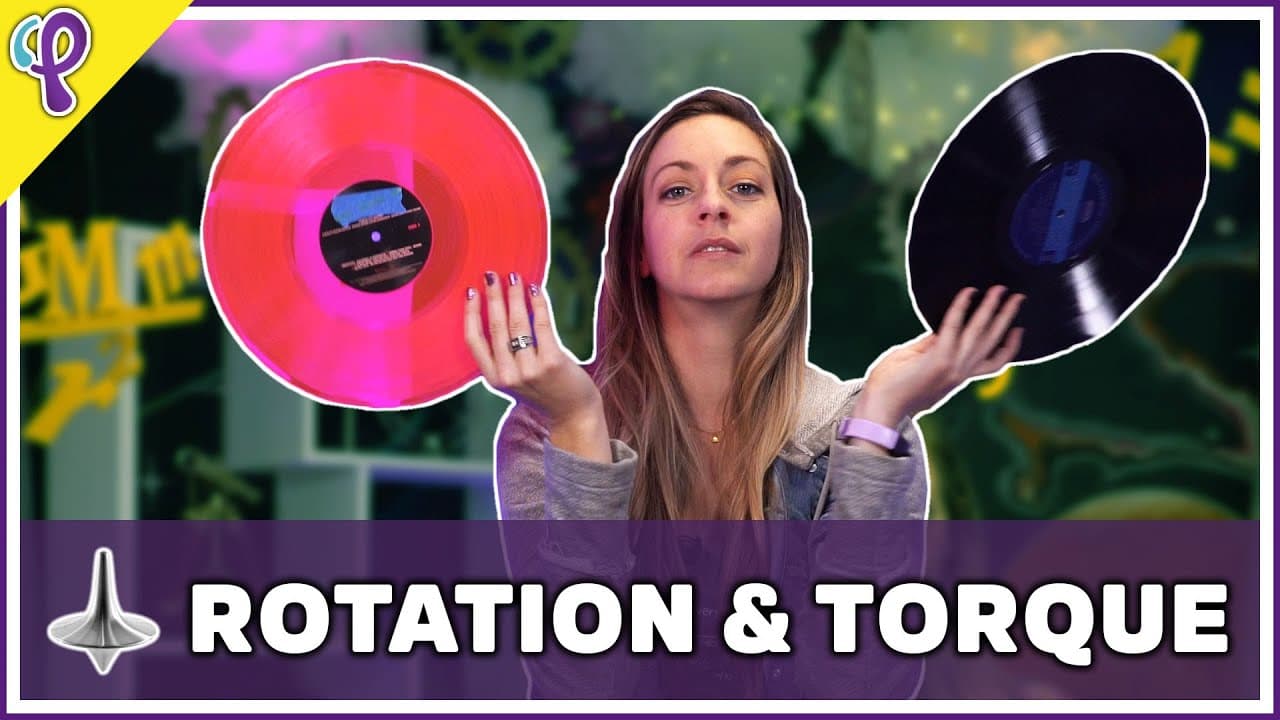
Rotation describes spinning around an axis, while torque is the rotational equivalent of force that makes objects spin. Dianna Cowern calculates Earth’s angular velocity as 0.0000727 radians per second and the linear speed at the equator as 464 meters per second. Read on to connect angular motion and torque with Earth, doors, screwdrivers, and spinning records.
Transcript
HOST: These are a bunch of random objects. And when I toss them in the air, they seem to wobble. They follow weird, strange paths. But watch what happens when I put them against a dark background with a fluorescent dot at a special place on the object. Now they follow a smooth, perfectly curved path. It's like they don't even have any shape anymore... Read More
Key Insights
- "The cool thing that we're doing today is to understand spinning things, which are everywhere." (0:43)
- "And it equals the change in angle over change in time." (4:27)
- "And we measure it in radians per second, Why radians?" (4:36)
Install to Summarize YouTube Videos and Get Transcripts
Explore YouTube Video Summarizer or Get YouTube Transcript Extractor
Questions & Answers
Q: What is the difference between rotating and moving around a circle?
Moving around a circle can describe something running along a circular path. Rotation describes an object spinning around an axis, which is the focus of lesson 14.
Q: What is angular velocity?
Angular velocity, represented by the Greek letter omega, is the change in angle divided by the change in time. It is the rotational analog of linear velocity and is measured in radians per second.
Q: How fast is Earth rotating in radians per second?
Earth completes one rotation, or 2 pi radians, per day. Using 86,400 seconds per day gives an angular velocity of 0.0000727 radians per second, also written as 7.27 times 10 to the minus 5 radians per second.
Q: How fast does Earth move someone standing at the equator?
Earth’s radius is about 6,380 kilometers, giving a circumference of about 40,100 kilometers. Covering that circumference in one day produces a linear speed of 464 meters per second, or about 1,000 miles an hour.
Q: How fast is someone in California moving because of Earth’s rotation?
At about 32 degrees North, Dianna’s distance from Earth’s rotational axis is approximately 4/5 of the equatorial radius. Her resulting linear speed is about 400 meters per second, or 800 miles an hour, toward the east.
Q: How are angular velocity and linear velocity related?
For one revolution, the traveled linear distance is the circumference, 2 pi r, while the angular distance is 2 pi radians. Converting Earth’s angular velocity with its radius of 6.38 times 10 to the 6 meters gives 464 meters per second at the equator.
Q: What is torque, and what determines it?
Torque is the rotational equivalent of force and is responsible for creating rotational motion. It depends on the applied force and the distance from the axis of rotation where that force is applied.
Q: Why are doorknobs placed at the edge of a door?
Placing a doorknob at the edge increases the distance between the applied force and the door’s axis of rotation. That greater distance produces more torque, making the door easier to rotate.
Summary & Key Takeaways
-
The video starts by discussing how objects in rotational motion can be described and how they differ from objects moving in a straight line.
-
It explains how to calculate the angular velocity and linear velocity of an object in rotational motion, using the example of the Earth's rotation.
-
The video then introduces the concept of torque, which is the rotational equivalent of force, and explains its role in making objects spin.
-
Several examples are provided to illustrate the application of torque, including the case of a bug clinging to a spinning record and the use of torque in screwdrivers.
Read in Other Languages (beta)
Share This Summary 📚
Summarize YouTube Videos and Get Video Transcripts with 1-Click
Try YouTube Summary with ChatGPT & Claude or YouTube Transcript Generator
Explore More Summaries from Physics Girl 📚




Summarize YouTube Videos and Get Video Transcripts with 1-Click
Try YouTube Summary with ChatGPT & Claude or YouTube Transcript Generator