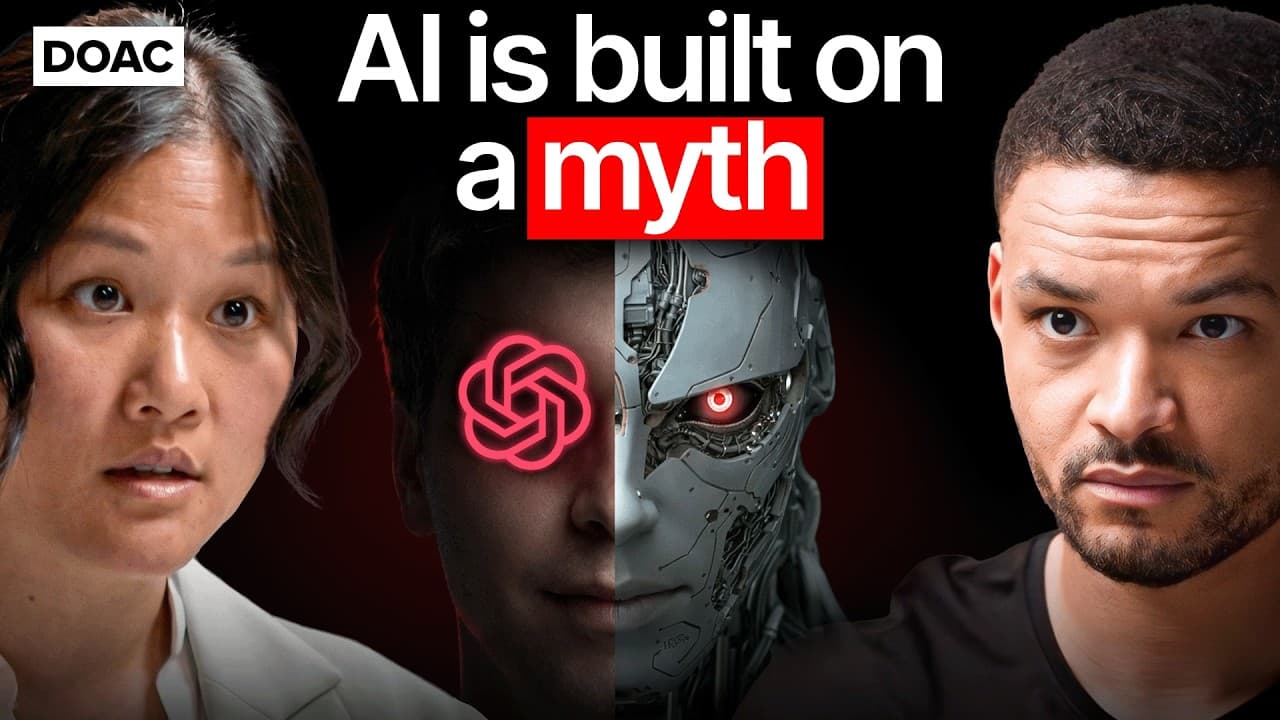
Karen Hao on Empire of AI: Are AI Companies Hiding the Truth From Us?
TL;DR
Journalist Karen Hao argues AI companies profit from a myth about AI's potential, deliberately shaping public perception so they can, in her words, "extract and exploit" resources and labor, citing internal documents she has seen. Author of "Empire of AI: Dreams and Nightmares in Sam Altman's OpenAI," she interviewed over 250 people, including current and former OpenAI staff, and compares today's AI firms to historical empires. Read on for how she reached this conclusion and what she says we should do about it.
Transcript
So much of what's happening today in the AI industry is extremely inhumane. >> But this is me playing devil's advocate. And logically, it could be the case that the civilization that accelerate their research with AI is going to be the superior civilization. >> No, it's not. This is a prediction that you're making, right? >> Making Zuckerberg's mak... Read More
Key Insights
- AI companies are accused of exploiting myths about AI's potential to profit and avoid regulation.
- The AI industry's promises of job creation often lead to worse job conditions compared to those displaced.
- There is significant debate about the true nature of AI and its potential to replace human intelligence.
- AI companies are compared to empires, exploiting resources and labor while controlling knowledge production.
- Critics argue that AI development is driven by profit rather than public benefit, raising ethical concerns.
- The AI industry's impact on employment is complex, with both job displacement and creation in different sectors.
- OpenAI's leadership has faced internal criticism and controversy over decision-making and company direction.
- There is skepticism about the AI industry's claims of impending technological breakthroughs and their societal impact.
- More videos with Karen Hao:
Install to Summarize YouTube Videos and Get Transcripts
Explore YouTube Video Summarizer or Get YouTube Transcript Extractor
Questions & Answers
Q: What is Karen Hao's main argument about AI companies?
Hao argues that AI companies profit enormously off a myth about AI's potential, and that they purposely try to create that feeling within the public so they can "extract and exploit." She says internal documents show this is deliberate. Her core claim is not that the technologies lack utility, but that the way they are currently produced inflicts significant harm on people.
Q: Why does Karen Hao compare AI companies to "empires"?
She draws parallels between the "empires of AI" and empires of old. They claim the intellectual property of artists, writers, and creators to train their models, and they exploit an extraordinary amount of labor. She adds that they create environmental and public health harms, spend hundreds of millions to kill legislation that gets in their way, and censor researchers who are inconvenient to their agenda.
Q: How do AI companies profit from myths about AI, according to Hao?
Hao says AI companies profit by promoting a myth about AI's transformative potential to investors and the public. She argues they deliberately cultivate this belief so they can keep extracting resources and labor for profit. She frames this narrative as a tool that justifies their control over AI development.
Q: What does the video say about AI's impact on jobs?
Hao describes how AI breaks the career ladder: someone gets laid off, is then hired to help train a model on the very job they lost, and that model may go on to trigger more layoffs once it learns the skill. She adds that when companies promise new, unimaginable jobs, many of the jobs actually created are far worse than the ones that were there before.
Q: What is Karen Hao's background and how did she research this?
Hao studied mechanical engineering at MIT, then moved to San Francisco and joined a mission-driven tech startup focused on fighting climate change. After the board fired that CEO because the company was not profitable, she reconsidered her path and eventually took a role at MIT Technology Review covering AI full-time. She has covered the tech industry for over 8 years and interviewed over 250 people for the book, beginning her reporting in 2018.
Q: What does Karen Hao think we should do about the AI industry?
Her proposed solution is direct: "We need to break up the empires of AI." She stresses that she is not saying the technologies have no utility. Instead, she points to research showing that the very same capabilities could be developed in a different way that avoids the harmful, unintended consequences of how they are built today.
Q: Does Karen Hao believe AI has no value at all?
No. She explicitly says her argument is not that these technologies don't have utility. Her concern is that the current production of these technologies is exacting a lot of harm on people, and she argues that a different approach could deliver similar capabilities without those consequences.
Summary & Key Takeaways
-
AI companies are accused of manipulating public perception to profit from myths about AI's capabilities. They redefine terms like AGI to suit their needs, raising ethical concerns about their impact on society. Critics argue that these companies prioritize profit over public benefit, exploiting resources and labor while controlling knowledge production.
-
The AI industry's promises of job creation often result in worse job conditions compared to those displaced. There is significant debate about the true nature of AI and its potential to replace human intelligence. Critics highlight the industry's impact on employment, with both job displacement and creation in different sectors.
-
OpenAI's leadership has faced internal criticism and controversy, with accusations of poor decision-making and instability. The AI industry's claims of impending technological breakthroughs are met with skepticism, as critics question the societal impact and ethical considerations of these developments.
Read in Other Languages (beta)
Share This Summary 📚
Summarize YouTube Videos and Get Video Transcripts with 1-Click
Try YouTube Summary with ChatGPT & Claude or YouTube Transcript Generator
Explore More Summaries from The Diary Of A CEO 📚


Summarize YouTube Videos and Get Video Transcripts with 1-Click
Try YouTube Summary with ChatGPT & Claude or YouTube Transcript Generator