How Britain Built the World's Financial System
TL;DR
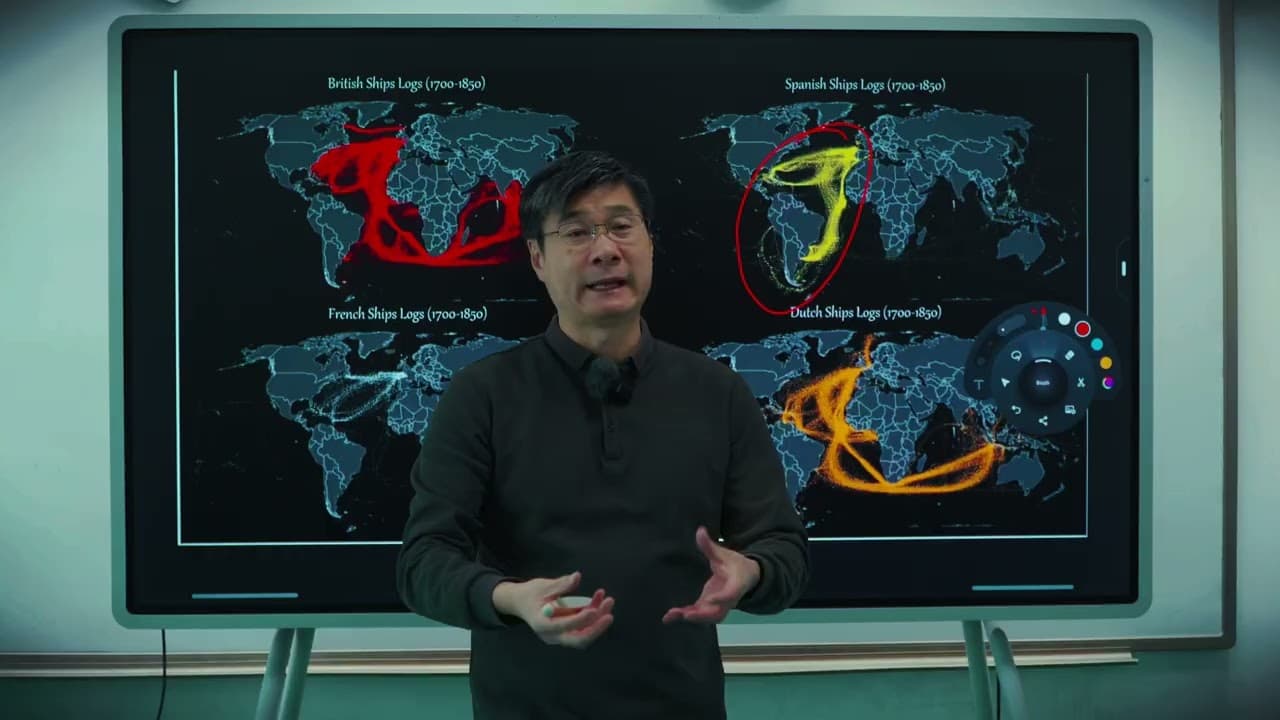
Britain’s global financial position emerged from a competitive system shaped by trade, manufacturing, shipping, piracy, religion, and imperial rivalry. The lecture argues that incentives created during conflicts among Spain, England, France, and the Dutch Republic eventually produced a British-led game that the United States inherited and that still influences choices involving English, dollars, education, and migration.
Transcript
Today I want to examine why you Chinese students behave the way you do. Okay. So believe it or not, but the way that you behave, the game that you are playing, it's strange. It's weird. So I'll point out three things that you do that don't really make any sense. The first thing that you do is you spend a lot of your time learning English. In fact, ... Read More
Key Insights
- The lecture’s central claim is that present-day preferences for English, United States dollars, and Western migration reflect a global game first constructed by the British Empire and later inherited by the United States as the dominant world power.
- Chinese students are portrayed as investing heavily in English because they associate it with knowledge, overseas study, communication, and internet access. The lecturer considers those stated reasons incomplete and asks what larger incentive system makes English more attractive than deeper mastery of Chinese.
- Status is presented as the underlying objective behind the pursuit of money, prestigious employment, marriage, and family. The lecture argues that accumulating United States dollars is only an indirect strategy for obtaining social respect, influence, and other desired outcomes.
- Migration to the United States is characterized as a strategically questionable choice for advantaged Chinese students. The lecturer claims they may possess stronger family connections and better prospects for status in China, while facing limits on corporate and political advancement after moving abroad.
- European maritime expansion is explained as a response to dependence on Eastern trade. After Christian forces reconquered Spain, Muslim powers allegedly restricted commerce or imposed heavy levies, encouraging Spanish and Portuguese voyages in search of alternative routes to valuable Southeast Asian spices.
- Spanish imperial wealth is attributed primarily to conquest in the Americas and the shipment of silver to Spain. The lecture argues that this rapid enrichment reduced incentives to work and encouraged Spain to purchase textiles, luxury goods, and trading services from other European societies.
- England’s rise is partly connected to state-supported piracy against Spanish silver shipments. The lecture identifies Francis Drake as the most famous pirate of the period and says he operated directly under Elizabeth I, allowing England to capture wealth moving from the Americas.
- Religious division is presented as intertwined with economic and political rivalry. Spain remained Catholic, while England and the Dutch differentiated themselves through Protestant or Calvinist ideas emphasizing hard work and wealth, then cooperated as Dutch resistance to Spanish taxation contributed to wider warfare.
Install to Summarize YouTube Videos and Get Transcripts
Explore YouTube Video Summarizer or Get YouTube Transcript Extractor
Questions & Answers
Q: Why did Chinese students prioritize learning English?
Chinese students are described as prioritizing English because they want access to knowledge, opportunities abroad, communication, and the internet. Professor Jiang regards these explanations as insufficient on their own. He argues that the deeper reason lies in a global incentive structure created by British power and inherited by the United States, which makes English valuable for education, mobility, status, and participation in international life.
Q: Why does the lecture question Chinese students’ focus on United States dollars?
The lecture argues that United States dollars are not the students’ final objective. Their deeper goals are described as status, respect, prestigious work, marriage, and a large family. From that perspective, focusing narrowly on dollars appears strange because money is only one instrument for pursuing those outcomes. Professor Jiang therefore asks why the international system makes this particular currency seem central to personal advancement.
Q: Why does the lecturer consider Western immigration a questionable strategy?
Professor Jiang claims that wealthy or well-connected Chinese students may have better opportunities to gain employment, influence, respect, and family status in China. He portrays the United States as a game structured against them, where even highly capable immigrants may become engineers or professors but are unlikely to attain major political power or lead a major company. These are the lecturer’s claims within the provided transcript.
Q: How does the lecture connect Britain to the modern global system?
The lecture’s stated argument is that the British Empire constructed the global game that shapes modern preferences for English, dollars, overseas education, and Western migration. The United States later inherited that system and extended it through its position as the global superpower. The description further identifies Britain’s evolution into an offshore financial system as the lecture’s subject, although the provided transcript excerpt ends before that development is fully explained.
Q: Why did Spain and Portugal search for new trade routes?
Europe is described as historically poor and dependent on trade for valuable goods, especially spices from Southeast Asia. After Christian forces reconquered Spain, Muslim powers allegedly blockaded commerce or demanded high levies from Christian traders. Spain and Portugal therefore searched for alternative maritime routes to the East Indies, where commodities such as cinnamon, nutmeg, and peppercorn could generate extraordinary wealth.
Q: How did silver affect the Spanish Empire in the lecture’s argument?
Spanish conquest in North and South America gave the empire access to wealth, particularly silver that could be transported back to Spain. The lecture argues that this enrichment made Spain powerful very quickly but also weakened its productive habits. Spanish elites and workers became less willing to labor, while the country increasingly relied on Britain, France, and the Dutch Republic for manufactured goods, luxury products, trade, and shipping.
Q: How did England and the Dutch Republic gain wealth while Spain declined?
England and the Dutch Republic are portrayed as poorer but more energetic commercial societies. They supplied goods and services that wealthy Spain no longer wanted to produce for itself, while Dutch traders undertook dangerous voyages to obtain spices. England also profited through piracy against Spanish silver shipments. These activities strengthened manufacturing, shipping, trade, and a growing middle class as Spain became overextended, corrupt, and financially unstable.
Q: What role did religion play in European imperial rivalry?
The lecture presents religion as both a genuine division and a marker of political and economic competition. Spain remained Catholic and sought influence over the Vatican, while England and the Dutch Republic adopted Protestant or Calvinist identities that emphasized hard work, energy, and acquiring wealth. Dutch demands for independence and Spanish demands for higher taxes contributed to conflict that became part of the wider Thirty Years’ War.
Summary & Key Takeaways
-
The lecture begins by questioning why Chinese students devote substantial effort to English, seek United States dollars, and hope to immigrate to Western countries. Professor Jiang argues that these choices appear inconsistent with their potential advantages in China, then frames them as responses to a global system originally constructed by Britain.
-
European demand for valuable Southeast Asian spices encouraged Spain and Portugal to seek new maritime routes after Muslim powers restricted or heavily taxed established trade. Spanish expansion into the Americas brought large quantities of silver, creating immense wealth while also supporting colonies, extensive trade, military commitments, and competition among European states.
-
Spain’s wealth allegedly encouraged dependence on foreign manufacturers, Dutch traders, and other intermediaries. Meanwhile, England and the Dutch Republic developed greater capacity in industry, shipping, commerce, and piracy. Their growing wealth and conflict with Catholic Spain contributed to Protestant differentiation, Dutch resistance to Spanish taxation, and wider European wars.
Read in Other Languages (beta)
Share This Summary 📚
Summarize YouTube Videos and Get Video Transcripts with 1-Click
Try YouTube Summary with ChatGPT & Claude or YouTube Transcript Generator
Explore More Summaries from Predictive History 📚




Summarize YouTube Videos and Get Video Transcripts with 1-Click
Try YouTube Summary with ChatGPT & Claude or YouTube Transcript Generator