How to Learn Faster With a Structured Workflow
TL;DR
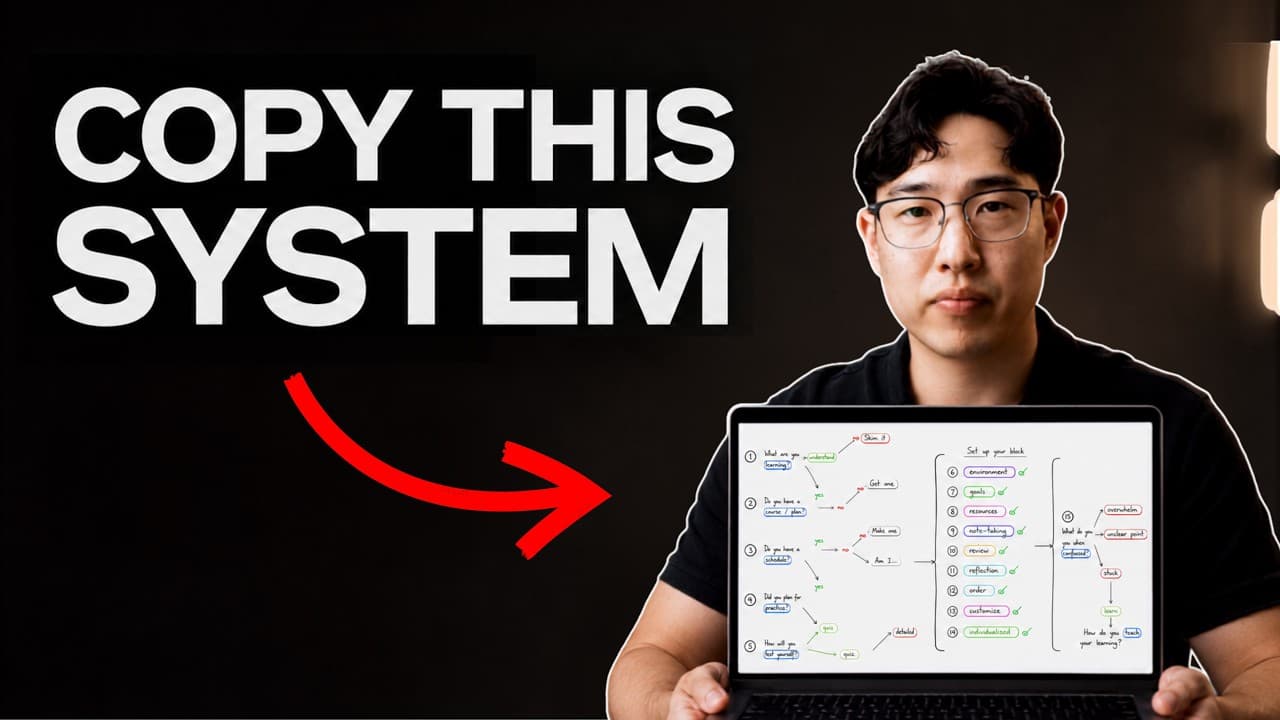
Measure learning by depth and retention, not by how quickly you cover material. Define the required outcome, schedule your sessions, prime yourself with the gist, remove distractions, and deliberately connect new ideas with existing knowledge. Reserve flash cards for isolated details that cannot be meaningfully connected and must still be memorized.
Transcript
So, I've been a learning coach now for almost 15 years teaching people how to learn more in less time. And although now I can learn very efficiently, it wasn't always like that. I distinctly remember being in school, sitting in class, studying as hard as I can, studying with the same methods that everyone else is using, but needing to put in double... Read More
Key Insights
- Learning efficiency is best measured by outcomes such as depth, retention, and usable knowledge, rather than by the speed of covering content. A fast method can be inefficient overall when it creates fragile memories and forces the learner to spend additional time relearning forgotten material.
- A clear purpose and plan give the brain a useful frame for learning. Formal learners can examine objectives, curriculum structure, and past exams, while professionals doing unstructured learning must define their own objectives and specify how they need to apply or perform with the knowledge.
- A learning schedule is necessary because available time changes which strategies are appropriate. Some methods work better during long sessions, while others suit short periods. Blocking out learning time in advance makes it possible to select methods that fit the actual constraints of the day.
- Priming is a short preparatory activity that makes later intensive learning less overwhelming and helps new information make sense. It can occur up to a week beforehand or only a few minutes before the main session, but it should be included when the schedule is created.
- Effective priming focuses on the gist rather than detailed study. Building a general understanding creates memory landmarks and anchor points for later details. A suggested benchmark is approximately 5–10 minutes of priming for an hour of learning, with longer sessions potentially indicating excessive attention to detail.
- A focused learning environment can be evaluated with a distraction sheet. Writing down each distraction reveals whether the setting supports concentration and identifies problems that should be removed before future sessions. Ideally, the sheet remains blank because no distractions occurred.
- Schema formation depends on connecting pieces of information into a network. Merely intending to remember or understand encourages relatively superficial processing, while comparing ideas, identifying differences, and judging importance require deeper processing that deliberately creates the connections stored as memory.
- Flash cards are most appropriate for isolated facts or details that cannot be meaningfully connected but still need to be memorized, such as required exam content. Information that can be related to other concepts should instead be processed through comparison, judgment, and connection building.
Install to Summarize YouTube Videos and Get Transcripts
Explore YouTube Video Summarizer or Get YouTube Transcript Extractor
Questions & Answers
Q: How should learning efficiency be measured?
Learning efficiency should be measured by whether a method produces deep knowledge, adequate performance, and lasting retention, not simply by how quickly it covers material. A strategy that feels fast at first may create fragile memories and require repeated relearning. A slower method can therefore be more efficient overall if it reduces forgetting and supports deeper use of the knowledge.
Q: Why can faster study methods waste time?
Faster study methods can waste time when they emphasize rapid content coverage without producing durable or usable knowledge. If the resulting memories are fragile, the learner must repeatedly revisit forgotten material. Evaluating the total process reveals that apparent speed at the beginning can create extra work later, while deeper methods may save time by reducing the need for relearning.
Q: How do you create a clear learning purpose and plan?
Start by defining what successful learning requires and how the knowledge must be used. In a formal curriculum, review the learning objectives, understand the structure of the material, and inspect past exams for the expected style of application. In unstructured professional learning, write your own objectives and describe the performance or practical application that would demonstrate success.
Q: Why should learning sessions be scheduled in advance?
Learning sessions should be scheduled in advance because the amount of available time affects which learning strategies will work. Some strategies are more suitable for long sessions, while others fit short blocks. Reserving specific hours also ensures that learning has a real place in the day and provides the information needed to plan priming and intensive study appropriately.
Q: What is priming before a learning session?
Priming is a brief period of preparation that gets the brain ready for more intensive learning. It establishes enough context to make later information easier to interpret, reduces overwhelm, and supports more efficient memory formation. Priming may happen up to a week before the main session or only minutes beforehand, but it should be intentionally included in the learning plan.
Q: How long should a priming session take?
A priming session should ideally take approximately 5–10 minutes for an hour of subsequent learning. Its purpose is to capture the gist, general concept, and overall structure, not to master every detail. If priming takes considerably longer, the learner may be treating it as a full study session and losing the contextual benefit that priming is meant to provide.
Q: How can you reduce distractions while studying?
Place a distraction sheet beside you during an intensive learning session and record every distraction that occurs. The resulting list provides evidence about whether the environment is genuinely focused and identifies specific problems to address. Before the next session, adjust the setting to remove those triggers. The ideal result is a blank sheet because the environment prevented distractions from arising.
Q: Why is connecting ideas better than trying to memorize them?
Connecting ideas encourages the brain to form schemas, which are networks created when pieces of information relate to one another. Compare a new idea with other concepts, identify similarities and differences, and judge its importance relative to your learning goal. These operations require deeper processing than merely trying to remember or understand. Flash cards should be reserved for isolated details that resist meaningful connection.
Summary & Key Takeaways
-
Efficient learning begins with choosing the right measure of success. Finishing material quickly can produce fragile memories and repeated relearning. A better standard is whether a method creates deep knowledge, lasting retention, and the ability to use information at the required level, even when the method initially takes more time.
-
Preparation gives learning direction and makes strategic choices possible. Define why the knowledge matters, how it must be applied, and what successful performance looks like. Then reserve specific learning periods on a schedule because the available session length affects which strategies are suitable. Include a short priming period before intensive study.
-
During study, create a focused environment and record distractions so recurring problems become visible. Prioritize comparisons, relationships, importance, and relevance instead of merely trying to remember or understand individual statements. These deeper judgments connect information into schemas. Use flash cards only for isolated details that cannot be connected but still require memorization.
Read in Other Languages (beta)
Share This Summary 📚
Summarize YouTube Videos and Get Video Transcripts with 1-Click
Try YouTube Summary with ChatGPT & Claude or YouTube Transcript Generator
Explore More Summaries from Justin Sung 📚

Summarize YouTube Videos and Get Video Transcripts with 1-Click
Try YouTube Summary with ChatGPT & Claude or YouTube Transcript Generator