What Are Sonar Waves and How Do They Work?
TL;DR
Sonar systems use ultrasonic sensors to emit signals that bounce back from objects, enabling range and directional measurements. Various transducer types like electrostatic, piezoelectric, and MEMS are utilized in these systems. Ranging techniques, including threshold-based and matched filter methods, differ in complexity and accuracy, affecting the reliability of measurements.
Transcript
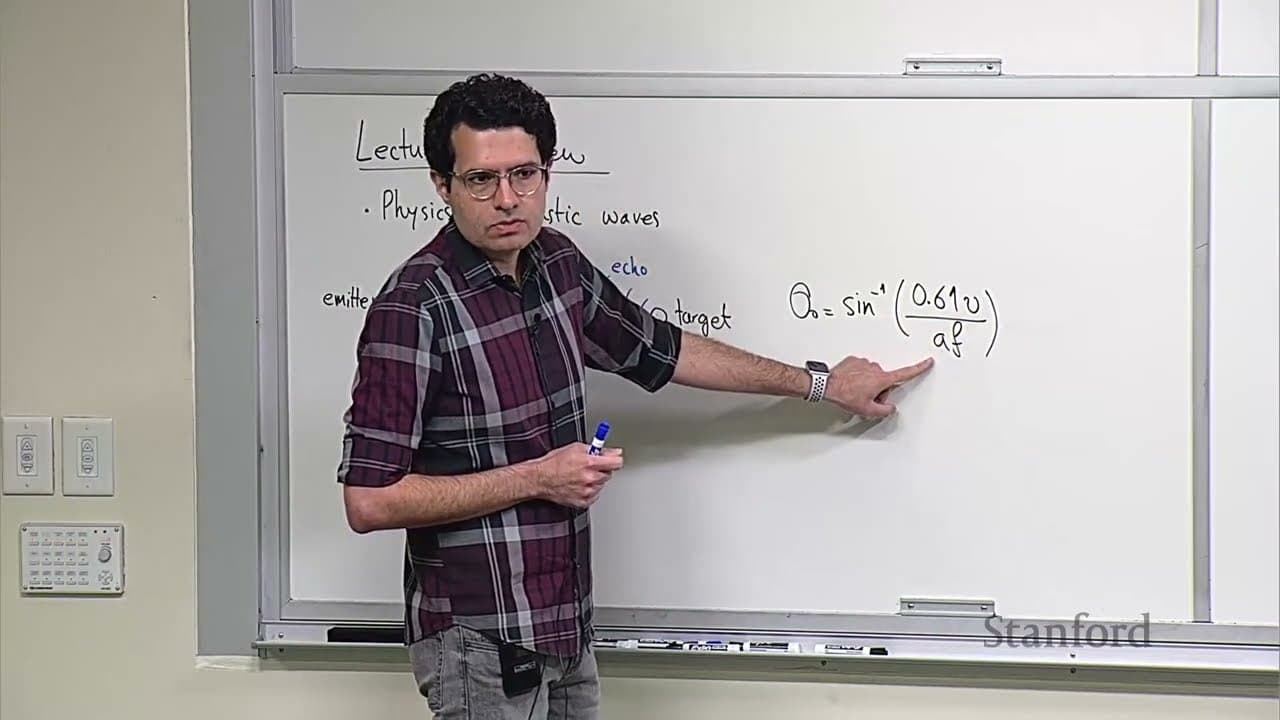
so last time uh we basically started the in-depth study of uh sonar or ultrasonic sensors and as usual we started with the physics of it right so physics of acoustic waves is what we started studying so uh at a very high level we said that the principle of operation of uh all active sensors that we'll be studying and specifically sonar it's uh it's... Read More
Key Insights
- 🧡 Sonar and ultrasonic sensors operate by emitting signals and analyzing the reflected echoes to determine range and bearing angle measurements.
- 👋 Different types of transducers, such as electrostatic, piezoelectric, and MEMS, are used to generate and receive ultrasonic waves in ultrasonic sensors.
- 🧡 Ranging in pulse echo sonar can be done using threshold-based or match filter ranging techniques, each with its own advantages and limitations.
- ⚾ Threshold-based ranging is simple but biased and sensitive to echo amplitude, while match filter ranging is more accurate but can be affected by waveform distortion and noise.
Install to Summarize YouTube Videos and Get Transcripts
Explore YouTube Video Summarizer or Get YouTube Transcript Extractor
Questions & Answers
Q: How does sonar operate to determine range and bearing angle measurements?
Sonar emits signals that are reflected back by the environment, allowing for measurements of range and bearing angles to targets. By measuring the time it takes for the echo to return and the direction of arrival, a 2D or 3D map of the scene can be reconstructed.
Q: What are the main types of transducers used in ultrasonic sensors?
Ultrasonic sensors use electrostatic, piezoelectric, or MEMS transducers. Each type has its advantages and limitations in terms of bandwidth, sensitivity, and operating frequency.
Q: How is ranging performed in pulse echo sonar?
Ranging in pulse echo sonar can be done using threshold-based ranging, where the output of an integrator is monitored to detect when it crosses a set threshold. Another method is match filter ranging, where the received waveform is correlated with a replica of the transmitted waveform to estimate the time of flight.
Q: What are the limitations of threshold-based ranging in pulse echo sonar?
Threshold-based ranging can be biased and sensitive to the amplitude of the echo. The ranging error increases exponentially with the bearing angle of the target, making it less accurate for larger angles.
Summary & Key Takeaways
-
Sonar operates by emitting signals that are reflected back by the environment, allowing for range and bearing angle measurements.
-
Ultrasonic sensors use transducers, such as electrostatic, piezoelectric, or MEMS, to generate and receive acoustic waves at ultrasonic frequencies.
-
Ranging in pulse echo sonar is done using threshold-based or match filter ranging techniques, each with its limitations and accuracy considerations.
Read in Other Languages (beta)
Share This Summary 📚
Summarize YouTube Videos and Get Video Transcripts with 1-Click
Try YouTube Summary with ChatGPT & Claude or YouTube Transcript Generator
Explore More Summaries from Stanford Online 📚

Summarize YouTube Videos and Get Video Transcripts with 1-Click
Try YouTube Summary with ChatGPT & Claude or YouTube Transcript Generator