Products
Features
YouTube Video Summarizer
Summarize YouTube videos
Web & PDF Highlighter
Highlight web pages & PDFs
Chat with PDF
Ask any PDF questions with AI
Ask AI Clone
Chat with your highlights & memories
Audio Transcriber
Transcribe audio files to text
Glasp Reader
Read and highlight articles
Kindle Highlight Export
Export your Kindle highlights
Idea Hatch
Hatch ideas from your highlights
Integrations
Obsidian Plugin
Notion Integration
Pocket Integration
Instapaper Integration
Medium Integration
Readwise Integration
Snipd Integration
Hypothesis Integration
Apps & Extensions
Chrome Extension
Safari Extension
Edge Add-ons
Firefox Add-ons
iOS App
Android App
Discover
Discover
Ideas
Discover new ideas and insights
Articles
Curated articles and insights
Books
Book recommendations by great minds
Posts
Essays and notes from readers
Quotes
Inspiring quotes collection
Videos
Curated videos and summaries
Explore Glasp
Glasp Newsletter
Weekly insights and updates
Glasp Talk
Interview series with great minds
Glasp Blog
Latest news and articles
Glasp Use Cases
Learn how others use Glasp
Build & Support
Glasp API
Access Glasp's API for developers
MCP Connector
Connect Glasp to Claude & ChatGPT
Community
Glasp Reddit Community
Students
Student discount and benefits
FAQs
Frequently Asked Questions
AboutPricing
DashboardLog inSign up

Edge Detection and Gradients - OpenCV with Python for Image and Video Analysis 10

129.1K views
•
December 31, 2015
by
sentdex
YouTube video player
Edge Detection and Gradients - OpenCV with Python for Image and Video Analysis 10

TL;DR

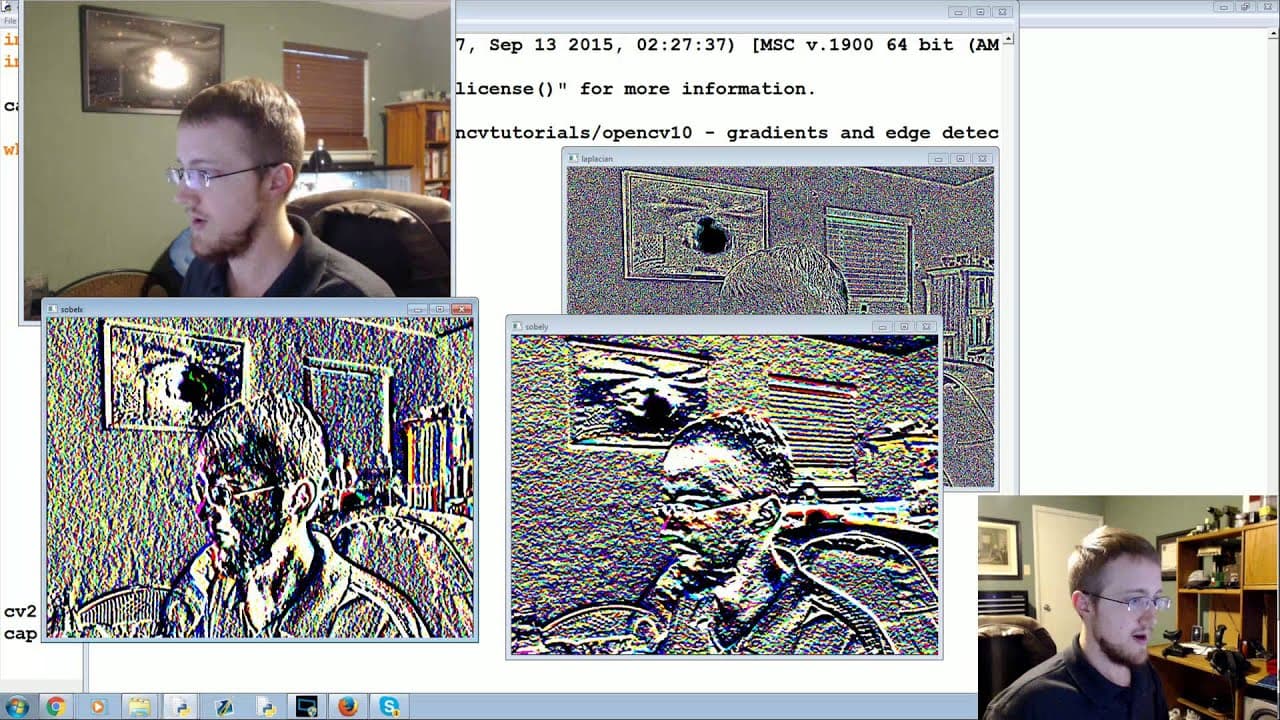
This tutorial provides an overview of how to apply gradients and perform edge detection using OpenCV with Python.

Transcript

what's going on everybody welcome to another open CV with python tutorial in this tutorial we're going to be talking about gradients as well as edge detection so let's go ahead and get started we are already have basically some stuff going on in in here that we really don't actually need anymore so I'm going to go ahead and remove all of this basic... Read More

Key Insights

  • 🦔 Gradients can be applied to images to determine directional intensity and identify edges.
  • 💻 Laplacian, Sobel X, and Sobel Y gradients are commonly used in computer vision applications.
  • 🦔 The canny edge detector allows for adjustable noise levels and is useful for identifying edges in images.
  • 🦔 Shadows and obstructions in images can sometimes be detected as edges by the edge detector.
  • ❓ Template matching is a more suitable method for object recognition tasks.

Install to Summarize YouTube Videos and Get Transcripts

Explore YouTube Video Summarizer or Get YouTube Transcript Extractor

Questions & Answers

Q: What is the purpose of applying gradients to an image?

Gradients provide information about the directional intensity in an image, making it possible to identify edges and other features.

Q: How can the canny edge detector be used to adjust noise levels?

By changing the parameters of the canny edge detector, such as the size of the region, noise levels in the resulting edge detection can be controlled.

Q: Are there alternative methods for edge detection?

Yes, there are multiple edge detection techniques available, with the canny edge detector being one of the most commonly used methods.

Q: Can gradients and edge detection be used for object recognition?

While gradients and edge detection provide useful information, there are other techniques, such as template matching, that are better suited for object recognition tasks.

Summary & Key Takeaways

  • The tutorial begins by removing unnecessary code and setting up the frame for analysis.

  • Gradients, including laplacian, Sobel X, and Sobel Y gradients, are applied to the frame to determine directional intensity.

  • The canny edge detector is used to identify edges in the frame, with the ability to adjust noise levels.


Read in Other Languages (beta)

English

Share This Summary 📚

Summarize YouTube Videos and Get Video Transcripts with 1-Click

Download browser extensions on:

Try YouTube Summary with ChatGPT & Claude or YouTube Transcript Generator

Explore More Summaries from sentdex 📚
Parsing XML - Go Lang Practical Programming Tutorial p.11 thumbnail
Parsing XML - Go Lang Practical Programming Tutorial p.11
sentdex
Python Generator Functions for massive Performance Improvements with Lists thumbnail
Python Generator Functions for massive Performance Improvements with Lists
sentdex
How to Train a Chatbot Using TensorFlow and Python thumbnail
How to Train a Chatbot Using TensorFlow and Python
sentdex
Python: How to Program the Chaikin Money Flow Trading Indicator thumbnail
Python: How to Program the Chaikin Money Flow Trading Indicator
sentdex
Python: How to Graph the Chaikin Money Flow Trading Indicator in Matplotlib thumbnail
Python: How to Graph the Chaikin Money Flow Trading Indicator in Matplotlib
sentdex
How to Parse Twitter for Twitter Analysis: Part 1 thumbnail
How to Parse Twitter for Twitter Analysis: Part 1
sentdex

Summarize YouTube Videos and Get Video Transcripts with 1-Click

Download browser extensions on:

Try YouTube Summary with ChatGPT & Claude or YouTube Transcript Generator

Apps & Extensions

  • Chrome Extension
  • Safari Extension
  • Edge Add-ons
  • Firefox Add-ons
  • iOS App
  • Android App

Key Features

  • YouTube Video Summarizer
  • Web & PDF Summarizer
  • Web & PDF Highlighter
  • Chat with PDF
  • Ask AI Clone
  • Audio Transcriber
  • Glasp Reader
  • Kindle Highlight Export
  • Idea Hatch

Integrations

  • Obsidian Plugin
  • Notion Integration
  • Pocket Integration
  • Instapaper Integration
  • Medium Integration
  • Readwise Integration
  • Snipd Integration
  • Hypothesis Integration

More Features

  • APIs
  • MCP Connector
  • Blog & Post
  • Embed Links
  • Image Highlight
  • Personality Test
  • Quote Shots

Company

  • About us
  • Blog
  • Community
  • FAQs
  • Job Board
  • Newsletter
  • Pricing
Terms

•

Privacy

•

Guidelines

© 2026 Glasp Inc. All rights reserved.