How Chatbase Bootstrapped Its Way to $10M ARR
TL;DR
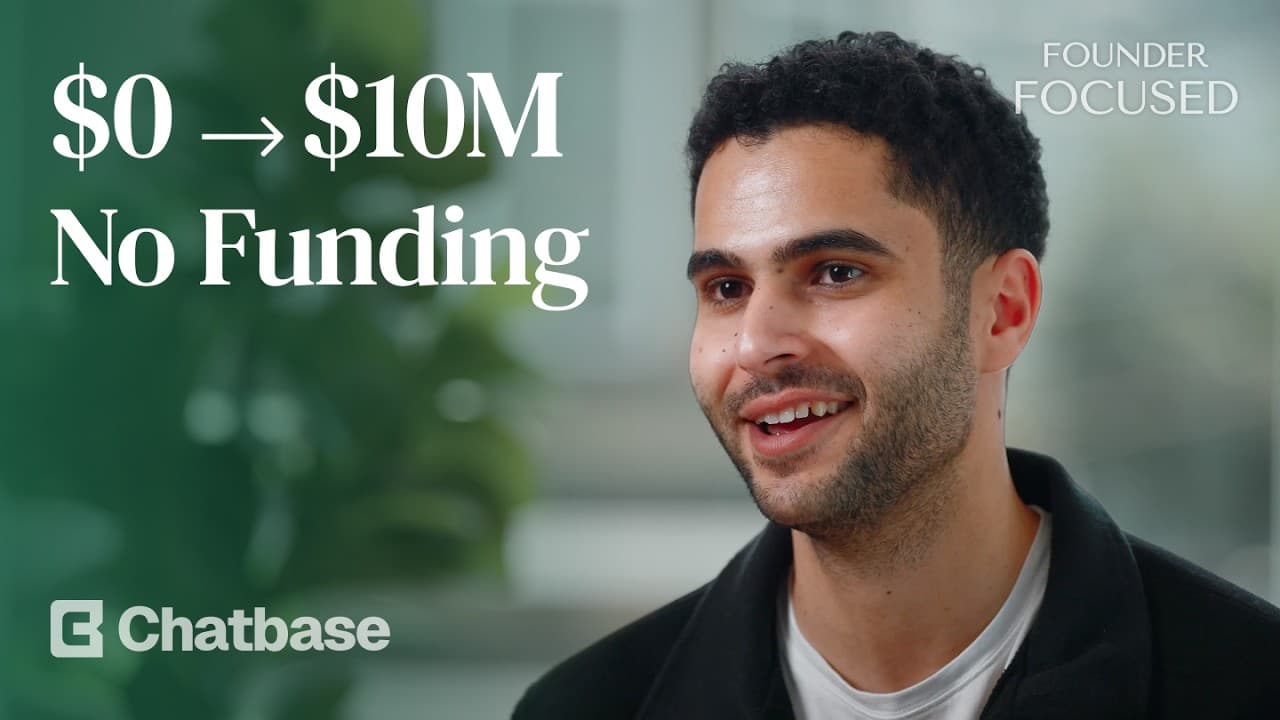
Chatbase reached $1 million ARR in 117 days and later grew to $10 million ARR without external funding. Yasser Elsaid attributes the company’s trajectory to rapid customer validation, skills developed through repeated small projects, close attention to customers, and a shift from extreme cost efficiency toward calculated risks, experiments, and hiring strong people once revenue became dependable.
Transcript
We started now close to 3 years ago. I launched I think at like 1:00 p.m. I got my first customer 30 minutes after that. I think 10 minutes after I got the second person, maybe an hour after I got the third person. At this moment, I knew that I need to stop everything else I'm doing in life. We did 1 million ARR in exactly 117 days. We've been grow... Read More
Key Insights
- Chatbase reached $1 million ARR in exactly 117 days and later grew to $10 million ARR while remaining bootstrapped. The company accepted no external funding, leaving Elsaid and his team in control of its direction and enabling them to prioritize customers directly.
- Early customer demand is a powerful signal of product potential. Elsaid received his first customer 30 minutes after launching, followed by a second roughly 10 minutes later and a third about an hour afterward, convincing him to focus on Chatbase completely.
- Bootstrapping is valuable because it preserves control over product and company decisions. Elsaid says founders can listen primarily to customers and their team, while retaining greater freedom to define what a successful financial outcome means for themselves and other stakeholders.
- Excessive caution is a common mistake among bootstrap founders. Cost efficiency, profitability, and positive returns are useful early, but Elsaid argues that founders seeking substantial growth must eventually accept risk, fund uncertain experiments, and hire talented people even when they appear expensive.
- AI tools make high-revenue companies with smaller teams more feasible. Elsaid expects more bootstrapped businesses with roughly 10 to 50 people because AI can assist with coding, customer support, and marketing while increasing revenue generated per employee.
- Repeatedly building small projects develops entrepreneurial skill, confidence, and judgment. Elsaid says those projects prepared him for Chatbase more directly than his Tesla and Facebook internships because they required turning ideas into products and gaining validation from paying customers.
- Starting a company is the most direct way to learn company building. Elsaid views an early solo business as similar to an individual sport because the founder controls the work, decisions, and preparation, making outcomes closely connected to personal inputs.
- Chatbase originated from a limitation in general language models. Elsaid recognized that they lacked information specific to an individual or company, so his initial product let users upload a textbook or book and hold a conversation with its content.
- More videos from this channel:
- More from this channel: EO
Install to Summarize YouTube Videos and Get Transcripts
Explore YouTube Video Summarizer or Get YouTube Transcript Extractor
Questions & Answers
Q: How did Chatbase reach $1 million ARR so quickly?
Chatbase reached $1 million ARR in exactly 117 days after receiving strong customer validation immediately after launch. Elsaid gained his first customer within 30 minutes, another roughly 10 minutes later, and a third about an hour after that. Those early purchases convinced him to stop his other activities and concentrate fully on the product, connecting sustained effort to already visible demand.
Q: Why did Yasser Elsaid bootstrap Chatbase instead of raising funding?
Elsaid bootstrapped Chatbase because retaining control allowed him to listen primarily to customers and his team while building what he wanted to build. He also believes external funding changes the definition of a successful outcome once a founder signs a term sheet. Remaining independent made an outcome serving himself, the team, and customers seem more achievable, while also making company building more enjoyable for him.
Q: What is the biggest mistake bootstrap founders make?
The biggest mistake is remaining excessively cautious after the business has dependable revenue. Elsaid says an early focus on profitability, efficiency, cash reserves, and positive returns makes sense, but it can later restrict growth. Founders with larger ambitions need to accept calculated risks, run experiments that might not produce immediate returns, and avoid delaying the recruitment of strong people simply because they are expensive.
Q: How do AI tools make bootstrapping more practical?
AI tools make bootstrapping more practical by helping small teams perform work across coding, customer support, and marketing. Elsaid believes these capabilities reduce the need for teams as large as companies previously required. He expects more bootstrapped businesses with roughly 10 to 50 employees and much higher revenue per employee, creating an operating model that can support substantial revenue without outside funding.
Q: How did Yasser Elsaid become interested in building companies?
Elsaid studied computer science in Canada and initially pursued the common goal of obtaining major technology internships in California. He interned at Tesla and Facebook but found the environment too safe and structured for his preferences. Watching independent builders turn ideas into products, share them publicly, and receive validation through customer payments gave him a stronger sense of freedom, purpose, and meaning.
Q: Why are small projects useful preparation for founding a company?
Small projects teach founders how to transform an idea into something real and place it before potential customers. Elsaid says repeating this process develops practical skills, increases confidence, and improves the ability to identify stronger product ideas. He found those lessons more relevant to building Chatbase than his experience at larger companies, whose structures, goals, and working dynamics differed substantially from an early startup.
Q: How did the original idea for Chatbase emerge?
The idea emerged while Elsaid was building other products with AI before ChatGPT launched. Working directly in the field exposed gaps that were less visible from the outside. He noticed that general language models were trained on broad information but lacked data specific to a person, company, or customer. His first implementation allowed someone to upload a textbook or book and then chat with it.
Q: What mindset does Yasser Elsaid recommend for solo founders?
Elsaid recommends treating early company building like an individual sport, where preparation and performance depend heavily on the individual. A solo founder controls the inputs, including effort and decisions, so the resulting output is closely tied to those choices. He found comfort in believing he could influence his own outcome through intelligence, energy, and conviction, rather than separating those qualities from the result.
Summary & Key Takeaways
-
Yasser Elsaid launched Chatbase and gained his first customer within 30 minutes, followed quickly by additional buyers. That immediate validation convinced him to stop his other activities and focus completely on the product. Chatbase reached $1 million ARR in exactly 117 days and later grew to $10 million ARR without external funding.
-
Elsaid chose bootstrapping because it preserved control and allowed the company to listen primarily to customers and its team. He argues that AI tools make smaller, highly productive companies increasingly feasible by assisting with coding, customer support, and marketing, reducing the need for the larger teams companies previously required.
-
Chatbase began from a gap Elsaid noticed while building other AI projects before ChatGPT launched. General language models lacked information specific to a person or company, so the first version allowed users to upload a textbook or book and chat with it. Repeated project-building helped him recognize and pursue that opportunity.
Read in Other Languages (beta)
Share This Summary 📚
Summarize YouTube Videos and Get Video Transcripts with 1-Click
Try YouTube Summary with ChatGPT & Claude or YouTube Transcript Generator
Explore More Summaries from EO 📚
Summarize YouTube Videos and Get Video Transcripts with 1-Click
Try YouTube Summary with ChatGPT & Claude or YouTube Transcript Generator