Marginal distribution and conditional distribution | AP Statistics | Khan Academy
TL;DR
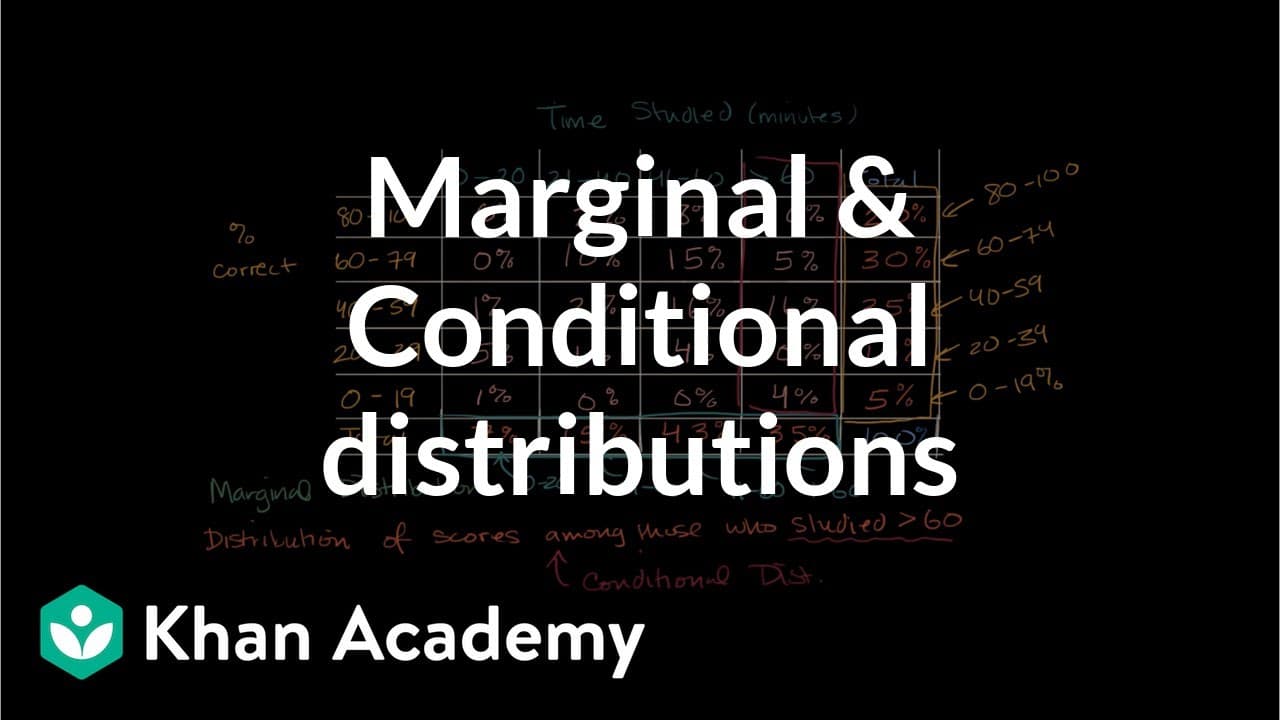
This video explains the concepts of joint, marginal, and conditional distributions in statistics through the example of a professor analyzing the relationship between study time and test scores.
Transcript
- [Instructor] Let's say we're a professor at a university of a statistics class and we administer an exam and we're curious about the relationship between the amount of time that students study and the percent that they get correct on the test. So, what we do is we grade all of the exams. We set up these buckets. The time studied, zero to 20 minut... Read More
Key Insights
- ❓ Joint distribution analyzes the relationship between two variables.
- 🤨 Marginal distribution provides the distribution of one variable by totaling up the rows or columns of a two-way table.
- ⚾ Conditional distribution explores the distribution of one variable based on the categories of another variable.
- 🆘 Marginal and conditional distributions help gain insights into specific aspects of data analysis.
Install to Summarize YouTube Videos and Get Transcripts
Explore YouTube Video Summarizer or Get YouTube Transcript Extractor
Questions & Answers
Q: What is a joint distribution in statistics?
A joint distribution in statistics refers to the relationship between two variables, where the categories or buckets of both variables are analyzed together.
Q: How is marginal distribution calculated?
Marginal distribution can be calculated by totaling up the rows or columns of a two-way table, representing the distribution of just one variable without considering the other variable.
Q: What is a conditional distribution?
A conditional distribution in statistics involves looking at the distribution of one variable based on the category or bucket of another variable. It provides insights into how one variable is distributed within specific categories of another variable.
Q: How can conditional distribution be useful in statistical analysis?
Conditional distribution allows researchers to analyze how the distribution of one variable changes when conditioned on different categories or values of another variable. It helps identify relationships and patterns between variables.
Summary & Key Takeaways
-
The video introduces the concept of joint distribution in statistics, which analyzes the relationship between two variables (time studied and percent correct on a test).
-
It explains how marginal distribution can be calculated by totaling up the rows or columns of a two-way table to get the distribution of just one variable (percent correct or time studied).
-
The video also discusses conditional distribution, which involves looking at the distribution of one variable based on the category or bucket of another variable.
Read in Other Languages (beta)
Share This Summary 📚
Summarize YouTube Videos and Get Video Transcripts with 1-Click
Try YouTube Summary with ChatGPT & Claude or YouTube Transcript Generator
Explore More Summaries from Khan Academy 📚




Summarize YouTube Videos and Get Video Transcripts with 1-Click
Try YouTube Summary with ChatGPT & Claude or YouTube Transcript Generator