Synthetic division | Polynomial and rational functions | Algebra II | Khan Academy
TL;DR
Synthetic division is a technique used to simplify polynomial expressions, offering advantages such as speed and space efficiency compared to traditional long division.
Transcript
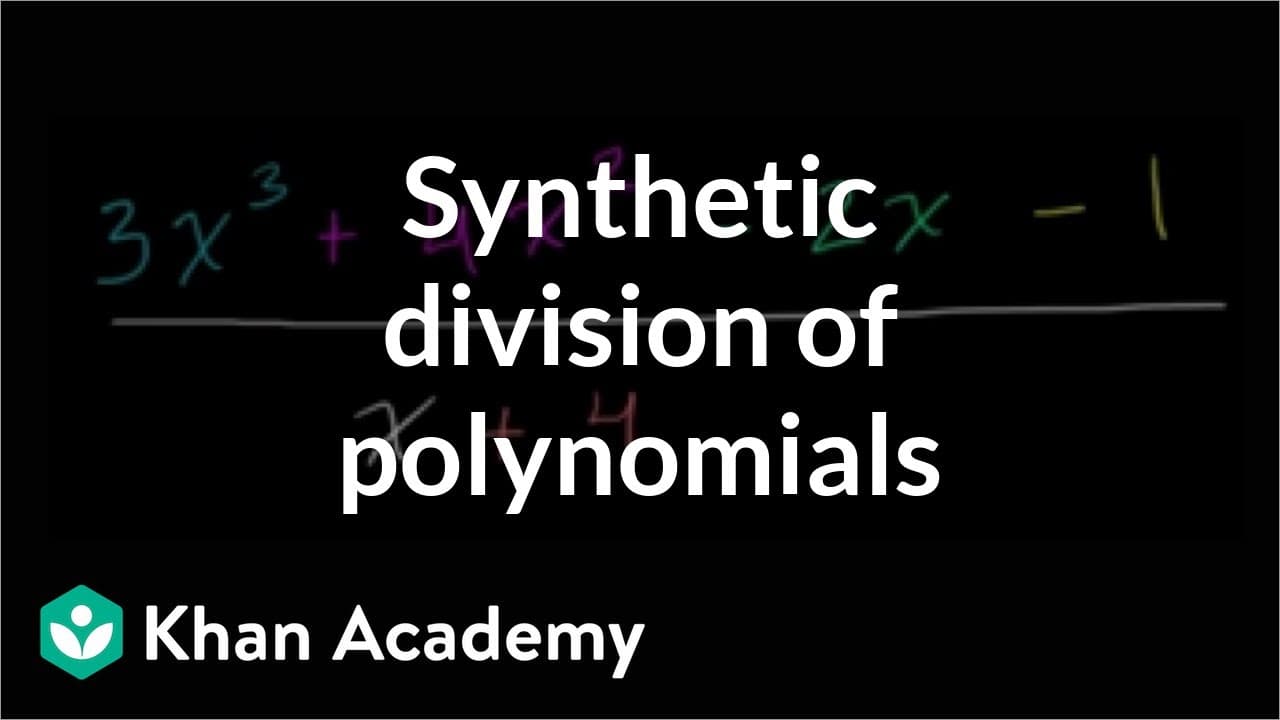
In this expression, we're dividing this third degree polynomial by this first degree polynomial. And we could simplify this by using traditional algebraic long division. But what we're going to cover in this video is a slightly different technique, and we call it synthetic division. And synthetic division is going to seem like a little bit of voodo... Read More
Key Insights
- ➗ Synthetic division is a voodoo-like technique that simplifies polynomial expressions by dividing a higher-degree polynomial by a first-degree polynomial.
- 💁 The most basic form of synthetic division requires the denominator polynomial to have a coefficient of 1 and be of degree 1.
- 😑 Synthetic division involves writing the coefficients, multiplying and adding, and separating out the answer to get the simplified expression.
- 👾 This technique is algorithmic and can be faster and more space-efficient than traditional long division.
- 💪 Synthetic division works for polynomials in the form of x plus or minus something.
- 😑 The remainder obtained in synthetic division is presented as a fraction and considered part of the simplified expression.
- 🔨 Synthetic division is a useful tool for solving polynomial equations and finding zeros of polynomials.
Install to Summarize YouTube Videos and Get Transcripts
Explore YouTube Video Summarizer or Get YouTube Transcript Extractor
Questions & Answers
Q: What is synthetic division?
Synthetic division is a technique used to simplify polynomial expressions by dividing a polynomial of degree 3 or higher by a polynomial of degree 1. It is a faster and more space-efficient alternative to traditional long division.
Q: What are the requirements for using synthetic division?
The polynomial in the denominator must have a coefficient of 1 and be of degree 1. If the coefficient is different or the degree is higher, additional steps are required for synthetic division.
Q: How is synthetic division performed?
Synthetic division involves writing the coefficients of the numerator polynomial and the negative of the coefficient of the denominator polynomial. Multiplication, addition, and moving down the row of coefficients are performed to simplify the expression.
Q: What are the advantages of synthetic division?
Synthetic division is faster and uses less paper space compared to traditional long division. It offers a more algorithmic approach for simplifying polynomial expressions.
Summary & Key Takeaways
-
Synthetic division is a method used to simplify polynomial expressions by dividing a polynomial of degree 3 or higher by a polynomial of degree 1.
-
The basic form of synthetic division requires the polynomial in the denominator to have a coefficient of 1 and be of degree 1.
-
To perform synthetic division, the coefficients of the numerator polynomial are written and the negative of the coefficient of the denominator polynomial is used. The process involves multiplication, addition, and moving down the row of coefficients.
Read in Other Languages (beta)
Share This Summary 📚
Summarize YouTube Videos and Get Video Transcripts with 1-Click
Try YouTube Summary with ChatGPT & Claude or YouTube Transcript Generator
Explore More Summaries from Khan Academy 📚



Summarize YouTube Videos and Get Video Transcripts with 1-Click
Try YouTube Summary with ChatGPT & Claude or YouTube Transcript Generator