What Is Tau and Why Is It Better Than Pi?
TL;DR
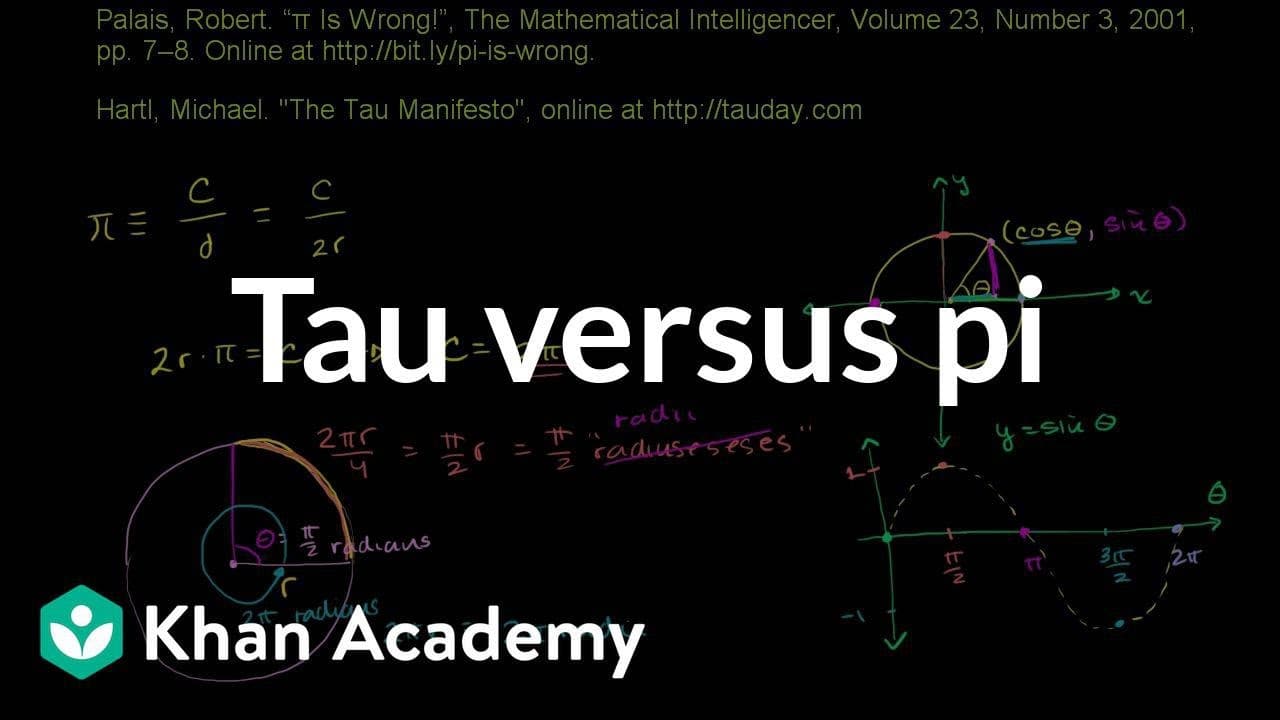
Tau, defined as 2 times pi, is considered a more intuitive way to measure angles since one complete revolution corresponds directly to tau radians. This eliminates the need for conversions used in the traditional pi-based system, simplifying calculations and making relationships between angles and arcs clearer, especially in trigonometry and calculus.
Transcript
What I want to do in this video is revisit a little bit of what we know about pi, and really how we measure angles in radians. And then think about whether pi is necessarily the best number to be paying attention to. So let's think a little bit about what I just said. So pi, we know, is defined-- and I'll write defined as a triple equal sign, I gue... Read More
Key Insights
- ✖️ The traditional measurement of angles in radians involves converting between radians and revolutions by multiplying or dividing by 2, which can be less intuitive.
- 🍉 Measuring angles in terms of tau eliminates the need for conversion and provides a direct relationship between radians and revolutions.
- 💁 Tau, being 2 times pi, offers a more elegant form of measurement that simplifies calculations and graphing trigonometric functions.
- ♉ Tau can be used in formulas, such as Euler's formula, to create more concise and profound representations of mathematical concepts.
Install to Summarize YouTube Videos and Get Transcripts
Explore YouTube Video Summarizer or Get YouTube Transcript Extractor
Questions & Answers
Q: How is pi traditionally defined?
Pi is traditionally defined as the ratio of the circumference of a circle to its diameter, or the circumference to 2 times the radius.
Q: How are angles in radians measured?
Angles in radians are measured by the length of the arc subtended by the angle, with the arc length being in terms of the radius.
Q: What is tau and how is it related to pi?
Tau is defined as 2 times pi, or tau = 2pi. It is proposed as a more intuitive way to measure angles, as one revolution around the unit circle is equal to tau radians.
Q: What is the significance of measuring angles in terms of tau instead of pi?
Measuring angles in terms of tau simplifies the conversions between radians and revolutions around the unit circle, making it more intuitive to determine angle measures.
Summary & Key Takeaways
-
Pi is defined as the ratio of the circumference of a circle to its diameter, or the circumference to 2 times the radius.
-
Angles in radians are measured by the length of an arc subtended by the angle, with the arc length being in terms of the radius or "radiusi."
-
Tau, defined as 2 times pi, is proposed as a more intuitive way to measure angles, as one revolution around the unit circle is equal to tau radians.
Read in Other Languages (beta)
Share This Summary 📚
Summarize YouTube Videos and Get Video Transcripts with 1-Click
Try YouTube Summary with ChatGPT & Claude or YouTube Transcript Generator
Explore More Summaries from Khan Academy 📚



Summarize YouTube Videos and Get Video Transcripts with 1-Click
Try YouTube Summary with ChatGPT & Claude or YouTube Transcript Generator