What Is the Science Behind Effective Storytelling?
TL;DR
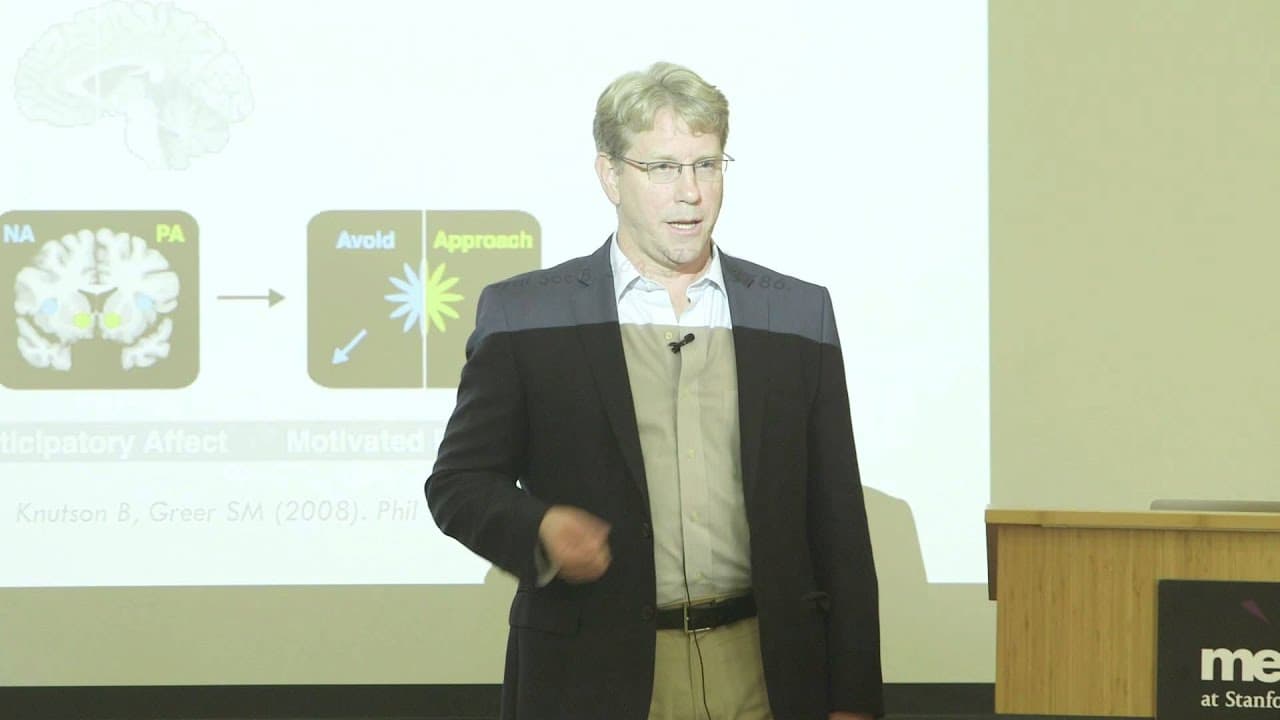
The science of effective storytelling hinges on understanding how the brain responds to anticipation and uncertainty. Research using fMRI shows that cultivating a hopeful uncertainty, rather than a clear conclusion, engages audiences more effectively. This approach can predict decision-making and influence behavior, suggesting a blend of scientific insight and narrative technique can enhance storytelling impact.
Transcript
[MUSIC] And I'm really happy to introduce Brian Knutson who's Associate Professor of Psychology in Neuroscience at Stanford University. He studies the way the brain works and how that translates into emotion, including perhaps, suspense, and is going to bring what's inside your and my heads now, and when we're listening to stories alive by talking ... Read More
Key Insights
- 🧠 New technologies like fMRI have revolutionized the study of the brain's response to anticipation, allowing researchers to observe activity deep within the brain at a high resolution.
- 🧠 Understanding how the brain anticipates events and influences decision-making is crucial for predicting and influencing human behavior in various contexts.
- 🙂 Affective neuroscience, the study of brain mechanisms involved in anticipation, is a growing field that can shed light on emotions and decision-making processes.
- 🤗 Brain activity patterns during anticipation can be used to predict whether individuals are more likely to approach or avoid certain options, opening up possibilities for applications like marketing and decision-making predictions.
- 🤪 Effective storytelling involves cultivating uncertainty and incorporating positive gains that are significant to the audience, going against traditional scientific storytelling methods of straightforward hypothesis and conclusion presentation.
- 🥺 The combination of science and storytelling can lead to more engaging and impactful communication, enabling scientists to effectively convey complex concepts and motivate action.
Install to Summarize YouTube Videos and Get Transcripts
Explore YouTube Video Summarizer or Get YouTube Transcript Extractor
Questions & Answers
Q: How can studying the brain's response to anticipation improve storytelling?
Studying how the brain anticipates events can help improve storytelling by understanding which elements, such as positive gains and uncertainty, engage the audience and make the story more effective. This knowledge can be used to craft narratives that captivate and motivate action.
Q: How does brain activity during anticipation differ from decision-making?
Brain activity during anticipation may not always directly influence decision-making. While various neural processes occur during anticipation, only some may actually shape subsequent choices. Understanding the relationship between anticipation and decision-making is crucial for predicting and influencing human behavior.
Q: What types of situations can brain activity during anticipation be applied to?
Anticipatory brain activity can be applied to various situations, including shopping, making financial decisions, and social choices. By analyzing brain activity patterns, researchers can predict whether individuals are more likely to approach or avoid certain options, enabling better understanding and manipulation of decision-making processes.
Q: How can uncertainty and positive gains be effectively used in storytelling?
According to the speaker, effective storytelling should cultivate a hopeful uncertainty by not stating conclusions outright and engaging the audience through dynamic uncertainty. Additionally, including positive gains that hold significance for the audience can make the story more engaging and motivate action.
Summary & Key Takeaways
-
The speaker discusses the importance of studying the brain's response to anticipation in storytelling and how it can make storytelling more effective.
-
New technologies like functional magnetic resonance imaging (fMRI) allow scientists to study brain activity in real-time, providing insights into how the brain anticipates events and makes decisions.
-
Two sets of questions are explored: which brain mechanisms anticipate good and bad events, and does anticipatory brain activity influence choice and decision-making.
Read in Other Languages (beta)
Share This Summary 📚
Summarize YouTube Videos and Get Video Transcripts with 1-Click
Try YouTube Summary with ChatGPT & Claude or YouTube Transcript Generator
Explore More Summaries from Stanford 📚



Summarize YouTube Videos and Get Video Transcripts with 1-Click
Try YouTube Summary with ChatGPT & Claude or YouTube Transcript Generator