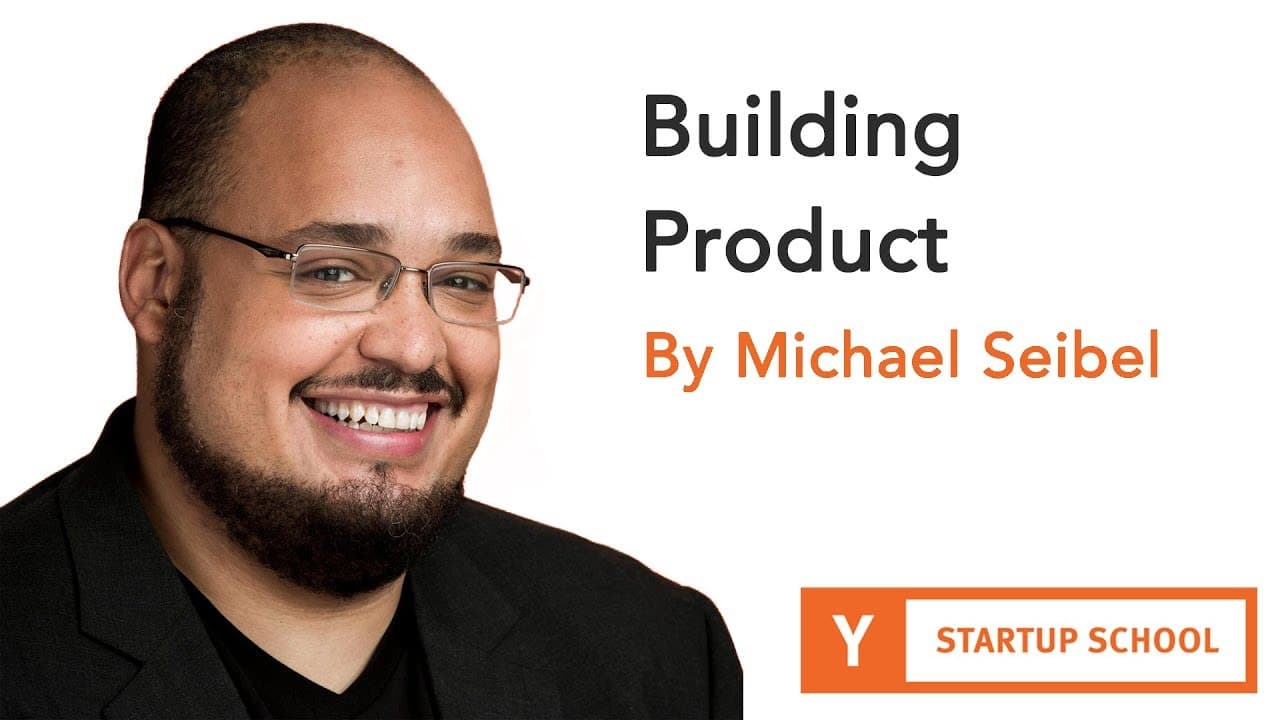
How Does Michael Seibel Build Products at Y Combinator, Justin.tv, and Twitch?
TL;DR
Michael Seibel’s product-building method starts with defining the customer’s problem clearly, then validating the solution through customer engagement, metrics, and rapid iteration. Drawing on Justin.tv, Twitch, Socialcam, and Poppy, he explains why founders should target customers with urgent, frequent problems and establish a clear KPI such as revenue or user engagement. Read on for practical guidance on validation, measurement, pricing, and iteration.
Transcript
without any further delay I will introduce to you Michael Seibel the CEO of Y Combinator the founder of companies like justin.tv and twitch and Socialcam to begin what is going to be a deep dive into product over the next several lectures Michael so before I begin its kind of had a conversation with Jeff and I and I wanted to say a couple of things... Read More
Key Insights
- 🔮 The founding team of companies like justin.tv and twitch broke many rules but were able to succeed because of their technical expertise, low spending, and strong emotional commitment to their startup.
- 💡 Understanding the problem you are solving is crucial for startups. At justin.tv, the initial problem was entertainment, and then it shifted to enabling anyone to broadcast live on the internet. Startups need to clearly define the problem they are solving and make sure they can solve it.
- 💼 Startups need to identify their target customers and understand their needs. It is important to focus on the most desperate customers who have a high frequency and intensity of the problem the startup is solving.
- 💸 Startups should consider charging customers from the beginning, as it helps to validate their solution and determine if customers are willing to pay for it. Offering free products may attract users, but it can lead to difficulties in monetization.
- 📊 Setting up metrics is essential for startups to measure success and make data-driven decisions. Google Analytics may be useful for basic metrics, but more in-depth analytics tools like Mixpanel or Amplitude are recommended for tracking user actions and engagement.
- 🔄 Iteration is a key part of the product development process. Startups should continuously iterate their product based on user feedback and constantly strive to improve key metrics. It is important to have a structured product development cycle and prioritize easy, medium, and hard tasks to maximize productivity.
- 👥 Startups should focus on finding and listening to their target customers, rather than relying on their own ideas. Engaging with users and building what they want increases customer satisfaction and loyalty.
- 📈 Startups should have a clear key performance indicator (KPI) that reflects the success of the business, whether it is revenue or user engagement. Revenue is typically the most important KPI, but other metrics like user retention or frequency of use can also be valuable. ⏰ Startups should be prepared for a slow burn and be patient. Building a successful startup takes time, and founders should be willing to iterate, pivot, and adjust their strategy over the long term.
- ❌ Avoid being a "fake Steve Jobs" who thinks they have all the answers and their ideas are perfect. Instead, be open to feedback, iterate on the product, and focus on solving real problems for real customers.
Install to Summarize YouTube Videos and Get Transcripts
Explore YouTube Video Summarizer or Get YouTube Transcript Extractor
Questions & Answers
Q: What is Michael Seibel’s approach to building a successful product?
Start by stating the problem clearly, ideally in one sentence, and identify the customers who experience it most intensely and frequently. Then engage those customers, establish a clear KPI, and iterate quickly using feedback and behavioral data.
Q: Why must founders define the problem before building a solution?
If founders do not know the problem, they cannot determine whether they have solved it. Seibel says a founder should be able to state the problem clearly in two sentences, and ideally one, rather than delivering an essay.
Q: How did the problem addressed by Justin.tv change after its pivot?
Justin.tv initially aimed to provide entertainment through Justin’s live, 24/7 broadcast, so success could be judged by whether anyone watched. After the company pivoted to an open platform, its problem became enabling anyone to broadcast live on the internet, which could be evaluated by whether people successfully used the platform.
Q: What three factors helped the Justin.tv and Twitch founding team survive mistakes?
Seibel identifies three essential factors: an extremely technical founding team, very low spending, and a strong emotional connection between the founders and their startup. He says the company needed all three and would have died if any one had been removed.
Q: How did technical expertise help the Justin.tv and Twitch founders?
Justin, Emmett, and Kyle were not intimidated by technical challenges, which gave the team room to break many conventional startup rules. Seibel credits the privilege of working with this highly technical team as a major reason the company survived.
Q: How did low spending give the founders more time to succeed?
The four founders lived in a two-bedroom apartment costing $2,500 per month and each received $500 per month in spending money. Because they spent so little, they had more capacity to make mistakes without immediately exhausting the company’s resources.
Q: Why should startups consider charging customers early?
Charging early tests whether customers value the solution enough to pay for it. Free products may attract users, but the existing guidance warns that they can create later monetization difficulties.
Q: Which metrics should a startup use to guide product iteration?
A startup should choose a clear KPI that reflects business success, typically revenue or user engagement. Basic measurement can use Google Analytics, while Mixpanel or Amplitude can track user actions and engagement in greater depth; the resulting data should guide continued product iteration.
Summary & Key Takeaways
-
Michael Seibel shares insights from his experience in building successful startups, including justin.tv and twitch.
-
The three key factors that allowed their companies to thrive were a highly technical founding team, low spending, and a strong emotional connection to their startup.
-
He emphasizes the importance of understanding the problem being solved, the target customer, the frequency and intensity of the problem, and the willingness of customers to pay.
-
Setting up metrics and iterating quickly are crucial in the product development process, along with listening to and involving customers.
-
Seibel highlights the importance of having a clear KPI and focusing on revenue or user engagement, depending on the business model.
-
The talk concludes with the reminder that success in building a startup requires iterative thinking, customer-focused solutions, and dedication to solving a real problem.
Read in Other Languages (beta)
Share This Summary 📚
Summarize YouTube Videos and Get Video Transcripts with 1-Click
Try YouTube Summary with ChatGPT & Claude or YouTube Transcript Generator
Explore More Summaries from Y Combinator 📚






Summarize YouTube Videos and Get Video Transcripts with 1-Click
Try YouTube Summary with ChatGPT & Claude or YouTube Transcript Generator