How Do Trees Defy Gravity to Transport Water?
TL;DR
Trees transport water to their leaves by creating negative pressures in their xylem tubes, reaching up to -15 atmospheres. This negative pressure allows trees to move water against gravity over 100 meters despite the natural limit of 10 meters in a standard tube. Most of the water absorbed is eventually evaporated, with less than 5% used for growth or photosynthesis.
Transcript
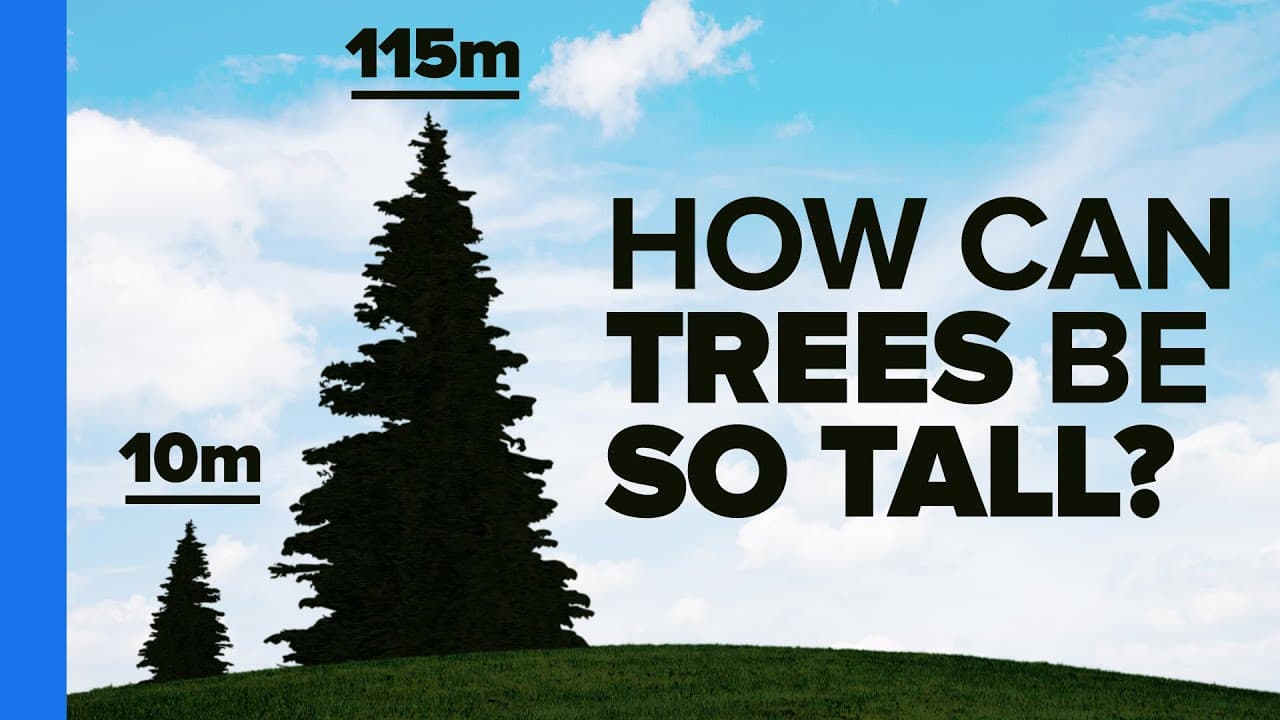
Sometimes the simplest questions have the most amazing answers. Like how can trees be so tall? It's a question that doesn't even seem like it needs an answer. Trees just are tall. Some of them are over 100 meters. Why should there be a height limit? I'll tell you why. Tress need to transport water from their roots up into their topmost branches in ... Read More
Key Insights
- 💦 Trees transport water through negative pressures, creating immense suction in their xylem tubes.
- 🫗 The assumption that the lowest pressure in a liquid is a pure vacuum is incorrect; in a liquid, negative pressures can be achieved.
- 💦 The water's high surface tension and the tiny size of the pores in the xylem tubes allow trees to maintain a continuous water column without the meniscus breaking.
- 💦 Most of the water transported by trees evaporates in the process of absorbing carbon dioxide, while only a small percentage is used for photosynthesis or growth.
Install to Summarize YouTube Videos and Get Transcripts
Explore YouTube Video Summarizer or Get YouTube Transcript Extractor
Questions & Answers
Q: How do trees transport water from their roots to their leaves?
Trees use a mechanism called transpiration, where water evaporates from the leaves, pulling up water molecules behind it. This mechanism creates suction but does not overcome the 10-meter height limit.
Q: How do trees create a pressure difference of 10 atmospheres to raise water 100 meters?
Trees do not contain continuous straw-like tubes but rather have cells that make up the xylem tubes. These tubes contain a continuous water column, and the tree uses squeezing-like motion to transport water upwards.
Q: Can osmotic pressure explain how trees transport water?
Osmotic pressure occurs when solute concentration pushes water in a certain direction. However, some trees live in environments with salty water, where osmotic pressure acts in the opposite direction, requiring additional pressure to suck water into the tree.
Q: Can capillary action explain how water is transported in trees?
Capillary action allows water to climb higher in thinner tubes. However, the tubes in a tree are too wide for capillary action to account for its water transport, as water would rise less than a meter.
Summary & Key Takeaways
-
Trees transport water from their roots to their leaves to survive, and this process is not as simple as it seems.
-
The height that water can be transported vertically in a tube is limited to 10 meters, creating a challenge for taller trees.
-
Trees overcome this challenge by using negative pressures, with the water column in their xylem tubes reaching as low as -15 atmospheres.
Read in Other Languages (beta)
Share This Summary 📚
Summarize YouTube Videos and Get Video Transcripts with 1-Click
Try YouTube Summary with ChatGPT & Claude or YouTube Transcript Generator
Explore More Summaries from Veritasium 📚






Summarize YouTube Videos and Get Video Transcripts with 1-Click
Try YouTube Summary with ChatGPT & Claude or YouTube Transcript Generator