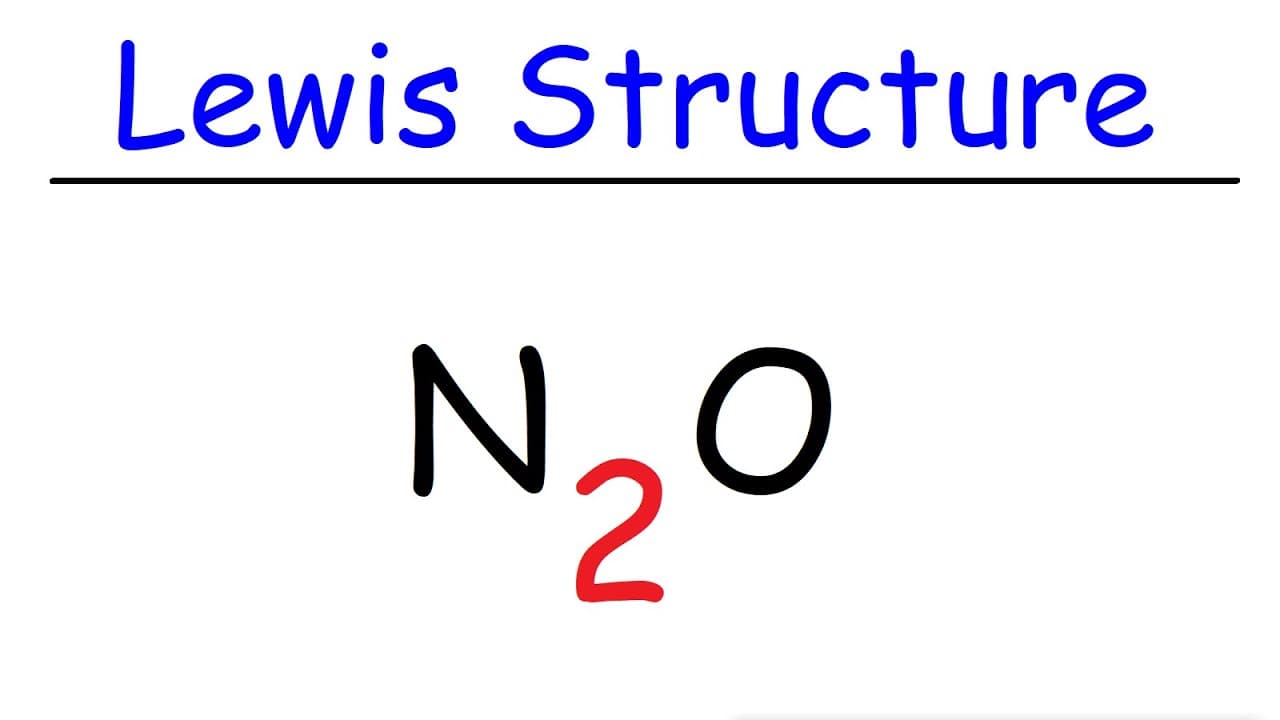
How to Draw the Lewis Structure of N2O (Nitrous Oxide)
TL;DR
To draw the Lewis structure of N2O, select nitrogen as the central atom, as it can form four bonds, while oxygen can only form two. Calculate the formal charges to determine the most stable resonance structure, ideally one that minimizes charge separation and places any negative charge on the more electronegative oxygen.
Transcript
in this video we're going to talk about how to draw the lewis structure of n2o nitrous oxide also known as dinitrogen monoxide so the first thing we're going to do is add up the number of valence electrons we have two nitrogen atoms and one oxygen atom in this molecule now nitrogen is found in group 5a of the periodic table and it therefore has fiv... Read More
Key Insights
- 🫀 The Lewis structure of N2O (nitrous oxide) is determined by choosing nitrogen as the central atom, which can form four bonds.
- 💁 Oxygen can only form two bonds due to the octet rule, limiting the possibilities for bonding in the molecule.
- 👔 Calculating formal charges for each atom helps determine the most stable Lewis structure, with the structure exhibiting the lowest formal charge separation being preferred.
- 🫀 The stability of a Lewis structure is influenced by the electronegativity of atoms, with more electronegative elements better able to stabilize charges.
- 👻 Formal charges provide information about the distribution of electrons within a molecule and allow for the determination of stable Lewis structures.
- 😐 The goal is to achieve a Lewis structure that is either neutral overall or neutral in individual atoms to maximize stability.
- 🫀 Different resonance structures of N2O can exist, but the most stable structure is the one with the negative charge on the more electronegative oxygen atom.
Install to Summarize YouTube Videos and Get Transcripts
Explore YouTube Video Summarizer or Get YouTube Transcript Extractor
Questions & Answers
Q: How do you determine the central atom when drawing the Lewis structure of N2O?
The central atom is determined by considering which element can form more bonds. In this case, nitrogen can form four bonds, while oxygen can only form two bonds. Thus, nitrogen is chosen as the central atom in the Lewis structure of N2O.
Q: Why can nitrogen only form a maximum of four bonds?
Nitrogen is in the second row of the periodic table and can only have a maximum of eight valence electrons. To achieve this, nitrogen can form three bonds, leaving a total of eight electrons in its outermost shell.
Q: How is the most stable Lewis structure of N2O determined?
The most stable Lewis structure is determined by analyzing the formal charges of each atom. The structure with the lowest formal charge separation is considered the most stable. In the case of N2O, the Lewis structure with a negative charge on the oxygen atom is preferred because oxygen is more electronegative and better able to stabilize the negative charge.
Q: What is the significance of formal charges in determining the stability of a Lewis structure?
Formal charges indicate the distribution of electrons within a molecule. The lower the formal charge separation, the more stable the Lewis structure. It is ideal to have a structure that is either neutral overall or neutral in individual elements to ensure stability.
Summary & Key Takeaways
-
The video explains the process of drawing the Lewis structure of N2O by determining the central atom and counting valence electrons.
-
The possibilities for bonding between nitrogen and oxygen are explored, considering the octet rule and the maximum number of bonds each element can form.
-
The concept of formal charge is introduced, and the video demonstrates how to calculate formal charges for each atom in the molecule to determine the most stable Lewis structure.
Read in Other Languages (beta)
Share This Summary 📚
Summarize YouTube Videos and Get Video Transcripts with 1-Click
Try YouTube Summary with ChatGPT & Claude or YouTube Transcript Generator
Explore More Summaries from The Organic Chemistry Tutor 📚


Summarize YouTube Videos and Get Video Transcripts with 1-Click
Try YouTube Summary with ChatGPT & Claude or YouTube Transcript Generator