Why Is the US Job Market Weakening in 2025?
TL;DR
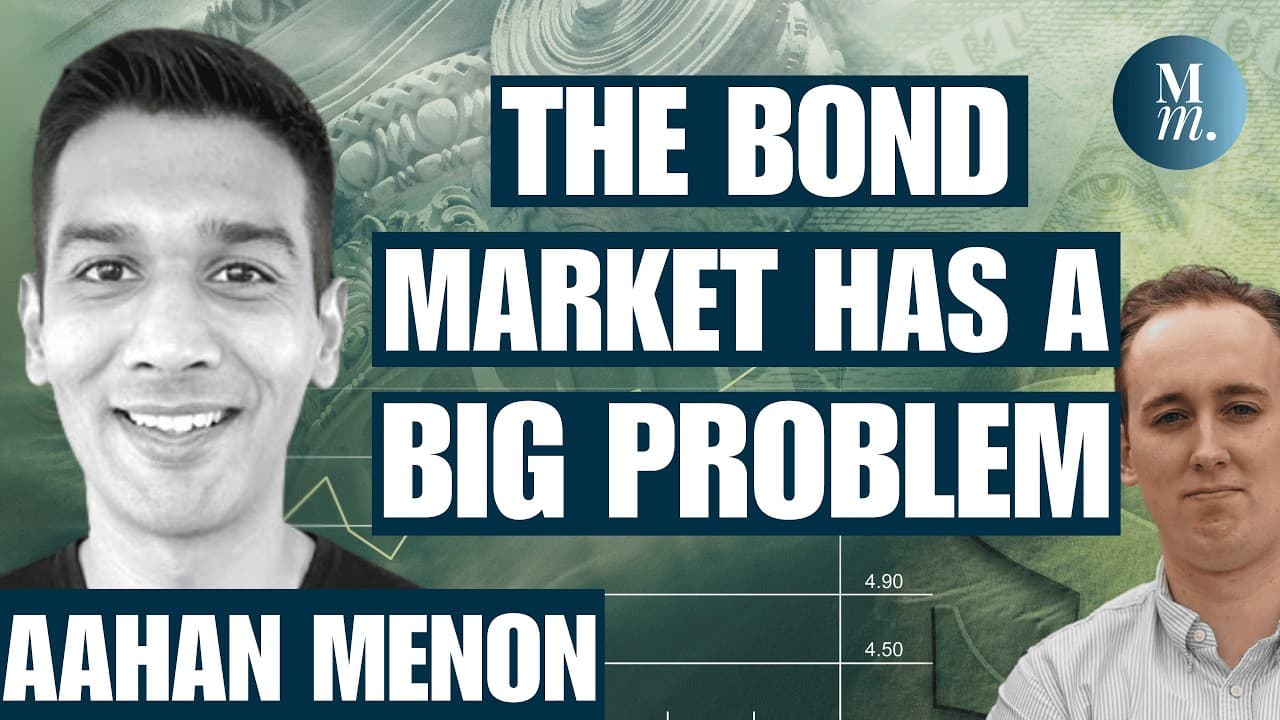
US labor market weakness stems from slowing immigration, a weak supply of workers rather than weak demand, according to Aahan Menon of Prometheus Macro. The broader economy remains in a business cycle expansion, with about 90% of consumer spending sectors expanding and technology investment driving disproportionate growth despite concentrated employment gains.
Transcript
the environment really really does look like it's a business cycle expansion. You look at the breadth of consumer spending if you aggregate all of the sectors that go into the personal consumption expenditures basket. About 90% of those sectors actually expanding, right? Which is again entirely inconsistent with any type of material slowing. What w... Read More
Key Insights
- The current business cycle is an expansion, supported by ongoing business investment, robust consumer spending, and the absence of very negative financial conditions. About 90% of the sectors in the personal consumption expenditures basket are actively expanding, which is inconsistent with any material economic slowing.
- Labor market weakness comes primarily from slowing immigration rather than weak labor demand, with a large part attributed to reduced illegal immigration. This makes it a supply-of-labor problem, placing the economy in a historically unique position not experienced before.
- Technology and intellectual property investment now anchor the business cycle, replacing the manufacturing and industrial activity that dominated over the last 60 to 80 years. This IP and information investment has been very stable, supporting corporate revenues and profits.
- Economic gains are highly concentrated rather than broadly distributed, with the tech sector expanding rapidly while employing a relatively small percentage of the population. Information and tech-related employment may even be modestly declining while sector spending keeps rising.
- AI-related capex contributes roughly 40 basis points to a headline real GDP number of about 1.4%, meaning this one small sector accounts for nearly 30% of total growth. This contribution is disproportionately large relative to the sector's size.
- Real intellectual property investment is less than 50 basis points of GDP, lower than in the 1990s when over 1% of yearly real GDP growth came from this category. The difference reflects a lower overall real GDP trend of roughly 1.5% today versus around 4% in the 90s.
- The composition of tech investment has shifted, with information processing equipment like computers becoming a smaller outlay as production grew more efficient, while intellectual property investment rose. This reshuffling plus lower aggregate GDP growth explains the smaller headline numbers.
- Tariffs caused consumption scares but not lasting damage, producing massive swings in durable goods and motor vehicle consumption. Numbers spiked around February and March 2025 when tariffs were announced, then reversed strongly when the tariffs did not materialize as expected.
Install to Summarize YouTube Videos and Get Transcripts
Explore YouTube Video Summarizer or Get YouTube Transcript Extractor
Questions & Answers
Q: What is the real reason the jobs market is weakening?
According to Aahan Menon of Prometheus Macro, the weakness in the labor market comes from slowing immigration, and he assumes a really big part of it is reduced illegal immigration. This makes it a weak supply of labor rather than weak demand for labor. He describes it as a unique spot the economy has not experienced before in history, since the broader economy still looks like a business cycle expansion with strong consumer spending and ongoing business investment.
Q: What business cycle is the US economy in right now?
Menon characterizes the current business cycle in one word: an expansion. He notes that early-year concerns about tariffs faded as tariffs deescalated and their mechanical impact proved smaller than feared. The consumer still seems fairly strong, spending is relatively robust, and businesses continue to invest, with a modest recent uptick in business investment. As long as investment and consumer spending continue and financial conditions are not very negative, the economy remains in a business cycle expansion, where it has been for a while.
Q: What is powering the current business cycle expansion?
Technology spending is at the center of what supports this business cycle, both in investment and consumption. Menon explains that over the last few decades the cycle shifted from manufacturing and industrial activity, which dominated for 60 to 80 years, toward intellectual property and information investment that has been very stable. Combined with resilient consumer spending on non-cyclical items like health care that do not cycle much with interest rates, this produces stable spending levels that translate into corporate revenues supporting corporate profits.
Q: Why is economic sentiment so negative when the data shows expansion?
Menon attributes the disconnect to concentration: the aggregate economy looks fine, but the gains are very concentrated in the technology sector, which employs a relatively small percentage of the population. Distribution is not the same as the aggregate. Depending on how you measure it, information and tech-related employment may even be modestly declining, yet spending in the sector keeps expanding rapidly. So while not all sectors are extremely strong, the concentrated economy reflects itself in a relatively stable aggregate, which clashes with widespread negative sentiment.
Q: How much does AI capex contribute to US GDP growth?
Menon estimates about 40 basis points of AI capex and information processing related spending on a headline real GDP number of 1.4%, which is roughly 30% of total growth. He frames this as a very big deal because this one small sector contributes to growth in a way totally disproportionate to its size. Most of the AI capital expenditure, slightly half or higher, he notes has gone to one company, Nvidia. The contribution to growth relative to the sector's share of the total economy is, in his words, off the charts.
Q: Why is intellectual property investment lower than in the 1990s?
Real intellectual property investment is less than 50 basis points of GDP today, compared with over 1% of yearly real GDP growth coming from it in the 1990s. Menon explains this by the different level of real GDP trend: today's trend is roughly 1.5%, versus about 4% growth in the 90s, so smaller absolute contributions are proportionally large now. There has also been a compositional shift, with information processing equipment like computers becoming a smaller outlay as production got more efficient, while intellectual property investment rose.
Q: How did tariffs affect US consumption in 2025?
Menon says tariffs caused some scares but did not necessarily make consumption falter. What happened were massive swings in durable goods and motor vehicle consumption when the tariffs were announced. Numbers went to the moon around February and March, then reversed really strongly when tariffs did not come through as expected. He notes there are only so many washing machines and cars households will consume, so the front-loaded buying naturally unwound. The underlying trajectory of consumption stayed relatively intact through these swings.
Q: Why does Aahan Menon prefer stocks over bonds?
As stated in the episode description, Menon returns to Monetary Matters to explain why he still thinks bonds offer a poor risk/reward relative to stocks. His broader view supports this stance: the economy remains in a business cycle expansion with robust consumer spending, ongoing business investment, and technology-driven growth contributing disproportionately to GDP. With the labor market weakness driven by a supply issue from slowing immigration rather than collapsing demand, the expansion backdrop underpins his relative preference for equities over bonds.
Summary & Key Takeaways
-
Aahan Menon of Prometheus Macro characterizes the current business cycle in one word: expansion. Early-year concerns about tariff effects faded as tariffs deescalated and their mechanical impact proved smaller than feared. The consumer remains fairly strong, spending is robust, and businesses continue investing, with a modest recent uptick in business investment sustaining the expansion.
-
The economy's engine has shifted from manufacturing and industrial activity, which dominated for 60 to 80 years, to intellectual property and information investment. This spending has been very stable and, combined with resilient consumer spending on non-cyclical items like health care, supports corporate revenues and profits at the center of the current cycle.
-
Labor market weakness reflects slowing immigration, particularly reduced illegal immigration, making it a supply rather than demand issue. Economic gains are concentrated in technology, which contributes disproportionately to growth: about 40 basis points of AI capex on a 1.4% real GDP number represents nearly 30% of total growth.
Read in Other Languages (beta)
Share This Summary 📚
Summarize YouTube Videos and Get Video Transcripts with 1-Click
Try YouTube Summary with ChatGPT & Claude or YouTube Transcript Generator
Explore More Summaries from The Monetary Matters Network 📚



Summarize YouTube Videos and Get Video Transcripts with 1-Click
Try YouTube Summary with ChatGPT & Claude or YouTube Transcript Generator