What Is Elinor Ostrom's Contribution to Economics?
TL;DR
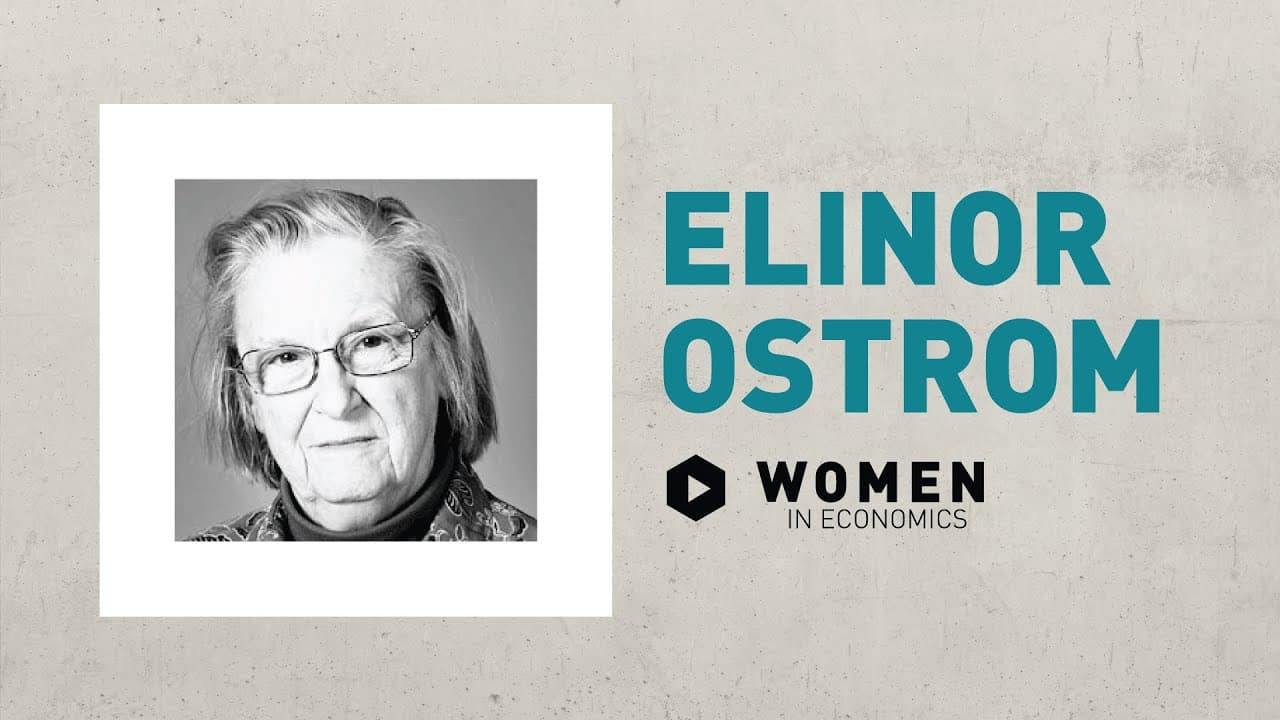
Elinor Ostrom, the first woman to win the Nobel Prize in Economics, fundamentally changed the understanding of resource management by demonstrating that local communities can effectively govern common resources through self-organization and cooperation. Her fieldwork showed that solutions to the tragedy of the commons are often found at the local level, challenging conventional beliefs that only centralized control or privatization are viable options.
Transcript
- [Assistant] We've been on set. - [Tyler] But this is already improvised so... ♪ [music] ♪ - [Narrator] Economists, not a group with a lot of Marys, Natashas or Juanitas, and that's caused a lot of controversy. However, what's often overlooked are the actual female economists who are pushing economics forward by addressing real world issues. We... Read More
Key Insights
- Elinor Ostrom was the first woman to win the Nobel Prize in Economics, recognized for her groundbreaking work on the tragedy of the commons.
- Ostrom's research demonstrated that local communities could effectively manage common resources through self-organization and cooperation, contrary to the prevailing economic theories.
- Her approach involved extensive fieldwork across the globe, studying real-world examples of resource management in diverse settings such as Spain, Nepal, and Japan.
- Ostrom's work emphasized the importance of interdisciplinary collaboration, incorporating insights from ecology, computer science, and psychology into her economic research.
- She challenged the notion that centralized control or privatization were the only solutions to resource management, highlighting the potential of local governance and group norms.
- Her findings showed that small groups could develop effective rules and sanctions to manage resources sustainably and avoid overexploitation.
- Ostrom's work has been widely cited, influencing economic thought and policy, particularly in environmental and resource management fields.
- She is celebrated as an environmental optimist, believing in the power of local action and cooperation to address global challenges.
Install to Summarize YouTube Videos and Get Transcripts
Explore YouTube Video Summarizer or Get YouTube Transcript Extractor
Questions & Answers
Q: What was Elinor Ostrom's major contribution to economics?
Elinor Ostrom's major contribution to economics was her research on the tragedy of the commons. She demonstrated that local communities could effectively manage common resources through self-organization and cooperation, challenging the prevailing economic theories that suggested common resources would inevitably be overexploited without centralized control or privatization.
Q: How did Ostrom approach her research on resource management?
Ostrom approached her research on resource management by conducting extensive fieldwork in various countries, studying real-world examples of how communities manage common resources. She traveled to places like Spain, Nepal, and Japan, observing and analyzing the practices of local communities, which allowed her to gather empirical evidence that challenged existing economic theories.
Q: What interdisciplinary methods did Ostrom use in her research?
Ostrom used interdisciplinary methods by integrating insights from fields such as ecology, computer science, and psychology into her economic research. This approach allowed her to gain a more comprehensive understanding of resource management, as she could analyze the complex interactions between human behavior, environmental factors, and economic systems.
Q: Why is Ostrom considered an environmental optimist?
Ostrom is considered an environmental optimist because her research demonstrated that local communities could successfully manage common resources through cooperation and self-organization. She believed in the potential of local action and group norms to address global environmental challenges, offering a more hopeful perspective on humanity's ability to manage resources sustainably.
Q: What impact did Ostrom's work have on economic policy?
Ostrom's work had a significant impact on economic policy, particularly in the fields of environmental and resource management. Her findings influenced policymakers to consider local governance and community-based approaches as viable solutions for managing common resources, as opposed to relying solely on centralized control or privatization.
Q: How did Ostrom challenge the notion of the tragedy of the commons?
Ostrom challenged the notion of the tragedy of the commons by providing empirical evidence that local communities could effectively manage common resources through self-organization and cooperation. Her research showed that, contrary to the belief that common resources would be overexploited, communities could develop rules and norms to sustain resource use.
Q: What distinguishes Ostrom's approach from traditional economic theories?
Ostrom's approach is distinguished from traditional economic theories by her emphasis on fieldwork and empirical evidence, as well as her interdisciplinary methodology. Unlike conventional theories that relied heavily on theoretical models, Ostrom's research was grounded in real-world observations and incorporated insights from various disciplines to provide a more nuanced understanding of resource management.
Q: What lessons can be learned from Ostrom's research on resource management?
Lessons from Ostrom's research on resource management include the importance of local governance and cooperation in managing common resources. Her work highlights the potential for communities to self-organize and develop effective rules and norms to sustain resource use, challenging the notion that centralized control or privatization are the only solutions to managing common resources.
Summary & Key Takeaways
-
Elinor Ostrom, the first woman to receive the Nobel Prize in Economics, revolutionized the understanding of resource management by disproving the tragedy of the commons theory. Her research highlighted the effectiveness of local governance and cooperation in managing common resources sustainably.
-
Ostrom's extensive fieldwork across various countries revealed that communities could self-organize to regulate resource consumption, challenging the idea that centralized control or privatization were the only viable solutions. Her interdisciplinary approach integrated insights from multiple fields, enriching her economic analyses.
-
Ostrom's contributions have had a lasting impact on economic theory and policy, particularly in environmental management. Her work demonstrated that small groups could develop effective rules and norms to manage resources, offering a more optimistic view of humanity's ability to tackle environmental challenges.
Read in Other Languages (beta)
Share This Summary 📚
Summarize YouTube Videos and Get Video Transcripts with 1-Click
Try YouTube Summary with ChatGPT & Claude or YouTube Transcript Generator
Explore More Summaries from Marginal Revolution University 📚

Summarize YouTube Videos and Get Video Transcripts with 1-Click
Try YouTube Summary with ChatGPT & Claude or YouTube Transcript Generator