How to Learn AI Foundations at Human Speed
TL;DR
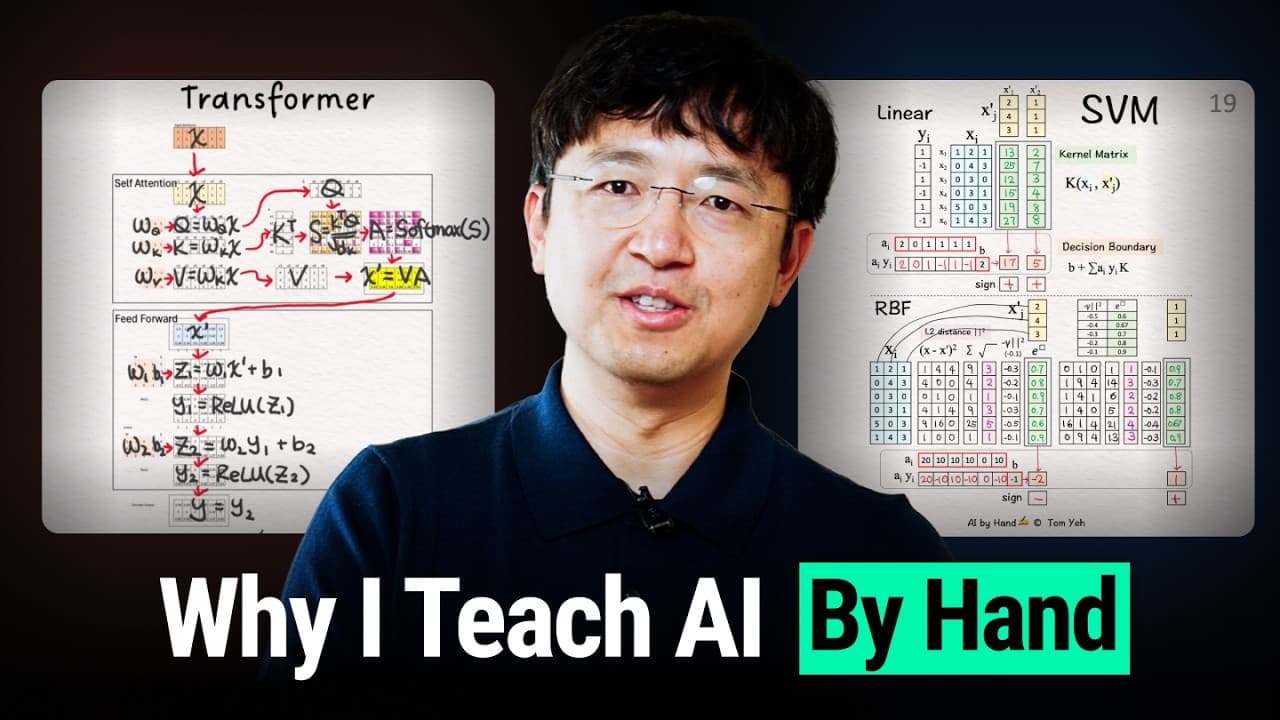
Foundational understanding lasts longer than quick hype, and learning by hand helps you internalize concepts at a human pace. The speaker argues that focusing on evergreen foundations enables you to adapt when new AI tools arrive, rather than chasing every new trend. Ownership of the material comes from time spent, not just answers.
Transcript
My name is Tom Diet. I'm a professor of computer science at the University of Colorado in Boulder. I'm also a founder of AI by Hand. It's a global education initiative to make AI inside a black box accessible and approachable. Writing out all the math with hand, in doing so, understanding that AI is not a big mystery. [music] It's something we all ... Read More
Key Insights
- Foundations in AI are evergreen and do not change with new tools, so investing in core math and concepts yields lasting usefulness.
- Learning by drawing, writing, and mapping out math helps internalize difficult topics better than watching algorithms perform tasks.
- Ownership of knowledge increases when learners invest time and effort, not when they simply obtain degrees or certificates.
- The ability to learn slowly and at human pace enables better comprehension and long term adaptability to new AI technologies.
- Transformers and attention mechanisms are presented as specific topics within a broader foundational skill set that endure beyond hype cycles.
- Cheating or shortcut culture is tied to incentives in education, and rebuilding learning ethics requires focusing on genuine understanding.
- Tools come and go, but a strong foundation allows rebuilding skills around new technologies without losing competence.
- The speaker emphasizes demonstration of skills over speed, suggesting that methodical, thoughtful study differentiates serious learners.
Install to Summarize YouTube Videos and Get Transcripts
Explore YouTube Video Summarizer or Get YouTube Transcript Extractor
Questions & Answers
Q: What is the core argument for slow learning in AI education
The core argument is that slow, deliberate learning builds durable understanding that survives changing tools and hype cycles. By focusing on foundational topics and practical understanding rather than chasing the latest model, learners develop transferable skills, stronger problem solving, and a steadier ability to adapt to future AI developments. This approach also fosters ownership of knowledge and long term growth.
Q: How does learning by hand help with AI comprehension
Learning by hand helps because it requires you to slow down, process concepts more deeply, and externalize your thinking through drawings and notes. This method improves retention and clarity, making it easier to map complex ideas like linear algebra, matrix multiplication, and attention mechanisms to real applications. It also reduces cognitive load compared to passive consumption of tutorials.
Q: What does the video say about ownership of learning
Ownership of learning comes from the time and effort invested in acquiring knowledge, not from certificates or degrees. When you spend meaningful effort on understanding a concept, you internalize it more fully and can apply it in new contexts. This ownership is what differentiates learners who can adapt to new AI tools from those who rely on external validation.
Q: Why is foundation more important than current AI tools
Foundation with core principles remains relevant even as tools evolve because it underpins the ability to understand, critique, and adapt to new technologies. A strong foundation enables rebuilding skills around new tools without starting from scratch, and it provides a stable reference when evaluating the usefulness and limitations of emerging AI systems.
Q: What view does the speaker have on the AI native trap
The speaker argues that AI cannot change people; instead, people change AI by applying foundational skills and human-centric approaches to learning and problem solving. Focusing on enduring human capabilities helps learners remain adaptable and capable of improving AI systems, rather than being dominated by the latest tools or trends.
Q: How does the talk relate cheating to learning incentives
The talk links cheating to the incentives within the education system, suggesting that the root problem is not cheating tools like Chegg or Khan Academy but the system that pressures students to shortcut understanding. True learning requires space for effortful problem solving and a focus on genuine comprehension rather than quick answers.
Q: What analogy is used for rebuilding skills after tool changes
An analogy is drawn to rebuilding a palace on a solid foundation after a fire, illustrating that if you have a strong base, you can reconstruct capabilities around new AI tools without losing the underlying structure. This emphasizes adaptable, foundation-based learning rather than dependence on any single technology.
Q: What practical advice does the speaker offer for students
The speaker advises focusing on fundamental skills, mapping concepts by hand, and investing time to understand why a method works rather than merely memorizing formulas. This approach builds transferable problem solving abilities and ensures that learners can adapt to future AI advances without losing confidence or capability.
Summary & Key Takeaways
-
The video argues that foundational learning is evergreen and more transferable than rapid tool mastery, so focusing on core concepts builds long term resilience in AI work. It emphasizes slow, deliberate study over rushing to implement the latest model or framework.
-
Learning by hand is presented as a method to improve retention and focus, allowing students to internalize ideas before using automated tools. This approach aligns with staying connected to human cognitive processes rather than substituting manual effort with software.
-
The speaker discusses ownership of knowledge, suggesting that true learning comes from time spent and effort invested, not from credentials or quick online answers. This mindset is proposed as essential for adapting to future AI developments.
Read in Other Languages (beta)
Share This Summary 📚
Summarize YouTube Videos and Get Video Transcripts with 1-Click
Try YouTube Summary with ChatGPT & Claude or YouTube Transcript Generator
Explore More Summaries from EO 📚

Summarize YouTube Videos and Get Video Transcripts with 1-Click
Try YouTube Summary with ChatGPT & Claude or YouTube Transcript Generator