How to Use Math for Profitable Trading
TL;DR
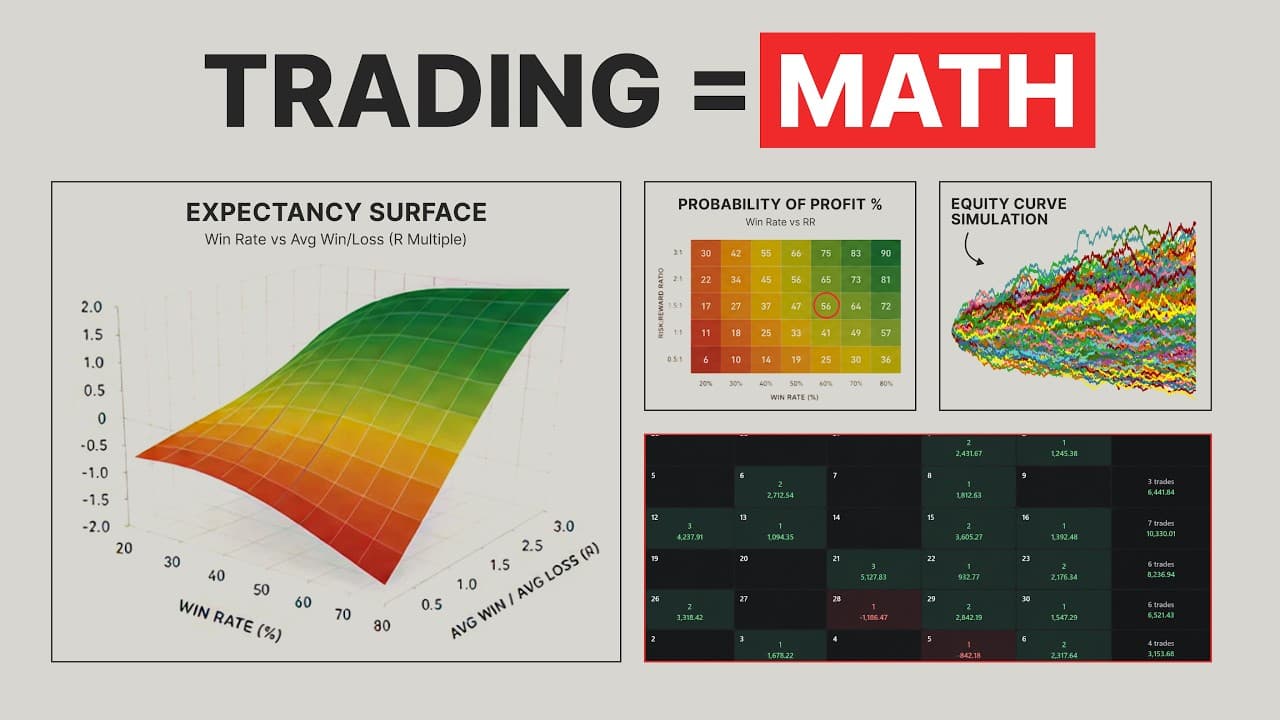
Understanding the math behind trading is crucial for long-term profitability. Key concepts include expectancy, system design, variance, and risk management. Expectancy is calculated using win rate, average win, and average loss, revealing that high win rates aren't always necessary for profitability. Effective risk management and position sizing are essential to survive market variance and avoid significant drawdowns.
Transcript
Trading is basic math, and if you don't understand these four essential concepts, no matter what strategy you use or how good your setups are, you will never become a profitable trader. But once you understand them, you'll realize why most traders never become profitable, even when they're learning the right strategy. In this video, I'll show you t... Read More
Key Insights
- Expectancy is the average profit per trade and is crucial for determining if a trading system is profitable.
- Expectancy is calculated as (win rate x average win) - (loss rate x average loss).
- High win rates do not guarantee profitability; the combination of win rate and reward-to-risk ratio is key.
- Transaction costs like spread, commission, and slippage can turn a seemingly profitable system into a losing one.
- Small sample sizes can be misleading; a large number of trades is needed to accurately assess a system's profitability.
- System design requires trade-offs; higher rewards often come with lower win rates and vice versa.
- Variance can lead to different outcomes with the same system, affecting traders emotionally and leading to poor decisions.
- Position sizing is crucial for risk management, ensuring consistent dollar risk across trades despite varying stop-loss sizes.
Install to Summarize YouTube Videos and Get Transcripts
Explore YouTube Video Summarizer or Get YouTube Transcript Extractor
Questions & Answers
Q: How is expectancy calculated in trading?
Expectancy in trading is calculated using the formula: (win rate x average win) - (loss rate x average loss). This formula helps determine the average profit or loss per trade, indicating whether a trading system is likely to be profitable over time. A positive expectancy suggests a profitable system, while a negative one indicates potential losses.
Q: Why is a high win rate not always indicative of a profitable trading system?
A high win rate alone does not guarantee profitability because it must be balanced with the reward-to-risk ratio. A system with a high win rate but low reward per trade may still result in losses if the occasional losing trades are significantly larger. Profitability depends on the combination of win rate and the size of wins relative to losses.
Q: What role do transaction costs play in trading profitability?
Transaction costs, including spread, commission, and slippage, can significantly impact trading profitability. These costs reduce the actual returns from trades, potentially turning a system that appears profitable on paper into a losing one in practice. Traders must account for these costs when calculating real expectancy to ensure sustainable profits.
Q: Why are small sample sizes misleading in trading?
Small sample sizes in trading can be misleading because they do not provide enough data to accurately assess a system's true performance. Initial trades may not reflect the long-term viability of a strategy, as short-term variance can skew results. A larger sample size is needed to determine if a system has a real edge and positive expectancy.
Q: How does variance affect traders emotionally?
Variance can lead to different outcomes with the same trading system, causing emotional stress for traders. A series of losses or wins can make traders doubt their strategy or become overconfident. This emotional impact may result in poor decision-making, such as abandoning a profitable system or increasing risk inappropriately during losing streaks.
Q: What is the importance of position sizing in trading?
Position sizing is critical in trading as it ensures consistent dollar risk across trades, regardless of varying stop-loss sizes. Proper position sizing helps manage risk, preventing significant drawdowns during losing streaks. By maintaining a consistent risk level, traders can survive market variance and allow their trading edge to manifest over time.
Q: How does the breakeven win-rate formula work?
The breakeven win-rate formula calculates the minimum win rate needed to avoid losses, based on the reward-to-risk ratio. For example, with a 1:1 reward-to-risk ratio, a 50% win rate is required to break even. With a higher reward-to-risk ratio, a lower win rate is sufficient. This formula helps traders understand the trade-offs between win rate and potential profits.
Q: Why is risk of ruin a concern for traders?
Risk of ruin refers to the probability of losing a significant portion of trading capital, making recovery difficult. As risk per trade increases, so does the risk of ruin, due to the compounding effect of losses. A 50% drawdown requires a 100% gain to recover, highlighting the importance of managing risk and maintaining a low risk per trade to ensure long-term survival.
Summary & Key Takeaways
-
Expectancy is the cornerstone of trading profitability, calculated by combining win rates with average wins and losses. A system with a low win rate can still be profitable if the reward-to-risk ratio is favorable. Transaction costs must be considered to ensure real-world profitability.
-
System design involves balancing win rates and rewards, as no perfect strategy offers both. Variance can lead to different experiences with the same system, making emotional resilience and large sample sizes essential for evaluating true performance.
-
Position sizing ensures consistent risk management, preventing significant drawdowns. Risk per trade should be kept low to survive periods of variance and allow the trading edge to manifest over time. Understanding these concepts is key to long-term trading success.
Read in Other Languages (beta)
Share This Summary 📚
Summarize YouTube Videos and Get Video Transcripts with 1-Click
Try YouTube Summary with ChatGPT & Claude or YouTube Transcript Generator
Explore More Summaries from Mulham Trading 📚
![The Ultimate ICT Silver Bullet Strategy: 33% ROI in 14 Days! [Backtesting] thumbnail](/_next/image?url=https%3A%2F%2Fi.ytimg.com%2Fvi%2FPOyd5Quw0WY%2Fhqdefault.jpg&w=750&q=75)
Summarize YouTube Videos and Get Video Transcripts with 1-Click
Try YouTube Summary with ChatGPT & Claude or YouTube Transcript Generator