What Is the God Equation and How Does String Theory Fit In?
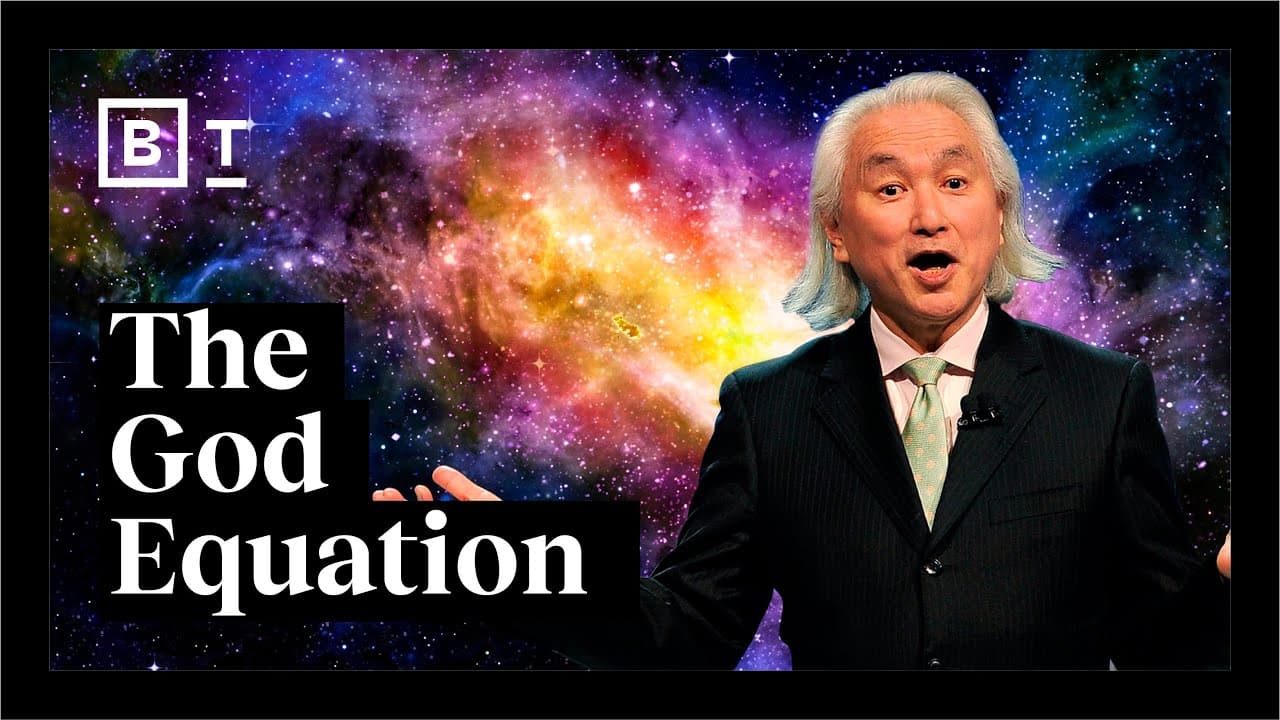
TL;DR
The God Equation aims to unify the four fundamental forces of nature into one theory. String theory, proposing that subatomic particles are tiny vibrating strings, is currently the most promising mathematical framework for achieving this unification, despite challenges in testability. It offers insights into the interconnectedness of particles and the fabric of the universe.
Transcript
MICHIO KAKU: What is the mind of God, that Albert Einstein chased after for 30 years of his life? Einstein wanted an equation that would unify gravity, electromagnetic force, and the two nuclear forces. He wanted unification of all four forces into one theory. The theory of everything, the God Equation. My name is professor Michio Kaku. I'm a profe... Read More
Key Insights
- 🛄 The God Equation, or a theory of everything, aims to unify the fundamental forces of nature into a single equation.
- ❓ String theory proposes that subatomic particles are vibrating strings, offering a potential solution to the unification problem.
- ❓ String theory is currently the most mathematically consistent theory among those proposed.
- 😚 Despite objections, such as the lack of current testability, advancements in technology are bringing us closer to potentially testing string theory.
- 🎙️ More videos with Michio Kaku:
Install to Summarize YouTube Videos and Get Transcripts
Explore YouTube Video Summarizer or Get YouTube Transcript Extractor
Questions & Answers
Q: How did Newton's theories on mechanics and gravity impact human history?
Newton's work on mechanics and gravity laid the foundation for the Industrial Revolution, driving advancements in technology and engineering that shaped modern society. It enabled the development of machinery, transportation systems, and understanding of celestial mechanics.
Q: Why is unifying the quantum theory and general relativity challenging?
The quantum theory describes the behavior of subatomic particles as discrete entities, while general relativity explains the curvature of spacetime as smooth and continuous. These opposing principles make it difficult to reconcile the two theories into a single framework.
Q: What is string theory, and how does it propose to unify physics?
String theory suggests that subatomic particles are actually tiny vibrating strings. These strings can vibrate in different modes, corresponding to different particle properties. This concept allows for the potential unification of quantum mechanics and general relativity by providing a mathematical framework that incorporates both principles.
Q: What are some potential implications of string theory?
String theory offers the possibility of phenomena such as time travel through wormholes, the existence of parallel universes, and insights into the universe before the Big Bang. While these ideas are still speculative, they demonstrate the mind-blowing potential of a theory of everything.
Summary & Key Takeaways
-
Albert Einstein sought to find an equation that would unify the four fundamental forces of nature into one theory, known as the God Equation.
-
The quantum theory of particles and the general theory of relativity are challenging to unify due to their conflicting principles of smoothness and particleization.
-
String theory proposes that subatomic particles are tiny vibrating strings, allowing for the symmetrical transformation of particles and potentially explaining the underlying fabric of the universe.
Read in Other Languages (beta)
Share This Summary 📚
Summarize YouTube Videos and Get Video Transcripts with 1-Click
Try YouTube Summary with ChatGPT & Claude or YouTube Transcript Generator
Explore More Summaries from Big Think 📚


Summarize YouTube Videos and Get Video Transcripts with 1-Click
Try YouTube Summary with ChatGPT & Claude or YouTube Transcript Generator