Rethinking my PKM part 5: How do you organize your notes?
TL;DR
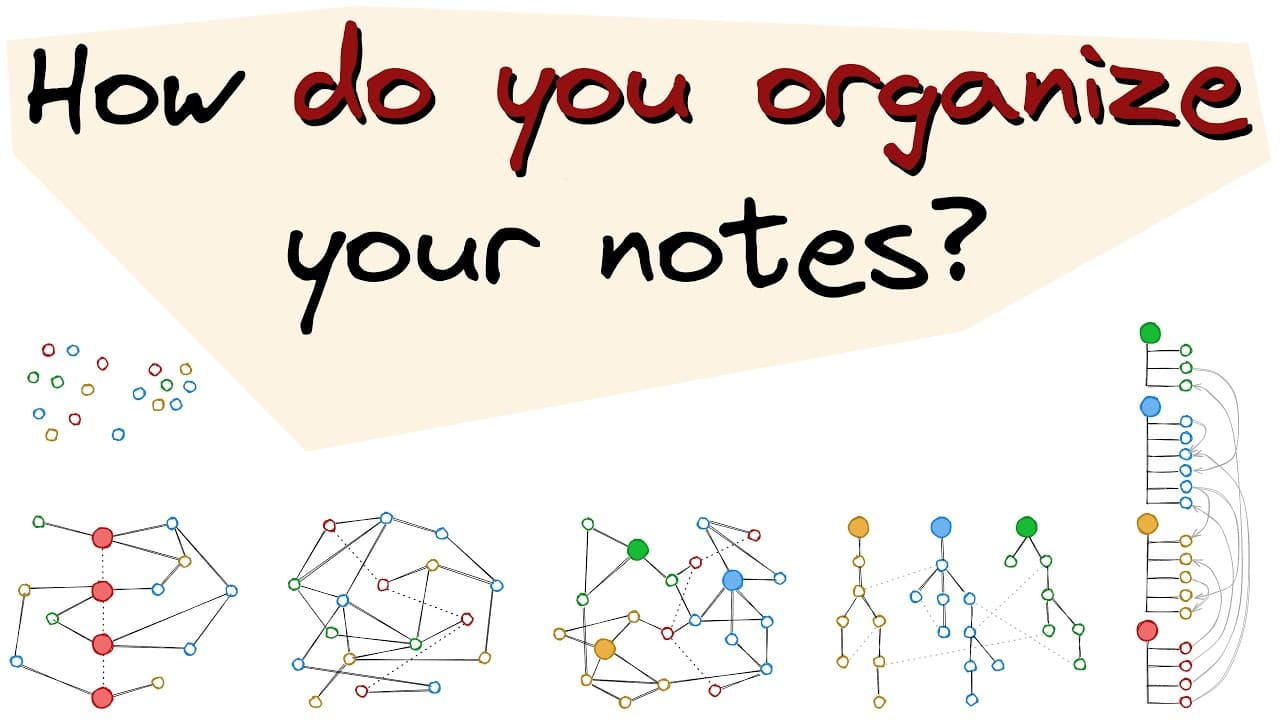
This video discusses five different approaches to organizing notes, including the random mess, daily notes first, content first, topic first, and action first approaches.
Transcript
hey everyone today i'd like to talk about the topic of organizing our notes so how do you organize your notes there is lots of opinion out there about this topic just couple of examples here so as i started to rethink my pkm of course i started to think about organizing my notes and sharing my thoughts about it a couple of years ago i read this art... Read More
Key Insights
- 🧩 Note-taking is a personal matter, but our tools and processes shape us over time. Consider who you want to become when choosing your note-taking system.
- 📚 Classification systems, like the architect-gardener-librarian-student model and the writer-collector-connector-databaser model, can help you understand your preferences and needs in note-taking.
- 🌪️ Our note-taking methods and preferences can evolve every couple of years or so. It's important to be open to adapting and tweaking your approach as you learn and grow.
- 💡 There are various ways to organize your notes, including the random mess (post-it notes), daily notes first, content first (atomic notes), topic first (map of content), and action first (context-centric) approaches.
- 🗂️ The random mess approach is characterized by scattered post-it notes, while the daily notes first approach treats the daily notes page as the backbone of the system.
- 📚 The content first approach emphasizes creating atomic pages for different topics and using links to navigate between notes, while the topic first approach involves creating maps of content or index pages as the starting point.
- 📚 The zettelkasten or slip box system is a popular research note-taking method where permanent notes build on one another, connected through lateral links.
- 🔁 It's possible to combine different approaches, like merging the daily notes first approach with the zettelkasten system, to create a personalized note-taking system that suits your needs.
Install to Summarize YouTube Videos and Get Transcripts
Explore YouTube Video Summarizer or Get YouTube Transcript Extractor
Questions & Answers
Q: What are the five different approaches to organizing notes mentioned in the video?
The five different approaches to organizing notes mentioned in the video are the random mess, daily notes first, content first, topic first, and action first approaches.
Q: How does the speaker's note-taking approach evolve over time?
According to the speaker's personal experiences, their note-taking approach has evolved from a content first approach to a topic first approach and eventually to a daily notes first and topic first hybrid system. They are now planning to incorporate elements of the zettelkasten system into their workflow.
Q: What is the pera method and how does it differ from other approaches?
The pera method, advocated by Thiago Forte, is an action first approach that focuses on organizing notes based on the context in which they will be used next. It involves categorizing information into projects, areas of life, resources, or archives. Unlike other approaches, the pera method emphasizes organizing for action rather than strict hierarchical structures or categories.
Q: What is the zettelkasten system and how does it work?
The zettelkasten system is a method of organizing research notes on a given topic. It involves creating permanent notes that build on one another and are linked together. The system encourages branching out into subtopics and creating lateral links between permanent notes. The zettelkasten system can be combined with other approaches, such as daily notes first or topic first, to create a hybrid system.
Summary & Key Takeaways
-
The video explores five different approaches to organizing notes: random mess, daily notes first, content first, topic first, and action first.
-
The speaker shares personal experiences and preferences for each approach.
-
They discuss the evolution of note-taking preferences over time and highlight the importance of finding a system that works for individual needs.
Read in Other Languages (beta)
Share This Summary 📚
Summarize YouTube Videos and Get Video Transcripts with 1-Click
Try YouTube Summary with ChatGPT & Claude or YouTube Transcript Generator
Explore More Summaries from Zsolt's Visual Personal Knowledge Management 📚
Summarize YouTube Videos and Get Video Transcripts with 1-Click
Try YouTube Summary with ChatGPT & Claude or YouTube Transcript Generator