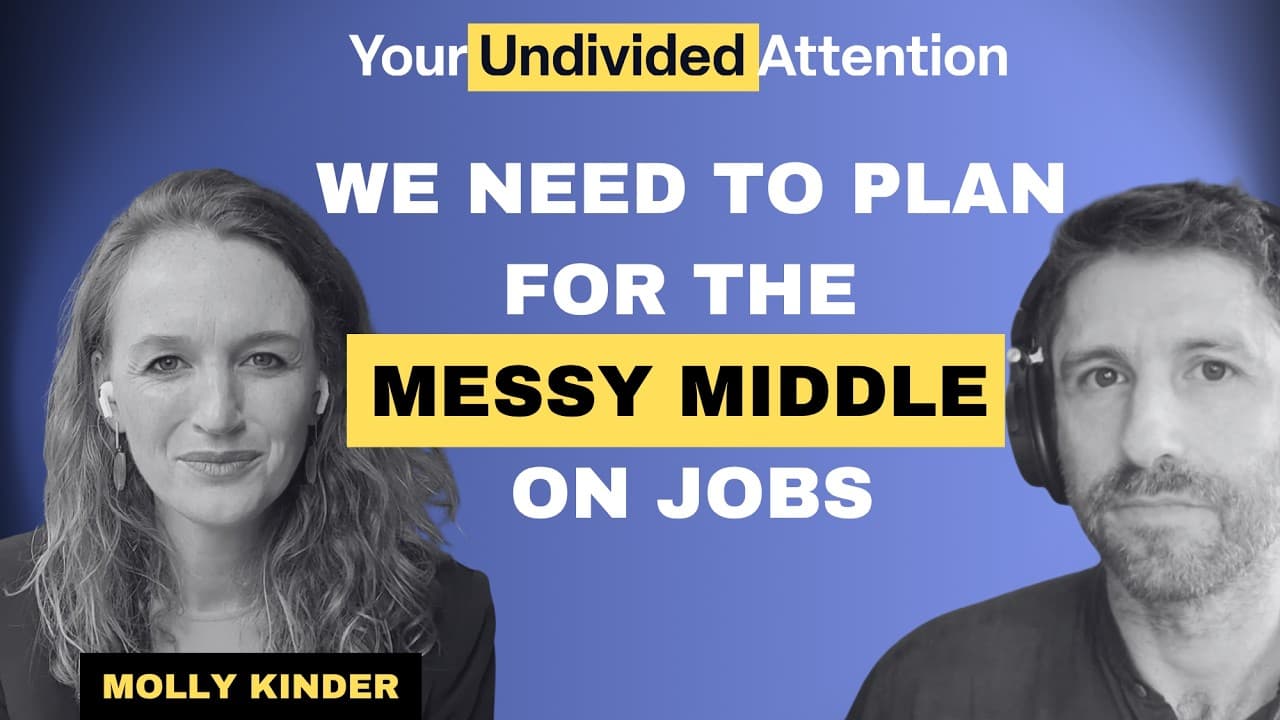
What is the messy middle of AI and jobs?
TL;DR
The near future will feature uneven, concentrated job disruption rather than universal collapse. Plan now for workers who lose or switch roles as AI advances, with policies that support retraining and livelihood protection. The focus should be on resilience, targeted supports, and proactive action rather than endless debate.
Transcript
Hey everyone, it's Tristan Harris and welcome to your undivided attention. It often feels like we're stuck in some kind of endless debate about what AI is going to mean for jobs and the economy. Now, no one knows the future, but we know that automation from AI is coming, and many fear that it will result in mass unemployment. But if you believe the... Read More
Key Insights
- AI disruption will be concentrated, not universal, with some occupations experiencing clear losses while others remain resilient.
- We are in the messy middle, a bounded period between today’s mild impacts and a distant, post employment future where work may be radically different.
- People in mid career face large income and identity strain when switching fields, especially if retraining requires pay cuts or relocate to new regions.
- Policy should focus on proactive workforce development and safety nets that are capable of supporting meaningful transitions, not just reactive unemployment benefits.
- Ubi is not the only proposed solution; a broader consideration of how to share productivity gains is needed, including meaningful avenues beyond traditional income support.
- The debate itself is a barrier to action; framing and incentives should point toward concrete steps that protect livelihoods now.
- Education and training systems must be redesigned to align with practical, real-world needs and the evolving tasks AI will take over.
- Understanding where AI will affect specific sectors allows targeted investment in retraining and regional economic adjustment.
Install to Summarize YouTube Videos and Get Transcripts
Explore YouTube Video Summarizer or Get YouTube Transcript Extractor
Questions & Answers
Q: What is the messy middle and why does it matter for workers?
The messy middle is described as a transitional period where AI brings enough progress to cause job losses in certain areas, but not an economy wide apocalypse. It matters because it creates concentrated pain for workers in specific roles, making it essential to anticipate who will be affected and when, so policies can be designed to protect livelihoods without waiting for a future that may never arrive as imagined.
Q: Why do the two stories about the Uber driver and the BA holder matter?
Those stories illustrate real world, human consequences of disruption that may not be tied to a single company or technology change. They show how professionals face large income drops and identity shifts, with limited unemployment support and retraining options, underscoring the need for systems that help people navigate transitions rather than treating all jobs as interchangeable.
Q: What role does policy play in addressing these disruptions?
Policy should move beyond debating if AI will destroy jobs and instead focus on concrete actions to protect livelihoods now. This includes designing scalable retraining programs, regional economic supports, and safety nets that adapt to uneven effects, enabling workers to transition into new, viable roles with less financial strain.
Q: How does the episode view universal basic income or universal high income?
The discussion critiques narrow promises of universal income solutions by highlighting that not all future scenarios will deliver quick, universal gains. It emphasizes the need to consider broader arrangements such as retraining, wage replacement, and access to new kinds of work that reflect the actual, uneven impact of AI on different occupations.
Q: What does the speaker imply about education and college decisions for kids?
The episode suggests that anxious families worry about whether college remains the best path given potential disruption. It advocates for more nuanced guidance that considers likely shifts in demand for different skills, rather than assuming college is universally the optimal route for every student in a changing economy.
Q: What is Molly Kinder’s main argument about where AI will hit the labor market?
Kinder argues that AI will cause concentrated, uneven disruptions rather than a uniform collapse, with certain jobs and workers bearing the brunt. She emphasizes the importance of understanding second and third order effects, and of taking proactive steps to prepare workers for transitions before disruption manifestly worsens.
Q: Why is the debate around AI and jobs a problem in itself?
The ongoing debate can stall action, as people oscillate between extremes rather than planning concrete steps. The episode argues that progress comes from incentives and policies that direct attention to near term actions, such as targeted retraining and regional support, instead of getting stuck in speculative narratives about the distant future.
Q: What is the suggested approach to safeguarding livelihoods in the near term?
The recommended approach is to map where AI will affect specific sectors, anticipate second and third order consequences, and implement systems level policies that support workers through transitions. This includes practical retraining programs, financial safety nets, and regional economic adjustments designed to blunt the hardest impacts while preserving opportunities for growth.
Summary & Key Takeaways
-
The episode proposes a middle ground between two extreme views on AI and employment, emphasizing uneven and focused disruption rather than a total jobs crisis. It argues for urgent action to support workers facing hard transitions and to rethink workforce development as AI capabilities grow.
-
The conversation highlights real people facing job displacement, illustrating how AI-related changes hit knowledgeable workers and complicate retirement plans. It stresses that unemployment benefits are limited and that retraining options may require substantial compromises in pay and identity.
-
The host and Molly Kinder advocate for systems level thinking to map where AI will hit, identify second and third order effects, and design policies that anticipate these shifts before displacement occurs.
Read in Other Languages (beta)
Share This Summary 📚
Summarize YouTube Videos and Get Video Transcripts with 1-Click
Try YouTube Summary with ChatGPT & Claude or YouTube Transcript Generator
Explore More Summaries from Center for Humane Technology 📚


Summarize YouTube Videos and Get Video Transcripts with 1-Click
Try YouTube Summary with ChatGPT & Claude or YouTube Transcript Generator