What Is the Nature of Time and Its Direction?
TL;DR
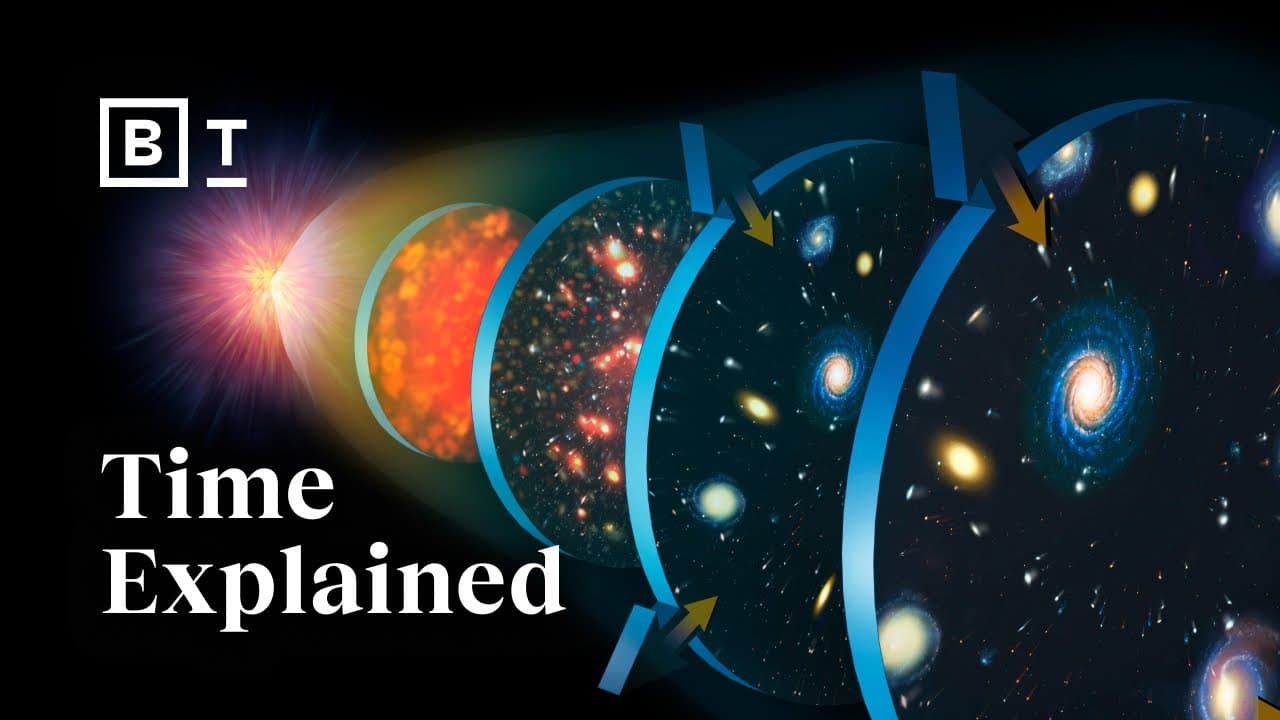
The nature of time involves the perception of its direction, influenced by the increase of entropy since the Big Bang. Although physics does not inherently define an arrow of time, our intuitive understanding arises from living in a universe where entropy consistently increases, allowing complex structures and memories to exist.
Transcript
- Lexicographers will tell you that time, the word, "T-I-M-E," is the most used noun in the English language. We can't get through the day without talking about time all the time. I think about how we use time, when we actually talk about it. If you say, "Meet me at 7 p.m.," no one panics. No one says like, "Oh my God, what are you talking about wi... Read More
Key Insights
- ⌛ Time is a widely used concept, but its properties and the direction of time are not fully understood.
- 💘 Physics theories do not distinguish between the past and future, challenging the perception of an inherent arrow of time.
- 💘 The perception of an arrow of time arises from living in a Universe with increasing entropy.
- 😘 Entropy is a measure of how disorganized and random a system is, and there is a natural tendency for systems to move from low entropy to high entropy.
- ⏳ The explanation for the increase in entropy from the past to the present is the low entropy state of the Universe at the time of the Big Bang.
- 🫒 Complex structures, such as living beings, rely on the increasing entropy of the Universe to exist.
- 👻 The journey from a low-entropy to a high-entropy state allows for intricate possibilities and complex systems to arise.
- 🎙️ More videos with Sean Carroll:
Install to Summarize YouTube Videos and Get Transcripts
Explore YouTube Video Summarizer or Get YouTube Transcript Extractor
Questions & Answers
Q: What is the nature of time and why do we perceive it with a past, present, and future?
Time is a label for different events in the Universe. The past, present, and future are different moments, but the properties and differences among them are still not fully understood. We perceive an arrow of time due to the influential event of the Big Bang and increasing entropy in the Universe.
Q: Why do we have memories of the past but not the future?
The absence of memories of the future is related to the asymmetry between the past and future in our perception of time. We remember the past because we have experienced it, while the future is unknown and uncertain to us.
Q: Can we travel back in time?
The possibility of time travel is still uncertain. While there are scientific theories that suggest the concept of time travel, such as wormholes and time dilation, practical implementation is currently beyond our technological capabilities.
Q: Why does the Universe have an increase in entropy over time?
The increase in entropy, as described by the second law of thermodynamics, refers to the tendency of systems to become more disordered and random. The Universe has been increasing in entropy since the Big Bang, leading to the perception of an arrow of time.
Summary & Key Takeaways
-
Time is a label that helps us differentiate between different moments in the Universe, but its properties and the direction of time are still not fully understood.
-
Physics theories do not distinguish between the past and future, challenging the concept of an inherent arrow of time.
-
The perception of an arrow of time arises from living in the aftermath of an influential event, the Big Bang, which increased the entropy in the Universe.
Read in Other Languages (beta)
Share This Summary 📚
Summarize YouTube Videos and Get Video Transcripts with 1-Click
Try YouTube Summary with ChatGPT & Claude or YouTube Transcript Generator
Explore More Summaries from Big Think 📚


Summarize YouTube Videos and Get Video Transcripts with 1-Click
Try YouTube Summary with ChatGPT & Claude or YouTube Transcript Generator