How Can AI Accelerate Scientific Discovery?
TL;DR
AI can accelerate scientific discovery by learning models from data and experience, then using those models to pursue defined goals and uncover solutions that researchers may not already know. DeepMind developed this approach through games such as Go before applying it to real scientific challenges, including AlphaFold and the 50-year problem of predicting protein structures.
Transcript
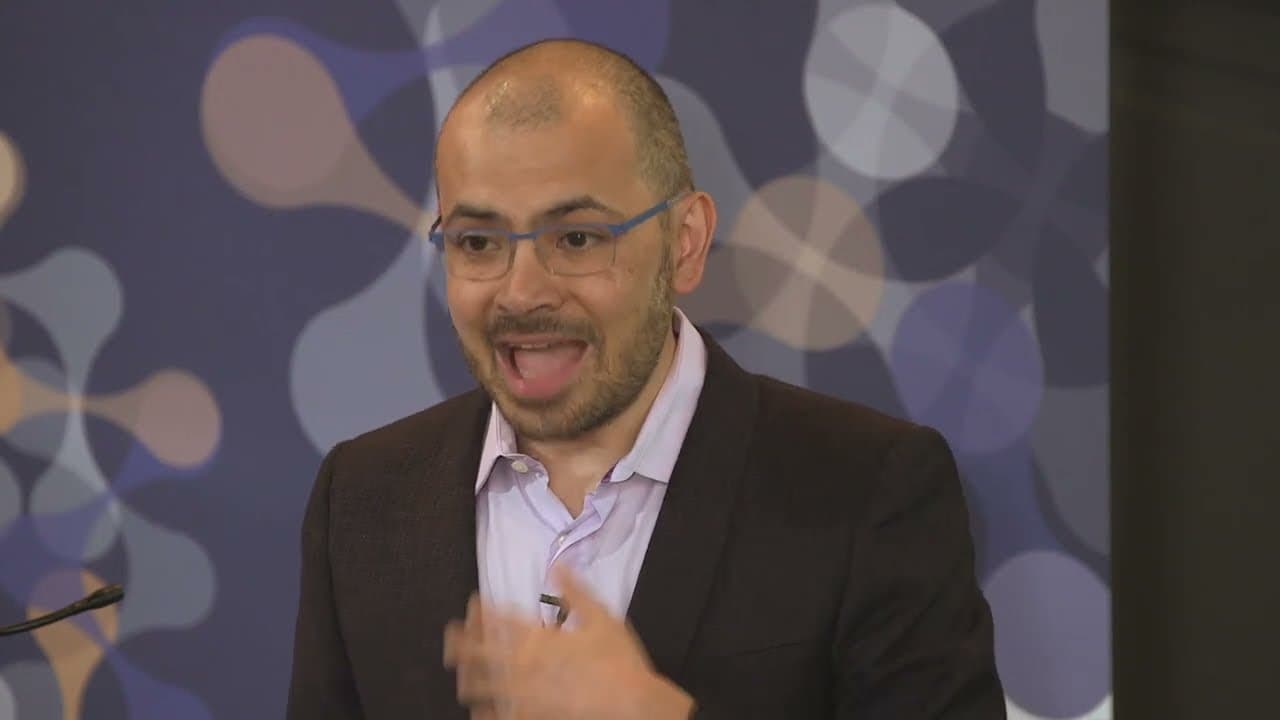
ladies and gentlemen a very warm welcome to this evening's lecture here in the Splendor of the sheldonian theater it is hosted by Oxford University's Institute for ethics in Ai and is part of the obit SE Tanner lectures on artificial intelligence and human values my name is Nigel shadbolt principal of Jesus College I'm also a professor of computer ... Read More
Key Insights
- Artificial general intelligence is defined here as a general system that can perform well across many tasks at least at human level. DeepMind was founded in 2010 as an Apollo program-like effort to pursue this broader capability rather than build systems limited to individual tasks.
- DeepMind's mission is to solve intelligence in order to advance science for the benefit of humanity. Scientific discovery was not presented as a recent change in direction, but as Demis Hassabis's original motivation for spending his career working to make artificial intelligence a reality.
- Expert systems are limited by the solutions and situations anticipated by their programmers. Even when cleverly designed, these hard-coded systems struggle with unexpected circumstances and cannot readily generalize beyond the cases that their developers explicitly incorporated.
- Learning systems discover solutions from first principles through experience. Their central promise is the ability to generalize to tasks for which they were not explicitly programmed and potentially solve problems that their designers or the scientists using them do not yet know how to solve.
- Deep reinforcement learning combines two complementary functions at scale. Deep neural networks build models of environments, data, and experience, while reinforcement learning uses those models to plan, select actions, pursue goals, and maximize rewards.
- An AI agent is an active participant in its own learning process. It observes an environment, updates an internal model, selects an action that should move it toward a goal, observes the consequences, and uses the resulting information to update the model again.
- Games are effective training grounds for developing and testing artificial intelligence algorithms. DeepMind moved from arcade games to Go, and AlphaGo later won 4–1 against former world champion Lee Sedol, demonstrating progress in systems that learn and plan.
- AlphaFold is presented as a solution to the 50-year grand challenge of protein structure prediction. Its development illustrates how methods refined through foundational research and games can be directed toward scientific problems, including producing an accurate and extensive picture of the human proteome.
Install to Summarize YouTube Videos and Get Transcripts
Explore YouTube Video Summarizer or Get YouTube Transcript Extractor
Questions & Answers
Q: How can AI accelerate scientific discovery?
AI can accelerate scientific discovery by learning useful models directly from data and experience, then using those models to plan actions toward defined research goals. Such systems may generalize beyond tasks for which they were explicitly programmed and may discover solutions that their designers do not already know. AlphaFold demonstrates this potential through its application to the long-standing problem of protein structure prediction.
Q: What is artificial general intelligence according to Demis Hassabis?
Artificial general intelligence is described as a general system capable of performing well on many tasks at least at human level. The term distinguishes DeepMind's ambition from narrower forms of everyday artificial intelligence. DeepMind was founded in 2010 to pursue this broader objective through an Apollo program-like effort focused on building general learning systems rather than isolated, task-specific programs.
Q: Why are learning systems more general than expert systems?
Learning systems develop solutions from first principles and direct experience, giving them the potential to generalize to tasks they were not explicitly programmed to handle. Expert systems instead contain solutions created and encoded by teams of programmers. Their behavior is therefore limited by situations the programmers anticipated, making it difficult for them to respond effectively when unexpected conditions arise.
Q: What is deep reinforcement learning?
Deep reinforcement learning is the combination of deep neural networks and reinforcement learning at scale. The neural network builds a model of the environment from data, observations, and experience. Reinforcement learning then uses that model to plan, select actions, seek goals, and maximize rewards. DeepMind's early work fused these two approaches into systems able to discover knowledge through trial and error.
Q: How does an AI agent learn from its environment?
An AI agent receives observations from an environment and uses them to build or update an internal model of how that environment works. It then selects an available action expected to move it incrementally toward a specified goal. The action may change the environment and produce another observation, which allows the agent to update its model and continue the learning cycle.
Q: Why did DeepMind use games to develop AI systems?
Games provided a training ground where DeepMind could develop and test learning algorithms before applying them to important real-world problems. The work began with arcade games and later progressed to Go. AlphaGo's 4–1 victory against former world champion Lee Sedol showed how systems combining learned models, planning, and action selection could achieve strong performance in a highly complex game.
Q: What scientific problem did AlphaFold address?
AlphaFold addressed protein structure prediction, described in the lecture as a 50-year grand challenge. The system is presented as a solution to that challenge and as evidence that artificial intelligence can contribute directly to scientific discovery. Its work culminated in the release of an accurate and extensive picture of the human proteome, demonstrating a practical scientific application of DeepMind's learning-system research.
Q: What is DeepMind's mission for artificial intelligence?
DeepMind's original mission was expressed in two steps: solve intelligence, then use intelligence to solve everything else. The organization later described the same purpose more specifically as solving intelligence to advance science for the benefit of humanity. This wording clarifies that its general learning research is intended to support scientific progress and address important real-world problems.
Summary & Key Takeaways
-
DeepMind was founded in 2010 with the ambition of building artificial general intelligence, meaning a system capable of performing many tasks at least at human level. Its mission combines solving intelligence with advancing science for humanity, reflecting Demis Hassabis's long-standing motivation to apply artificial intelligence to difficult real-world problems.
-
DeepMind combines deep neural networks with reinforcement learning. Neural networks build internal models from observations, data, and experience, while reinforcement learning uses those models to select actions that advance a specified goal. Through repeated observation, action, and model updating, the resulting agent actively participates in generating the experiences from which it learns.
-
Games provided controlled environments for developing and testing general learning algorithms, progressing from arcade games to AlphaGo and its victory over former world champion Lee Sedol. DeepMind later transferred this research direction toward science, where AlphaFold addressed the 50-year challenge of protein structure prediction and supported a highly accurate, extensive picture of the human proteome.
Read in Other Languages (beta)
Share This Summary 📚
Summarize YouTube Videos and Get Video Transcripts with 1-Click
Try YouTube Summary with ChatGPT & Claude or YouTube Transcript Generator