How Readers and Translators Shape Literature
TL;DR
Literature gains meaning through an ongoing encounter among writers, translators, readers, and other interpreters, so no author has the final word on a text. Borges's infinite library and Bolaño's elusive poetry movement illustrate literature's openness, while the history of translation shows how creative linguistic choices carry Latin American writing across cultures and generations.
Transcript
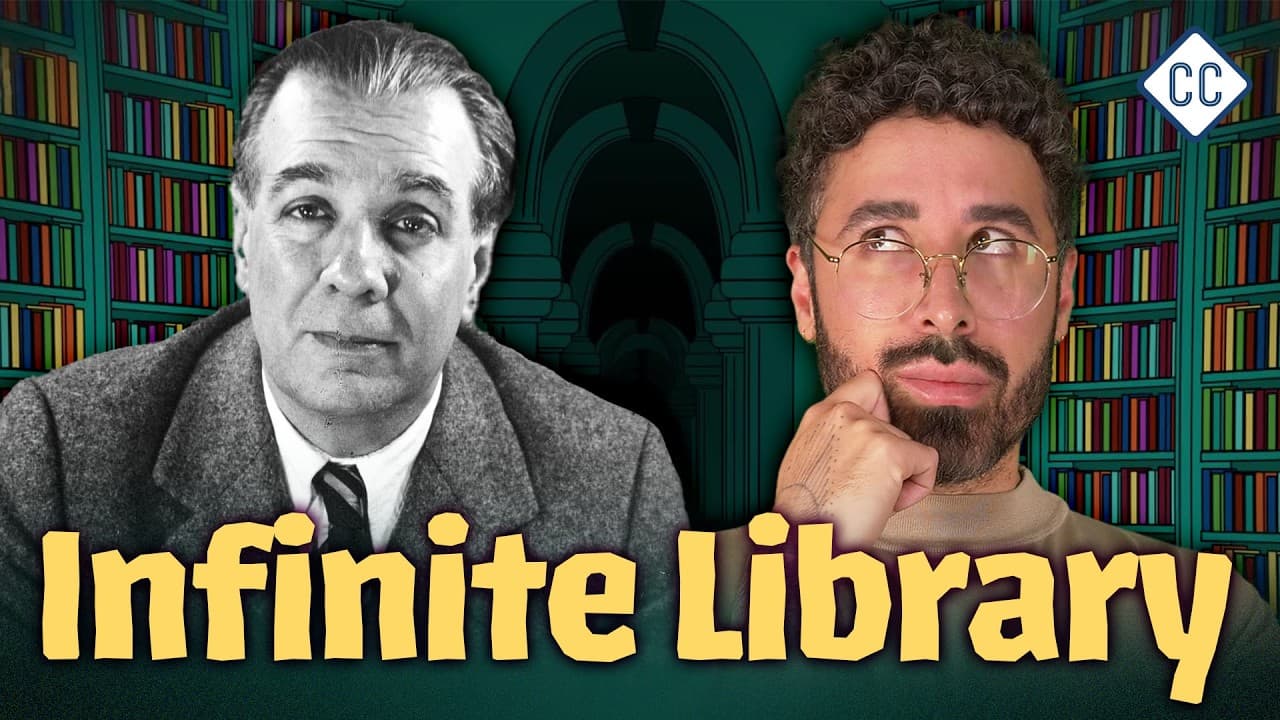
Picture this. You're in a hallway lined with mirrors leading to a strange hexagonal room with books. You pass through another mirrored hallway leading to a room exactly like the first, and another, and another, all with the same number of shelves, same number of books, same number of pages, except every book is unique. Somewhere in the stacks is Pe... Read More
Key Insights
- Borges's "The Library of Babel" presents the universe as a limitless library containing every possible arrangement of the alphabet, punctuation, and spaces, including all books that have existed or could exist alongside vast quantities of apparent nonsense.
- Unreadable language is not necessarily meaningless because a combination of characters may possess significance in a language or interpretive system that a particular reader does not understand, making comprehension different from meaning itself.
- Metaliterature is writing that reflects on writing and literature's possibilities, and Borges's infinite library demonstrates how a text can generate confusion, wonder, dread, and continuing interpretations long after its publication.
- Bolaño's "The Savage Detectives" uses diary entries and interviews to follow young poets searching internationally for Cesárea Tinajero, whose wordless visual poem leaves interpretation open and effectively invites readers to participate as detectives.
- An author does not retain the final word on a work because readers approach literature through different historical influences, personal perspectives, and interpretive lenses, allowing the same words to support multiple encounters and meanings.
- Translation is a creative art because words have different connotations across languages, literal equivalents can fail, and literary rhythms or wordplay require translators to convey a work's spirit rather than merely replace individual words.
- Translation helped religious texts reach Indigenous languages in the 1500s, carried French political thought into nineteenth-century Latin American independence movements, and introduced Latin American writers to readers around the world during the 1960s.
- Literature is a communal act shaped by writers, translators, readers, filmmakers, and later authors, with each participant interpreting or reimagining earlier work and extending its possibilities beyond the moment when the original words were written.
Install to Summarize YouTube Videos and Get Transcripts
Explore YouTube Video Summarizer or Get YouTube Transcript Extractor
Questions & Answers
Q: What does Borges's Library of Babel represent?
Borges's "The Library of Babel" represents the universe as a limitless sequence of mirrored hallways and hexagonal rooms filled with books. Because the library contains every possible combination of letters, punctuation, and spaces, it includes every book that has existed or could exist, along with enormous amounts of apparent nonsense. The idea reflects literature's seemingly endless possibilities and the difficulty of identifying meaning.
Q: Why are the meaningless books important in The Library of Babel?
The apparently meaningless books test the assumption that readers can determine whether language has significance. The narrator argues that every combination of characters may conceal a terrible significance in one or more secret tongues. A book that looks like gibberish to one person may therefore remain meaningful within another language or interpretive framework. Lack of present understanding does not prove that a text has no meaning.
Q: What is metaliterature, and how does Borges use it?
Metaliterature is writing that reflects on writing and on the possibilities of literature itself. Borges uses an infinite library containing every possible book to explore how texts acquire meaning, why readers search for authoritative explanations, and whether apparent nonsense can still matter. The story turns the act of reading into its subject and continues generating different interpretations decades after its publication.
Q: How does The Savage Detectives make readers into interpreters?
"The Savage Detectives" follows young poets searching for Cesárea Tinajero, the elusive founder of the fictional visceral realist poetry movement. Most of the movement's poems disappeared, and Tinajero's surviving poem contains no words, only squiggles. Because the novel does not supply a single explanation, the visual poem invites readers to investigate its possibilities and become literary detectives themselves.
Q: Who decides what a literary work means?
No single participant has the final authority over a literary work's meaning. Writers create the words, but readers bring personal perspectives and interpretive lenses, translators make consequential choices across languages, and scholars, filmmakers, and other authors reshape how texts are understood. Literature therefore operates as an encounter whose possibilities continue whenever another person reads, interprets, translates, or reimagines it.
Q: Why is literary translation considered a creative art?
Literary translation is a creative art because languages do not offer perfectly interchangeable words, connotations, rhythms, or idioms. A literal rendering can sound wrong or lose the original spirit, as illustrated by the phrase "el mundo es un pañuelo," which literally describes the world as a handkerchief but roughly corresponds to "It's a small world." Translators must interpret before they can recreate meaning.
Q: How has translation shaped Latin American literature?
Translation has shaped the region across several historical periods. Religious texts were adapted into Indigenous languages during the 1500s as part of Catholic conversion efforts. Translations of French political thinkers later helped spark nineteenth-century independence movements. During the 1960s, translation introduced Latin American writers to the wider world, and contemporary translators continue bringing additional authors to English-speaking readers.
Q: Why was Pedro Páramo translated into English multiple times?
Juan Rulfo's "Pedro Páramo" is described as an opaque novel that translators have struggled to render effectively. The first English translator omitted complete sentences that were not understood, while the second embellished the text too heavily. Valeria Luiselli praised Douglas J. Weatherford's newer translation and suggested that the novel may have needed three translations before entering Anglophone consciousness more broadly and indelibly.
Summary & Key Takeaways
-
Jorge Luis Borges's 1941 story "The Library of Babel" imagines the universe as a limitless library containing every possible combination of letters, punctuation, and spaces. Its meaningful books and apparent nonsense raise questions about whether unreadable writing lacks significance or simply conceals meanings that its present readers cannot understand.
-
Roberto Bolaño's 1998 novel "The Savage Detectives" follows young poets seeking Cesárea Tinajero, the elusive founder of the fictional visceral realist movement. Her surviving poem contains only squiggles, inviting readers to become interpreters themselves and demonstrating that literature can sustain multiple meanings rather than provide one final explanation.
-
Translation has shaped Latin American culture from religious adaptations into Indigenous languages during the 1500s to political translations, international literary circulation, and modern retranslations. Translators such as Edith Grossman, Megan McDowell, Chris Andrews, Natasha Wimmer, and Douglas J. Weatherford creatively bridge languages, experiences, and readers while influencing how works are understood.
Read in Other Languages (beta)
Share This Summary 📚
Summarize YouTube Videos and Get Video Transcripts with 1-Click
Try YouTube Summary with ChatGPT & Claude or YouTube Transcript Generator
Explore More Summaries from CrashCourse 📚



Summarize YouTube Videos and Get Video Transcripts with 1-Click
Try YouTube Summary with ChatGPT & Claude or YouTube Transcript Generator