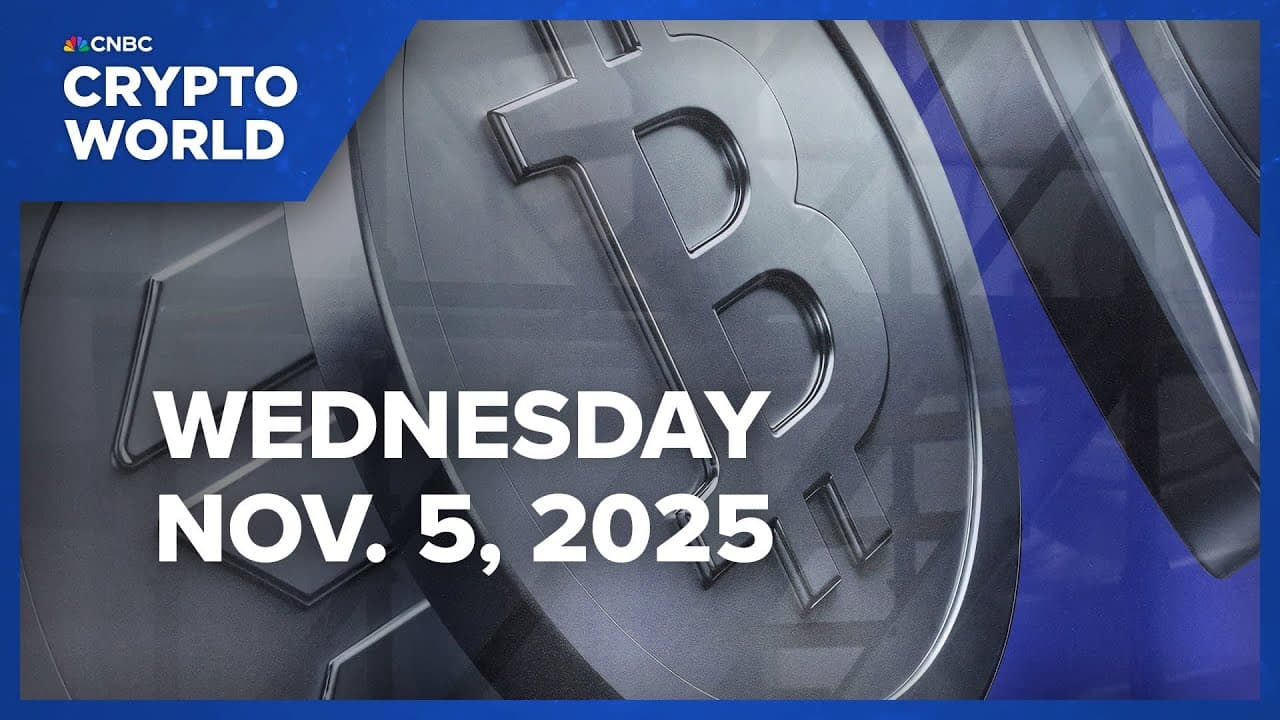
Why Did Bitcoin Rebound After the Crypto Sell-Off?
TL;DR
Bitcoin rebounded above $103,000 as the crypto sell-off paused and U.S. equities also rose, but slowing ETF flows and weakened risk appetite remained important concerns. Ripple, meanwhile, raised $500 million at a $40 billion valuation and is expanding beyond payments into stablecoins, crypto custody, prime brokerage, and corporate treasury management.
Transcript
Today, crypto prices take a break from this week's sell-off. A panel of federal judges expressed doubts they should grant an appeal of Sam Bankman Freed's fraud conviction. And Brad Garlinghouse, the CEO of Ripple, breaks down the company's growth plans from the firm's Swell Conference in New York City. Welcome to CNBC's Crypto World. I'm Talia Kap... Read More
Key Insights
- Bitcoin's rebound followed a two-day sell-off that had pushed the cryptocurrency below $100,000 for the first time in four months. By noon Eastern, Bitcoin was up more than 1.5% and trading just under $104,000, while Ether and XRP also advanced.
- The crypto recovery aligned with gains in U.S. equities as companies associated with the AI trade attempted to rebound from valuation concerns. Investors were also considering the Supreme Court's skepticism toward President Trump's tariffs, placing the cryptocurrency move within a broader improvement in market risk appetite.
- Slowing ETF flows and fading risk appetite were identified by Citi analysts as major causes of the recent crypto sell-off. Their note said cryptocurrency markets had remained weak despite an upbeat trend in stocks, showing that digital assets were not simply following broader equity strength.
- The October 10 liquidations may have damaged risk appetite among crypto-native investors and spot ETF participants. Citi's onchain analysis also found that Bitcoin whale holdings were gradually declining while holdings in smaller retail wallets were increasing, indicating a change in the distribution of ownership.
- Spot ETF flows are the key indicator to watch for a change in crypto market sentiment, according to Citi analysts. They still viewed financial advisers and other investors as being early in the adoption cycle, but suggested stronger flows would be needed to support a clearer improvement.
- Sam Bankman-Fried's appeal faced skepticism from a three-judge federal panel, including a judge who cited very substantial evidence of guilt. His attorney argued that the original trial was fundamentally unfair, partly because prosecutors described customer and lender losses as permanently unrecoverable.
- Ripple's $500 million funding round valued the company at $40 billion after several acquisitions and an expansion beyond payments. Its newer business lines include crypto-asset custody, prime brokerage, and corporate treasury management, supporting its effort to serve institutional clients with digital-asset technology.
- RLUSD is designed primarily for institutional payments and collateral rather than broad consumer distribution. Garlinghouse said the stablecoin passed a $1 billion market capitalization in ten months and could be used when a payment corridor or currency pair is more efficient with RLUSD than XRP.
Install to Summarize YouTube Videos and Get Transcripts
Explore YouTube Video Summarizer or Get YouTube Transcript Extractor
Questions & Answers
Q: Why did Bitcoin rebound after the crypto sell-off?
Bitcoin rebounded as the two-day cryptocurrency sell-off paused and broader U.S. equities moved higher. By noon Eastern, Bitcoin had gained more than 1.5% and was trading just under $104,000. The recovery aligned with a rebound among companies associated with the AI trade, although slowing ETF flows and diminished risk appetite remained concerns for the cryptocurrency market.
Q: What caused the recent cryptocurrency market sell-off?
Citi analysts attributed the sell-off to slowing ETF flows over the preceding weeks and fading appetite for risk. They also suggested that the October 10 liquidations may have impaired sentiment among crypto-native investors and spot ETF participants. This weakness occurred despite an upbeat trend in stocks, showing that cryptocurrency markets had recently faced pressures beyond general equity-market performance.
Q: What do Bitcoin wallet trends reveal about investor behavior?
Onchain metrics cited by Citi showed that Bitcoin whale holdings were gradually declining while balances in smaller retail wallets were increasing. The report did not establish a single cause for this change, but it showed that ownership was shifting away from larger holders toward smaller wallets. Citi nevertheless described spot ETF flows as the key measure for detecting a broader change in sentiment.
Q: Why are spot Bitcoin ETF flows important to market sentiment?
Spot ETF flows indicate whether investment demand is strengthening or weakening through regulated market products. Citi analysts said these flows would be the key factor to monitor for a change in crypto sentiment. Although they believed financial advisers and other investors remained early in the adoption cycle, the recent slowdown in flows contributed to market weakness and reduced appetite for risk.
Q: Why did judges appear skeptical of Sam Bankman-Fried's appeal?
A three-judge panel repeatedly interrupted attorney Alexandra Shapiro as she argued that Sam Bankman-Fried deserved a new trial because the original proceeding was fundamentally unfair. One judge said the record contained very substantial evidence of guilt. Shapiro challenged prosecutors' characterization of customer and lender losses, pointing to creditor recoveries and the assets remaining in the FTX estate.
Q: How is Ripple expanding beyond cryptocurrency payments?
Ripple is moving into crypto-asset custody, prime brokerage, and corporate treasury management as it broadens its institutional product base. The company has completed several acquisitions and raised $500 million at a $40 billion valuation. Ripple President Monica Long said the company did not need the capital, but institutional investors wanted an opportunity to own a share of the business.
Q: How does Ripple plan to use the RLUSD stablecoin?
Ripple plans to focus RLUSD distribution on institutional use cases, including payments and regulated collateral. Garlinghouse said Ripple integrates RLUSD into payment flows when a corridor or currency pair can operate more efficiently or inexpensively with a stablecoin than with XRP. RLUSD can also be used as collateral on Ripple Prime, the company's prime brokerage platform.
Q: What cryptocurrency regulations does Ripple want in the United States?
Ripple wants clear rules defining when a digital asset is a security and when it is a commodity. Garlinghouse welcomed the stablecoin clarity provided by the Genius Act and expressed hope for progress on the Clarity Act. He said other digital assets should receive the type of legal clarity that XRP obtained through the courts, while emphasizing Ripple's compliance-first approach.
Summary & Key Takeaways
-
Major cryptocurrencies recovered modestly after a two-day decline pushed Bitcoin below $100,000 for the first time in four months. By noon Eastern, Bitcoin had risen more than 1.5% to just under $104,000, Ether traded at $3,436, and XRP gained more than 2% as U.S. equities also moved higher.
-
Citi analysts attributed the preceding crypto weakness to slowing spot ETF flows and fading risk appetite, partly following the October 10 liquidations. Onchain metrics indicated declining Bitcoin whale holdings and growing balances in smaller retail wallets. The analysts identified spot ETF flows as the key signal for a potential shift in market sentiment.
-
Ripple raised $500 million at a $40 billion valuation while expanding beyond payments through acquisitions and new institutional services. CEO Brad Garlinghouse said RLUSD had surpassed a $1 billion market capitalization in ten months and would support payments and regulated institutional collateral. Ripple is also seeking clearer U.S. digital-asset classifications.
Read in Other Languages (beta)
Share This Summary 📚
Summarize YouTube Videos and Get Video Transcripts with 1-Click
Try YouTube Summary with ChatGPT & Claude or YouTube Transcript Generator
Explore More Summaries from CNBC Television 📚





Summarize YouTube Videos and Get Video Transcripts with 1-Click
Try YouTube Summary with ChatGPT & Claude or YouTube Transcript Generator