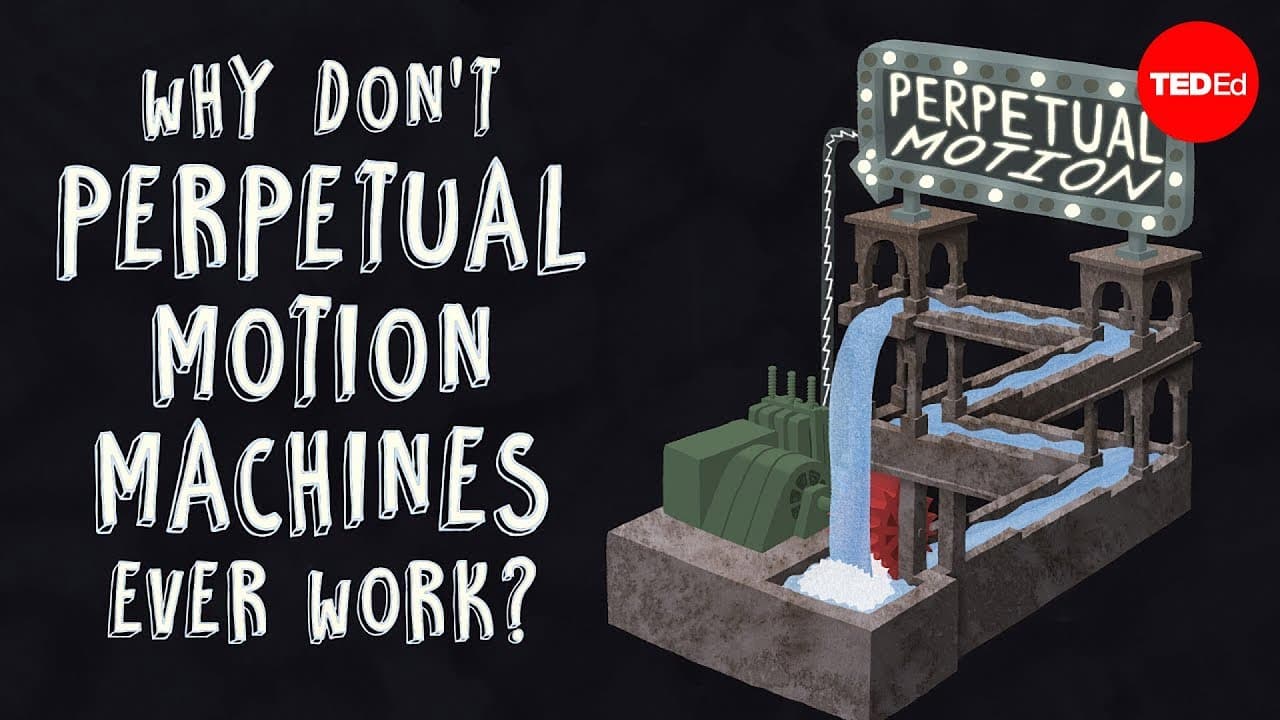
Why don't perpetual motion machines ever work? - Netta Schramm
TL;DR
Perpetual motion machines, which can do work indefinitely without any external energy source, have been a subject of fascination for inventors. However, they violate fundamental laws of thermodynamics and do not work.
Transcript
Around 1159 A.D., a mathematician called Bhaskara the Learned sketched a design for a wheel containing curved reservoirs of mercury. He reasoned that as the wheels spun, the mercury would flow to the bottom of each reservoir, leaving one side of the wheel perpetually heavier than the other. The imbalance would keep the wheel turning forever. Bhask... Read More
Key Insights
- 👮 Perpetual motion machines have fascinated inventors for centuries but are fundamentally impossible due to the laws of thermodynamics.
- 🤳 Designs such as over-balanced wheels, self-watering pots, and magnet-based devices have all failed in realizing perpetual motion.
- 👮 The first law of thermodynamics states that energy cannot be created or destroyed, while the second law highlights that energy tends to spread out, preventing perpetual motion.
- 🥵 Even if a machine managed to bypass the first law, friction and heat loss would cause it to inevitably stop.
Install to Summarize YouTube Videos and Get Transcripts
Explore YouTube Video Summarizer or Get YouTube Transcript Extractor
Questions & Answers
Q: Why are perpetual motion machines impossible?
Perpetual motion machines violate the first law of thermodynamics, which states that energy cannot be created or destroyed. Therefore, a machine can only produce as much energy as it consumes, making perpetual motion impossible.
Q: What are some examples of failed perpetual motion machine designs?
Examples include Bhaskara's over-balanced wheel with rolling balls or weights on swinging arms and Robert Boyle's self-watering pot. These designs either fail due to the shifting center of mass or the inability to overcome gravity or magnetism.
Q: Could a perpetual motion machine work if it didn't violate the laws of thermodynamics?
Even if a machine were designed to not violate the first law of thermodynamics, it would still be subject to the second law. Energy tends to spread out through processes like friction, and any real machine would experience friction and heat loss, eventually causing it to stop.
Q: Is there a possibility of discovering a perpetual motion machine in the future?
While it is difficult to definitively say, currently, the laws of thermodynamics suggest that perpetual motion machines are impossible. However, as our understanding of the universe grows, we may encounter new forms of matter or uncover phenomena on quantum scales that could challenge our current knowledge.
Summary
This video explores the concept of perpetual motion machines, which are devices that can do work indefinitely without any external energy source. While inventors have proposed various ideas for such machines throughout history, they all violate one or more fundamental laws of thermodynamics. The first law states that energy cannot be created or destroyed, ruling out the possibility of generating more energy than is put in. The second law explains that energy tends to spread out through processes like friction, making it unlikely for any real machine to sustain perpetual motion. Despite these limitations, the search for perpetual motion machines continues, fueled by the possibility of new scientific discoveries.
Questions & Answers
Q: Who was Bhaskara the Learned and what was his contribution to perpetual motion?
Bhaskara the Learned was a mathematician who sketched a design for a wheel containing curved reservoirs of mercury around 1159 A.D. He believed that as the wheel spun, the mercury would flow to the bottom of each reservoir, creating an imbalance that would keep the wheel turning forever. His design was one of the earliest examples of a perpetual motion machine.
Q: Why have perpetual motion machines captured inventors' imaginations?
Perpetual motion machines have captured inventors' imaginations because they have the potential to transform our relationship with energy. If such a machine existed and included humans as part of its perfectly efficient system, it could sustain life indefinitely. The idea of a machine that produces its own energy without the need for external sources has been a fascinating concept.
Q: What fundamental laws of thermodynamics do perpetual motion machines violate?
Perpetual motion machines violate one or more fundamental laws of thermodynamics. The first law states that energy cannot be created or destroyed. Therefore, a perpetual motion machine would only ever produce as much energy as it consumed, ruling out the possibility of generating excess energy. The second law explains that energy tends to spread out through processes like friction, making it impossible for a real machine to sustain perpetual motion.
Q: Are there any designs or ideas that come close to achieving perpetual motion?
Inventors have proposed various ideas and designs for perpetual motion machines. Some of these include variations on Bhaskara's over-balanced wheel with rolling balls or weights on swinging arms. However, none of these designs have been successful. The moving parts that make one side of the wheel heavier also shift its center of mass downward, causing the wheel to swing back and forth like a pendulum before eventually coming to a stop. Other ideas, such as using capillary action or magnets, also fail to achieve perpetual motion.
Q: Why do these machines fail to achieve perpetual motion?
These machines fail to achieve perpetual motion because they would need to create extra energy to continue moving beyond their stopping point. This would violate the first law of thermodynamics, which states that energy cannot be created. Additionally, even if engineers were able to design a machine that didn't violate the first law, the second law of thermodynamics comes into play. Energy tends to spread out through processes like friction, leading to the gradual reduction of available energy and ultimately causing the machine to stop.
Q: Is it possible that the laws of thermodynamics could be revisited in the future?
While it is challenging to conclusively say that we will never discover a perpetual motion machine, the currently known laws of thermodynamics have stymied all ideas thus far. It is always possible that new scientific discoveries, such as exotic forms of matter or phenomena on quantum scales, could force a reexamination of the laws of thermodynamics. However, at present, the search for perpetual motion machines continues, driven by the understanding that there is still much about the universe that we do not know.
Takeaways
The concept of perpetual motion machines, which can do work indefinitely without external energy, has fascinated inventors throughout history. However, all proposed ideas for such machines have violated fundamental laws of thermodynamics, specifically the first and second laws. The first law states that energy cannot be created, making it impossible for a machine to generate more energy than it consumes. The second law explains that energy tends to spread out through processes like friction, ultimately leading to the dissipation of energy and the machine coming to a stop. While the discovery of a perpetual motion machine cannot be definitively ruled out, the search continues, driven by the possibility of new scientific discoveries in the future.
Summary & Key Takeaways
-
Bhaskara the Learned sketched a design for a perpetual motion machine in 1159 A.D., but it violated the laws of thermodynamics.
-
Various attempts have been made to create perpetual motion machines, including over-balanced wheels and self-watering pots, but all have failed.
-
The first and second laws of thermodynamics, which state that energy cannot be created or destroyed and tend to spread out, respectively, prevent the creation of perpetual motion machines.
Read in Other Languages (beta)
Share This Summary 📚
Summarize YouTube Videos and Get Video Transcripts with 1-Click
Try YouTube Summary with ChatGPT & Claude or YouTube Transcript Generator
Explore More Summaries from TED-Ed 📚




Summarize YouTube Videos and Get Video Transcripts with 1-Click
Try YouTube Summary with ChatGPT & Claude or YouTube Transcript Generator