How to Build a Brand That Commands Higher Prices
TL;DR
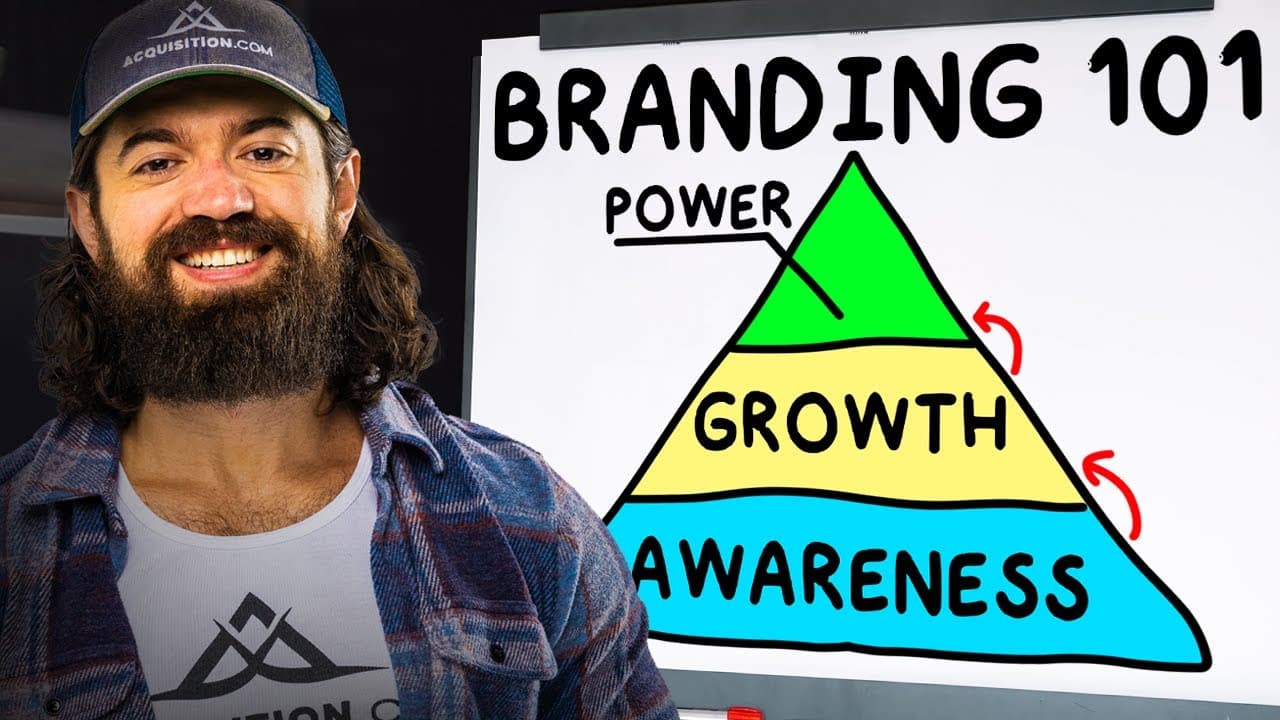
Branding builds deliberate associations between a business and ideas its target customers already value. Strong, repeated associations can increase conversion, support higher prices, reduce customer acquisition cost, and encourage repeat purchases, but the process begins by choosing a growing, affluent, reachable audience with a real need for the offer.
Transcript
you can get people to pay you 10 times more than they pay somebody else you can get customers to convert on ads 10 times higher than they normally do which means it cost you a tenth to get 10 times more that's a 100x differential and that is how massive Brands print money over time and so I want to give you the six steps to building a personal bran... Read More
Key Insights
- Branding is the association between two things, typically pairing an unfamiliar person or business with something the intended audience already knows and likes. Repetition strengthens the pairing until the favorable meaning can remain attached to the brand by itself.
- Pairing is the active process used to build a brand. Every appearance, message, relationship, and context can shape what customers associate with a business, whether those associations are chosen deliberately or formed haphazardly through inconsistent activity.
- A chaotic brand is a meaningless brand because too many unrelated associations prevent audiences from identifying what it represents. Focused branding resembles cultivating a garden, where unwanted associations are removed and the desired ones are repeatedly reinforced.
- Customer acquisition cost is the amount required to acquire a customer, while lifetime value is the gross profit earned across that customer's relationship with the business. Their ratio represents the fundamental economic exchange behind how much a business spends to generate more money.
- A strong brand can improve both sides of business economics. It may increase audience conversion, reduce acquisition cost, support higher prices, encourage repeat purchases, and make customers less willing to buy from competing providers.
- Brand building is a form of teaching because repeated pairings train customers to connect a business with a specific meaning. This process takes time, but sufficiently strong positive associations can become a durable source of economic value.
- The right target market is growing, financially capable, easy to locate, and experiencing a real problem. These four qualifications improve the likelihood that a business can reach customers, charge appropriately, and sell an offer they already want.
- Specialization supports premium positioning and operational consistency because a business can solve similar problems repeatedly for one defined market. A generalist must accommodate varied customers and may need to develop custom solutions each time someone new enters the business.
Install to Summarize YouTube Videos and Get Transcripts
Explore YouTube Video Summarizer or Get YouTube Transcript Extractor
Questions & Answers
Q: What is branding in business?
Branding is the association between two things. A business builds its brand by repeatedly pairing itself, or a personal brand, with qualities, contexts, or ideas that the intended audience already recognizes and likes. Once the association becomes strong enough, the favorable meaning remains connected to the brand even when the original paired element is no longer present.
Q: How can branding help a business charge higher prices?
Branding can support higher prices by creating strong positive associations with the customers a business wants to serve. When those customers connect the company with a valued quality and understand what it represents, the offer is less likely to be judged only against the commoditized market price. The resulting preference can make customers willing to pay more.
Q: Why does a strong brand lower customer acquisition cost?
A strong brand can lower customer acquisition cost because positive associations may cause a higher percentage of the audience to convert. When more people respond to the same advertising or marketing activity, the business spends less to acquire each customer. The transcript also argues that branding can combine higher conversion with higher customer value, improving the overall economics of acquisition.
Q: What is the relationship between lifetime value and customer acquisition cost?
Customer acquisition cost is how much a business spends to acquire a customer, while lifetime value is the gross profit generated from that customer throughout the relationship. The example given is spending one dollar to acquire a customer who produces ten dollars in gross profit, creating a 10-to-1 lifetime-value-to-acquisition-cost ratio. This relationship is presented as a fundamental business measure.
Q: How do repeated associations build a brand?
Repeated associations teach an audience to connect a person or business with a particular quality, category, or context. If the same pairing appears consistently, the connection becomes stronger until people make the association automatically. The process works best when the paired idea is already familiar and desirable to the intended customer, allowing some of that positive meaning to transfer.
Q: Why can inconsistent branding weaken a business?
Inconsistent branding creates many unrelated associations, making it difficult for customers to understand what the business represents. The transcript compares this problem to a garden filled with several unrelated flowers instead of a concentrated display of red roses. A business must remove unwanted associations and repeatedly cultivate the desired ones to establish a clear, recognizable meaning.
Q: How should a business choose its target market?
A business should look for a target market with four characteristics: it is growing, its members can afford the offer, its members are easy to find, and they experience a problem that creates demand for the service. These criteria help the company pursue an expanding opportunity, reach buyers efficiently, charge appropriately, and sell something customers genuinely want.
Q: Why should a service business specialize instead of remaining a generalist?
Specialization allows a service business to focus on a defined market and potentially charge a premium for relevant expertise. It also makes operations more consistent because the company can perform similar work repeatedly for similar customers. A generalist faces more varied needs and may have to create custom solutions for each new customer, making delivery less repeatable.
Summary & Key Takeaways
-
Branding is the deliberate pairing of a person or business with qualities an audience already knows and likes. Repeating a focused pairing transfers that positive association to the brand. Unmanaged pairings create confusion, while consistent associations teach customers what the brand represents and distinguish it within a crowded market.
-
A brand improves business economics by influencing both customer acquisition cost and lifetime value. Positive associations can raise conversion rates, support premium pricing, encourage customers to purchase repeatedly, and reduce their interest in alternatives. These effects strengthen the fundamental relationship between what acquiring a customer costs and the gross profit that customer generates.
-
Effective branding starts with selecting a precise audience rather than serving everyone as a generalist. The preferred market is growing, has enough money to afford the offer, is easy to identify and target, and experiences a meaningful problem. Specialization also makes service delivery more repeatable and reduces the need for custom solutions.
Read in Other Languages (beta)
Share This Summary 📚
Summarize YouTube Videos and Get Video Transcripts with 1-Click
Try YouTube Summary with ChatGPT & Claude or YouTube Transcript Generator
Explore More Summaries from Alex Hormozi 📚






Summarize YouTube Videos and Get Video Transcripts with 1-Click
Try YouTube Summary with ChatGPT & Claude or YouTube Transcript Generator