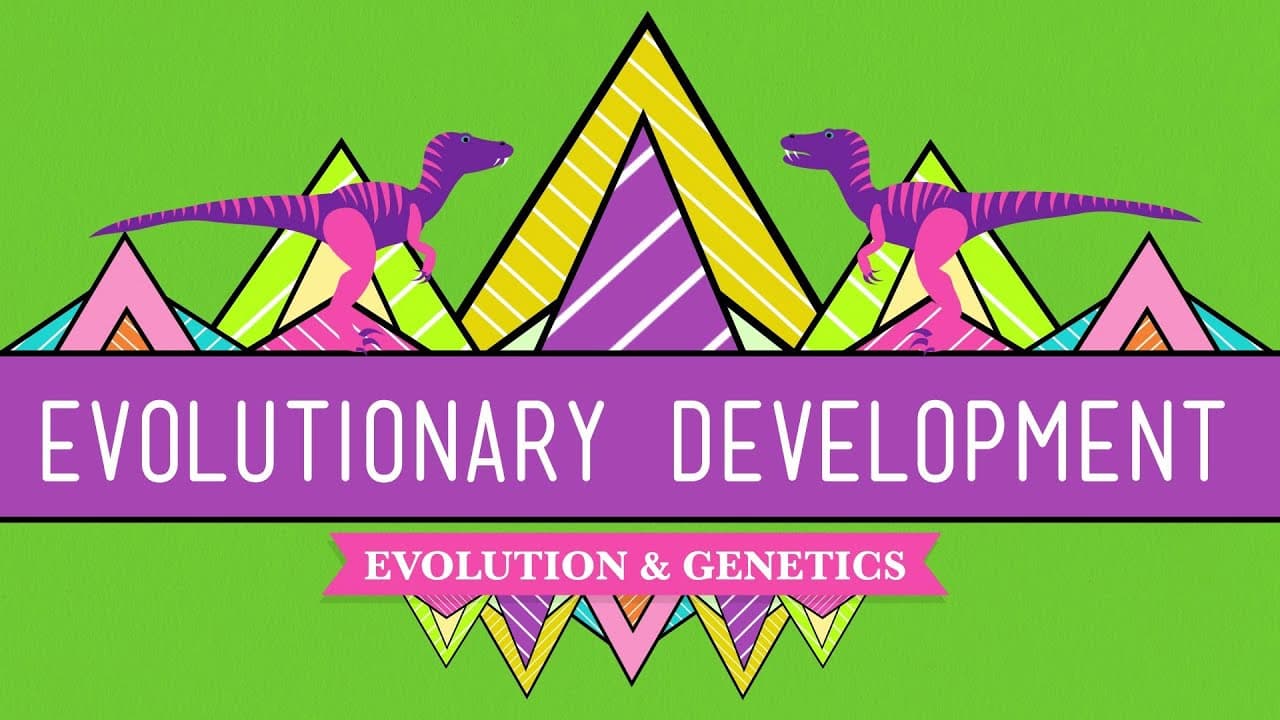
Evolutionary Development: Chicken Teeth - Crash Course Biology #17
TL;DR
Evo-Devo explores genetic similarities and evolutionary changes in organisms.
Transcript
When little kids say they want to grow up to be a scientist, here's what they actually mean: a. They want to blow things up in a laboratory setting. b. They want to get bitten by a radioactive monkey which will turn them into a terrifying humanoid battle monkey. c. They want to make a fly with eyeballs on its butt, or like, chickens with fangs. Mos... Read More
Key Insights
- Evolutionary developmental biology, or Evo-Devo, examines genetic instructions that guide the development of organisms, revealing evolutionary mechanisms and similarities among species.
- Developmental regulatory genes, including hox genes, play a crucial role in determining the body plan of organisms by activating specific genes at the right time during development.
- Hox genes act as master architects, dictating where body parts should be placed without detailing how they should be constructed, leaving that to subordinate genes.
- Genetic similarities between species, such as humans and mice sharing 85% of their DNA, highlight the shared evolutionary history and common regulatory genes across different animal groups.
- Evo-Devo offers insights into rapid evolutionary changes, suggesting that minor mutations in regulatory genes can lead to significant changes in an organism's physical form.
- Experiments with fruit flies demonstrate that regulatory genes can instruct the formation of body parts, such as eyes, in unconventional locations, showcasing genetic flexibility.
- Research indicates that latent genes, like those for teeth in birds, can be reactivated through mutations, leading to the reappearance of ancestral traits.
- The study of Evo-Devo is relatively new and continues to evolve, with ongoing research into the roles of regulatory genes and the potential functions of previously considered 'junk DNA'.
Install to Summarize YouTube Videos and Get Transcripts
Explore YouTube Video Summarizer or Get YouTube Transcript Extractor
Questions & Answers
Q: What is evolutionary developmental biology?
Evolutionary developmental biology, or Evo-Devo, is a scientific discipline that studies the genetic instructions governing the development of organisms. It aims to understand how these instructions lead to the formation of different body parts and how these processes have evolved over time, revealing genetic similarities and differences among species.
Q: How do developmental regulatory genes function?
Developmental regulatory genes, such as hox genes, play a crucial role in directing the development of an organism's body plan. They activate specific genes at the right time and location, ensuring that body parts develop in the correct order and position. These genes act as master architects, providing instructions without detailing the construction process.
Q: What are hox genes and their significance?
Hox genes are a type of regulatory gene that control the identity and placement of body parts in an organism. They are significant because they dictate the overall body plan, determining where limbs, tails, and other structures should be placed. Hox genes are highly conserved across species, highlighting common evolutionary ancestry.
Q: How do genetic similarities among species relate to Evo-Devo?
Genetic similarities among species, such as humans and mice sharing 85% of their DNA, are crucial to Evo-Devo. These similarities indicate shared evolutionary history and the presence of common regulatory genes that guide the development of similar body structures across different species, emphasizing the interconnectedness of life.
Q: What role do mutations play in Evo-Devo?
In Evo-Devo, mutations in regulatory genes can lead to significant evolutionary changes. A small mutation at the top of the genetic hierarchy can have profound effects on an organism's morphology, explaining how rapid evolutionary transformations occur without extensive genetic changes, such as the loss of teeth in birds.
Q: How do experiments with fruit flies illustrate Evo-Devo concepts?
Experiments with fruit flies demonstrate Evo-Devo concepts by showing how regulatory genes can direct the formation of body parts in unconventional locations. For example, inserting a mouse hox gene into a fruit fly led to the development of a fruit fly eye on its leg, illustrating genetic flexibility and the role of regulatory genes.
Q: Can ancestral traits reappear in modern species?
Yes, ancestral traits can reappear in modern species if latent genes are reactivated through mutations. For instance, chickens with reactivated genes can develop teeth, a trait lost millions of years ago. This phenomenon, observed in various species, highlights the potential for dormant genetic instructions to resurface under certain conditions.
Q: What is the significance of 'junk DNA' in Evo-Devo?
In Evo-Devo, 'junk DNA,' previously thought to be non-functional, may contain regulatory genes that play crucial roles in development. Scientists are exploring how these genes influence the activation and suppression of other genes, potentially reshaping our understanding of genetic regulation and evolutionary processes.
Summary & Key Takeaways
-
Evo-Devo, or evolutionary developmental biology, investigates how genetic instructions shape the development and evolution of organisms, revealing deep genetic similarities across species.
-
Regulatory genes, including hox genes, orchestrate the development of body plans by turning on specific genes at precise times, acting as master planners in the genetic hierarchy.
-
Evo-Devo research provides insights into rapid evolutionary changes, showing how small mutations in regulatory genes can lead to significant morphological transformations, such as the reappearance of ancestral traits.
Read in Other Languages (beta)
Share This Summary 📚
Summarize YouTube Videos and Get Video Transcripts with 1-Click
Try YouTube Summary with ChatGPT & Claude or YouTube Transcript Generator
Explore More Summaries from CrashCourse 📚



Summarize YouTube Videos and Get Video Transcripts with 1-Click
Try YouTube Summary with ChatGPT & Claude or YouTube Transcript Generator