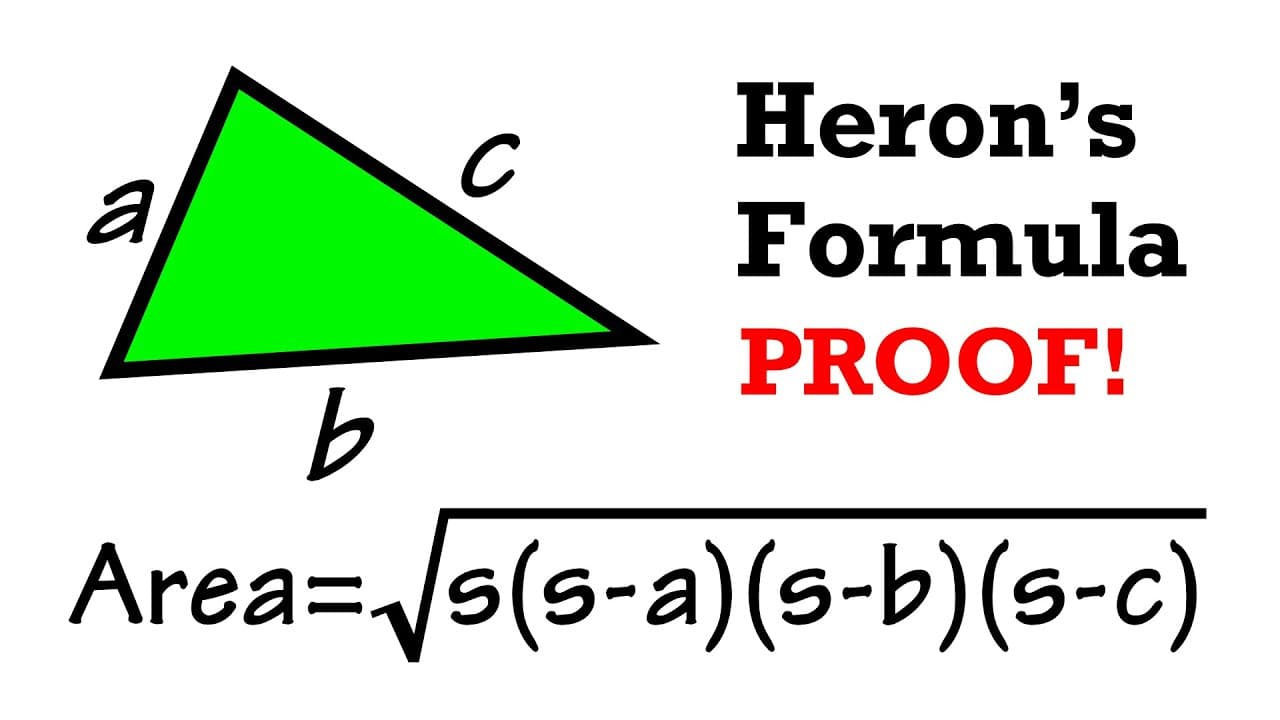
Heron's Formula Proof (the area of a triangle when you know all three sides)
TL;DR
This video provides a step-by-step proof of the Heron's Formula for finding the area of a triangle.
Transcript
okay here we'll prove the hijran's formula and here we go first let's begin with the triangle and let me just draw it right here and i will call this to be a b and c and remember the area of the triangle is just going to be one half base times height and let me take this for the base and i would just say here is going to be the height and... Read More
Key Insights
- 🙃 The Heron's Formula allows for the calculation of a triangle's area using only the lengths of its sides.
- 😒 The proof involves algebraic manipulations and the use of relevant mathematical identities such as the Pythagorean theorem and the difference of two squares.
- 😑 The formula is expressed in terms of the triangle's semi-perimeter, allowing for an efficient calculation of the area.
- 🔺 The formula is widely used in geometry and trigonometry to solve various problems involving triangles.
- ❓ Understanding the derivations and proofs of mathematical formulas enhances mathematical knowledge and problem-solving skills.
- 📛 The Heron's Formula is named after Hero of Alexandria, who first recorded it in his book "Metrica" in the 1st century AD.
- 🏑 The formula is a fundamental tool in fields such as engineering, architecture, and physics, where the area of triangles needs to be determined accurately.
Install to Summarize YouTube Videos and Get Transcripts
Explore YouTube Video Summarizer or Get YouTube Transcript Extractor
Questions & Answers
Q: What is the purpose of the Heron's Formula?
The Heron's Formula allows us to find the area of a triangle when we know the lengths of its sides without needing the height or the angle measurements.
Q: How does the proof of the Heron's Formula start?
The proof begins by considering a triangle and its base and height, and then expressing the area of the triangle as one-half times the base times the height.
Q: What equations are used to derive the Heron's Formula?
The equations used include the Pythagorean theorem, which relates the sides and heights of a right triangle, and the difference of two squares identity.
Q: How is the Heron's Formula expressed in terms of the triangle's side lengths?
The Heron's Formula can be written as the square root of (s)(s - a)(s - b)(s - c), where s is the semi-perimeter of the triangle and a, b, and c are the lengths of its sides.
Summary & Key Takeaways
-
The video presents the derivation of the Heron's Formula, which calculates the area of a triangle.
-
The derivation starts by considering a triangle and its base and height.
-
Several equations and substitutions are made to simplify the formula and express it in terms of the triangle's side lengths.
Read in Other Languages (beta)
Share This Summary 📚
Summarize YouTube Videos and Get Video Transcripts with 1-Click
Try YouTube Summary with ChatGPT & Claude or YouTube Transcript Generator
Explore More Summaries from blackpenredpen 📚
Summarize YouTube Videos and Get Video Transcripts with 1-Click
Try YouTube Summary with ChatGPT & Claude or YouTube Transcript Generator