What Is Linear Discriminant Analysis (LDA)?
TL;DR
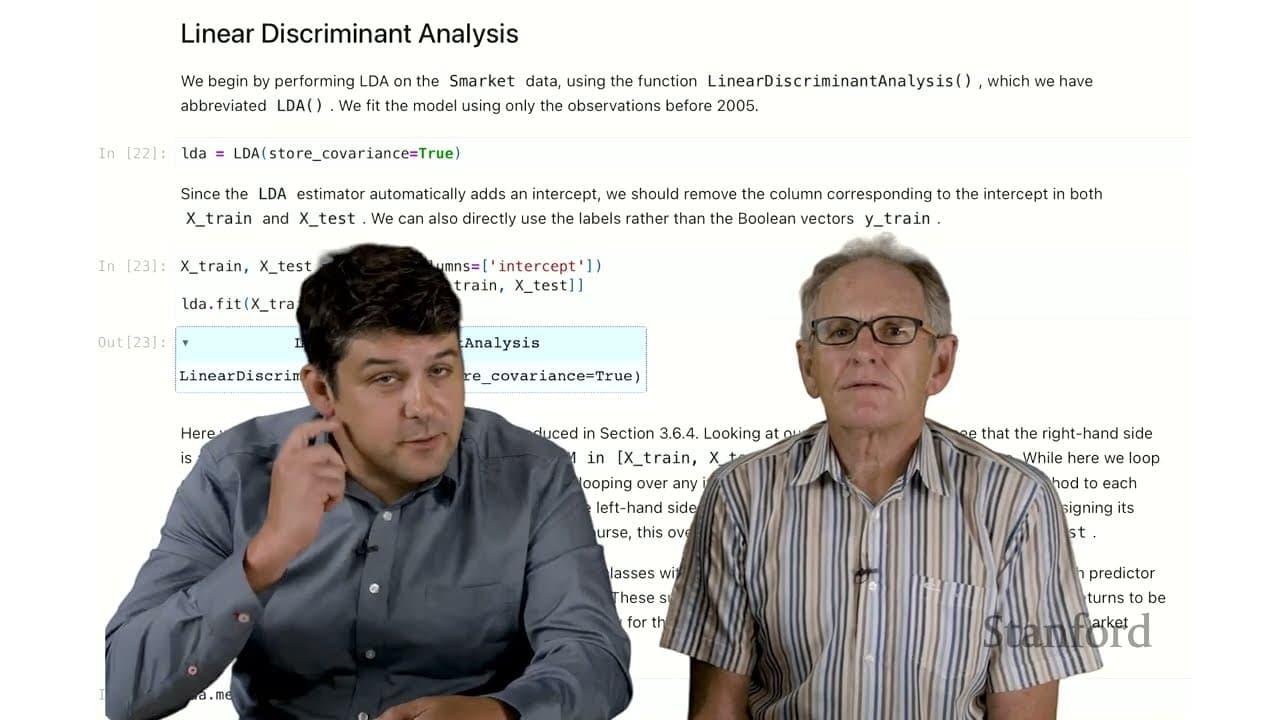
Linear Discriminant Analysis (LDA) is a powerful classifier that works by analyzing features and responses to make predictions. This video covers LDA alongside Quadratic Discriminant Analysis (QDA) and Naive Bayes, explaining their functionality, covariance considerations, and how to evaluate their accuracy using confusion matrices. Expect insights into their comparative performances with financial data.
Transcript
so after logistic regression we're going to start talking about um which was using stats models we'll start using some of the classifiers from Psych learn so the first one we will fit is this LDA model um so the way uh pych learn works for these prediction problems is there's some object um in this case we've called it LDA that was just a shorthand... Read More
Key Insights
- ❓ Logistic regression was previously discussed, and now the focus is on different classifiers such as LDA, QDA, and naive Bayes.
- 👻 LDA is a classifier from scikit-learn that fits on a matrix of features and a response, while QDA allows for class-specific covariance matrices.
- 💦 The intercept should be dropped for LDA to prevent issues with invertibility.
- 🏛️ Understanding the parameters of the LDA model, such as the common covariance and within-class means, is important for interpretation.
- 🫤 Naive Bayes is a simplified version of QDA with diagonal covariance matrices.
- 📈 Evaluating the performance of classifiers can be done using confusion matrices and accuracy metrics.
- 👋 LDA, QDA, and naive Bayes all achieve reasonably good accuracy on financial data.
Install to Summarize YouTube Videos and Get Transcripts
Explore YouTube Video Summarizer or Get YouTube Transcript Extractor
Questions & Answers
Q: How does LDA work as a classifier?
LDA, or linear discriminant analysis, is a classifier that fits on a matrix of features and a response. It can then predict on new data. LDA does not require any data input to the classifying object, only arguments such as storing the covariance matrix.
Q: Why is the intercept dropped for LDA?
LDA does not require the intercept and can become non-invertible if it is included. Therefore, it is advised to drop the intercept before fitting the LDA model.
Q: What are the parameters of the LDA model?
The parameters of the LDA model include the common covariance, within-class means, and a scaling matrix, which represents the discriminant function used for prediction.
Q: How does QDA differ from LDA?
QDA, or quadratic discriminant analysis, is similar to LDA but allows for class-specific covariance matrices. This makes QDA a more flexible classifier compared to LDA.
Q: What is the difference between naive Bayes and QDA?
Naive Bayes is a simplified version of QDA that imposes the constraint that the covariance matrices are diagonal. This reduces the number of parameters compared to QDA but still provides a reasonably accurate classifier.
Summary & Key Takeaways
-
Logistic regression has been discussed previously, and now the focus shifts to classifiers such as LDA, QDA, and naive Bayes.
-
LDA is a classifier from scikit-learn that requires no data input to the classifying object. It then fits on a matrix of features and a response and can predict on new data.
-
The process of splitting the data into a test and training set is explained, and the intercept is dropped for LDA.
-
The parameters of the LDA model, such as the common covariance and within-class means, are discussed.
-
The QDA classifier is introduced as a similar, but more flexible, alternative to LDA with class-specific covariance matrices.
-
Naive Bayes is described as a simplified version of QDA, with diagonal covariance matrices.
Read in Other Languages (beta)
Share This Summary 📚
Summarize YouTube Videos and Get Video Transcripts with 1-Click
Try YouTube Summary with ChatGPT & Claude or YouTube Transcript Generator
Explore More Summaries from Stanford Online 📚

Summarize YouTube Videos and Get Video Transcripts with 1-Click
Try YouTube Summary with ChatGPT & Claude or YouTube Transcript Generator