How Digital Light Processing (DLP) works
TL;DR
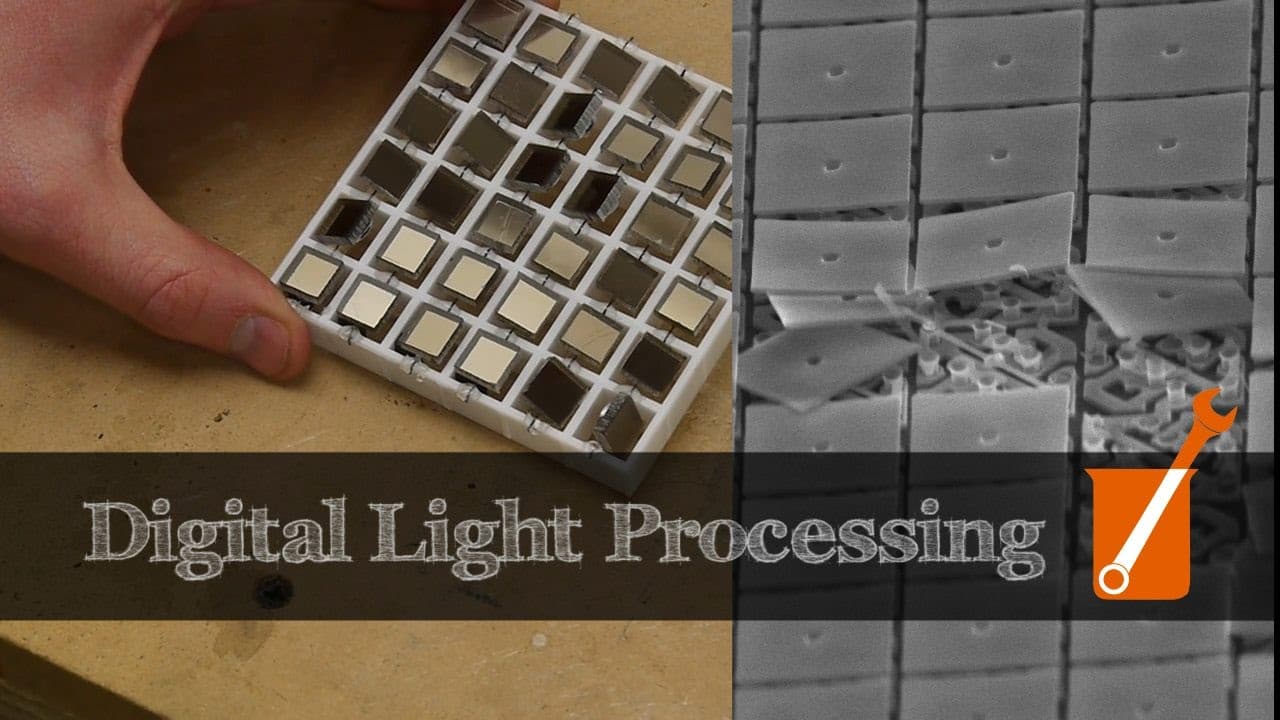
Digital white projectors use a digital micromirror device (DMD) with tiny mirrors that reflect or scatter light to create images on a projection screen. They are a cheaper and high-performance alternative to LCD projectors.
Transcript
today on Applied Science I'd like to talk about how digital white projectors work and so to demonstrate this I made a macro scale digital mirror chip which we'll have some fun with and then also we'll zoom way in and check out what an actual DLP chip looks like under the scanning electron microscope okay so let's get started almost all projectors w... Read More
Key Insights
- 🙂 Digital white projectors use a DMD with tiny mirrors to create images on a projection screen through reflection or scattering of light.
- 📽️ The DMD in a DLP projector simplifies the optical path by using a single light path, unlike LCD projectors.
- 🧑🦼 Color in DLP projectors is achieved through a spinning color wheel and color filters, while gray values are created by switching the mirrors on and off quickly.
- 📽️ DLP projectors offer a more cost-effective and high-performance alternative to LCD projectors.
- 🛩️ DLP projectors do not require polarization filters, resulting in more efficient use of light and smaller light source requirements.
- 👻 The mirrors in a DMD are controlled by an electrostatic attraction mechanism, allowing for fast operation and precise image rendering.
- 👻 The size of mirrors in a DMD is about 10 microns, and the suspension mechanism allows them to pivot back and forth.
Install to Summarize YouTube Videos and Get Transcripts
Explore YouTube Video Summarizer or Get YouTube Transcript Extractor
Questions & Answers
Q: How does a DMD in a digital white projector work?
The DMD in a digital white projector consists of thousands of tiny mirrors that represent individual pixels. By reflecting or scattering light through the projection lens, these mirrors create images on the screen.
Q: How does a DLP projector simplify the optical path compared to an LCD projector?
Unlike LCD projectors that require three separate LCDs for red, green, and blue colors, DLP projectors use a single light path, making the optical path simpler and reducing complexity.
Q: How do DLP projectors achieve color?
DLP projectors use a spinning color wheel and color filters. As the color wheel rotates, the mirrors in the DMD are adjusted to display the corresponding color, creating a full-color image on the screen.
Q: How do DLP projectors achieve gray values without semi-transparent pixels?
DLP projectors switch the mirrors on and off at a very high speed, creating the illusion of gray values. The small size of the mirrors allows for fast switching, making gray levels appear.
Summary & Key Takeaways
-
Digital white projectors work on the principle of using a DMD, which consists of tiny mirrors that reflect or scatter light to create images on a projection screen.
-
Unlike LCD projectors, DLP projectors utilize a single light path, which simplifies the optical path and improves performance.
-
Color is achieved in DLP projectors through a spinning color wheel and color filters.
Read in Other Languages (beta)
Share This Summary 📚
Summarize YouTube Videos and Get Video Transcripts with 1-Click
Try YouTube Summary with ChatGPT & Claude or YouTube Transcript Generator
Explore More Summaries from Applied Science 📚


Summarize YouTube Videos and Get Video Transcripts with 1-Click
Try YouTube Summary with ChatGPT & Claude or YouTube Transcript Generator