How Will Atlas Robots Address Worker Shortages?
TL;DR
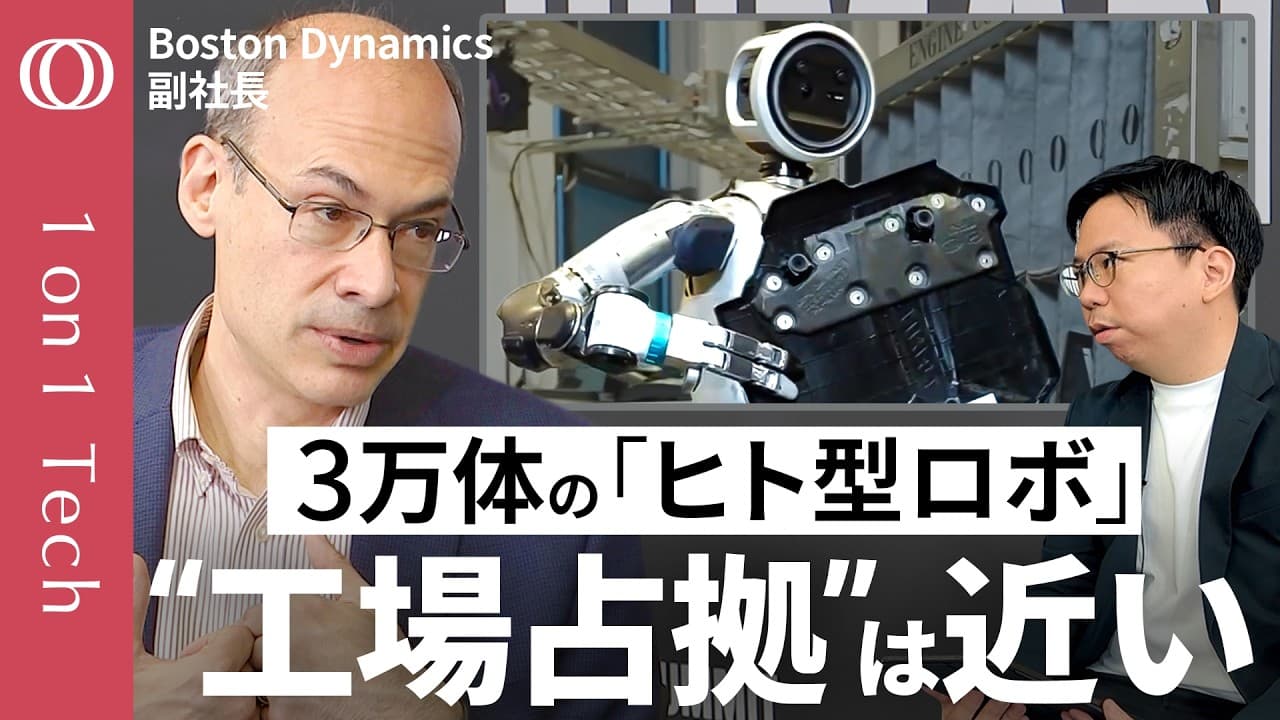
Atlas is being prepared for automotive manufacturing, where it can move parts, lift heavy objects, and perform tasks in spaces designed for people. Boston Dynamics combines scalable hardware, continuous reliability testing, and AI-trained behavioral models, with planned Hyundai factory deployments intended to address worker shortages while improving the efficiency and safety of physically demanding work.
Transcript
Wow. Dynamics. Okay, we have Brandon Schumman from Boston Dynamics here. Thank you for coming today. Thank you for having me. Yeah. Um, so Boston Dynamics has been at the very forefront of the robotics uh research and industry. Um I think it's one of the companies first companies to develop highly capable humanoid like Atlas. So and the robots that... Read More
Key Insights
- Boston Dynamics has worked on legged robots for more than 30 years, beginning as a spinout from the Massachusetts Institute of Technology. Its commercial focus began about seven years before the interview and centers on satisfying customer needs in practical industrial applications.
- Reliability is developed through continuous real-world testing. Spot robots walk around Boston Dynamics facilities 24 hours a day, repeatedly exposing failures that engineers can study and correct, turning long-term testing into a central complement to the company’s robotics research and engineering experience.
- Robot programming is shifting from deterministic instructions to AI training. Boston Dynamics uses reinforcement learning and large behavioral models, which rely on extensive behavioral data to help Atlas learn manufacturing actions demonstrated to it rather than requiring every movement to be programmed individually.
- Useful humanoid robots require both capable hardware and dependable software. AI can train behaviors, but the physical machine must still walk, move, touch, lift, and manipulate objects reliably before those learned behaviors can create repeatable value in an industrial environment.
- Atlas is designed for efficient manufacturing and repair. Its legs are interchangeable, and only two actuator designs are used across the entire robot, choices intended to simplify maintenance, lower costs, and support commercial deployment at a much larger scale.
- Spot is primarily suited to industrial inspection and public safety. Its low four-legged form is effective for scanning facilities, collecting data, supporting preventive maintenance, and entering dangerous situations, but it cannot perform many tasks requiring humanlike reach or two-handed manipulation.
- Atlas can learn from human demonstrations because its body resembles the operator’s. A person using a visual headset and hand controllers can see through the robot and generate movement data that transfers directly to Atlas, which would not map naturally onto Spot’s four-legged body.
- Automotive manufacturing offers an initial market for Atlas because factories need repetitive material movement and heavy lifting. Boston Dynamics demonstrated Atlas lifting a 45 kg refrigerator, illustrating its potential to handle loads that people should not lift in factory settings.
Install to Summarize YouTube Videos and Get Transcripts
Explore YouTube Video Summarizer or Get YouTube Transcript Extractor
Questions & Answers
Q: How will Atlas robots help address worker shortages?
Atlas is intended to perform automotive manufacturing tasks that are difficult, repetitive, dangerous, or physically demanding for people. Examples include moving components between sorting or staging containers, lifting objects into position, and handling heavy loads. Boston Dynamics sees factories as an initial market because worker shortages create demand for automation, while robot labor can contribute directly to producing goods with downstream value.
Q: What gives Boston Dynamics an advantage in legged robotics?
Boston Dynamics points to more than 30 years of work on legged robots, experienced roboticists, and sustained attention to commercial reliability. The company began as a spinout from the Massachusetts Institute of Technology and later shifted toward customer applications. Its advantage is presented not only as technical research expertise, but also as the ability to turn experimental machines into dependable products that solve industrial problems.
Q: How does Boston Dynamics make Spot robots reliable?
Boston Dynamics continuously tests Spot by having robots walk around its facilities 24 hours a day. Engineers expect failures to occur, observe what causes them, and use those findings to improve the system. This testing has continued for years, allowing reliability to develop through repeated operation rather than demonstrations alone. The approach supports Spot’s use in inspections and situations where dependable movement is essential.
Q: How has AI changed the development of Atlas?
AI has changed how Boston Dynamics creates robot behaviors. Instead of relying entirely on deterministic programming, the company uses reinforcement learning and large behavioral models. Engineers generate a large collection of behavioral data by showing the robot how to perform tasks, allowing Atlas to train on those demonstrations. The change affects behavioral programming, while hardware design and physical engineering remain necessary parts of development.
Q: What are large behavioral models for robots?
Large behavioral models are described as an approach for training robots through extensive data about actions and movements. Unlike large language models, which focus on language, text, or related content, these models focus on behavior. Demonstrations provide examples of how a task should be performed, and the resulting data helps a robot learn useful physical actions for applications such as manufacturing.
Q: Why does Atlas need a humanoid body?
A humanoid body allows Atlas to work in environments and perform tasks designed around people. It can reach higher areas, carry objects with two hands, and handle activities that Spot’s four-legged body cannot. The form also simplifies training from human demonstrations because movements recorded through a visual headset and hand controllers can transfer to a robot with a corresponding humanlike physical structure.
Q: What is the difference between Spot and Atlas?
Spot is a four-legged robot used mainly for industrial inspection and public safety. Its low form is effective for scanning, acquiring data, supporting preventive maintenance, and entering dangerous situations. Atlas has a humanoid form with two arms and legs, making it more appropriate for reaching, lifting, carrying, and manipulating objects in spaces and workflows originally designed for human workers.
Q: What tasks could Atlas perform in automotive factories?
Atlas could move parts from one sorting or staging container to another, lift components into place, and perform other actions within an automotive manufacturing cell. Boston Dynamics is particularly interested in heavy lifting and material movement because those tasks can injure human workers. The company demonstrated the robot lifting a 45 kg refrigerator to show the type of physical load it can handle.
Summary & Key Takeaways
-
Boston Dynamics attributes its strength to more than 30 years of legged robotics experience, skilled roboticists, and relentless reliability testing. Spot robots continuously walk around the company’s facilities so failures can be observed and corrected. Its commercial strategy focuses on delivering measurable value in industrial inspection, public safety, manufacturing, and other customer applications.
-
Generative AI techniques have changed how Boston Dynamics programs robot behavior. Atlas is trained with reinforcement learning and large behavioral models built from demonstrations rather than relying entirely on deterministic programming. Human operators can use visual headsets and hand controllers to produce training data that transfers naturally because Atlas has a humanlike body with two arms and two legs.
-
Atlas is planned for deployment at Hyundai’s automotive factory in Georgia, beginning later in the year discussed and increasing the following year. Proposed tasks include moving components between containers, lifting parts into position, and handling heavy objects. Manufacturing is the initial focus because it offers clear economic value and addresses hazardous work and worker shortages.
Read in Other Languages (beta)
Share This Summary 📚
Summarize YouTube Videos and Get Video Transcripts with 1-Click
Try YouTube Summary with ChatGPT & Claude or YouTube Transcript Generator
Explore More Summaries from TBS CROSS DIG with Bloomberg 📚





Summarize YouTube Videos and Get Video Transcripts with 1-Click
Try YouTube Summary with ChatGPT & Claude or YouTube Transcript Generator