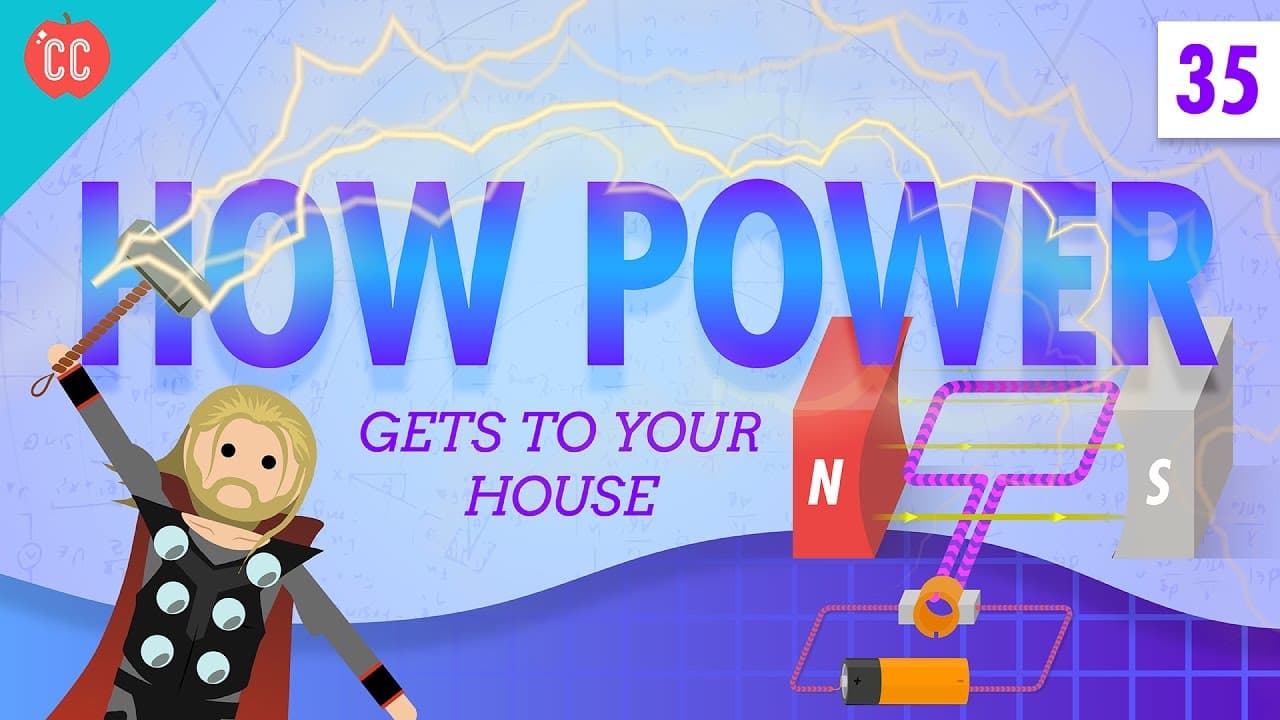
How Power Gets to Your Home: Crash Course Physics #35
TL;DR
Explains how electricity is generated and transmitted to homes.
Transcript
Wherever you are right now, there’s probably an electrical outlet within easy reach. Whether you want to vacuum the living room or recharge your phone, all you have to do is plug into the wall, and bam – instant access to electricity. But have you ever wondered how all of that electrical power gets to your house, school, or office in the first plac... Read More
Key Insights
- Electric generators convert mechanical energy into electrical energy using induction, which involves a rotating coil within a magnetic field.
- Alternating current (AC) is produced by generators due to the rotation of the coil, which reverses the current direction multiple times per second.
- Transformers are essential for adjusting the voltage of electricity, enabling efficient long-distance transmission by reducing power loss.
- High voltage transmission reduces energy loss as heat, making it more efficient than low voltage transmission.
- Mutual inductance in transformers allows voltage changes by inducing an electromotive force (emf) in a secondary coil.
- Step-up transformers increase voltage by having more loops in the secondary coil, while step-down transformers decrease voltage.
- Wireless chargers use mutual inductance to transfer power without physical connections, employing coils in both the charger and the device.
- The principles of induction and mutual inductance not only facilitate electricity transmission but also enable modern wireless technologies.
Install to Summarize YouTube Videos and Get Transcripts
Explore YouTube Video Summarizer or Get YouTube Transcript Extractor
Questions & Answers
Q: How do electric generators work?
Electric generators operate on the principle of induction, converting mechanical energy into electrical energy. They consist of a rotating coil within a magnetic field, which induces a current due to the changing magnetic flux. This process results in alternating current (AC) as the direction of the current reverses with each half-rotation of the coil.
Q: What is the significance of alternating current (AC) in electricity transmission?
Alternating current (AC) is crucial for electricity transmission because it enables the use of transformers, which require AC to function. Transformers adjust voltage levels, allowing electricity to be transmitted efficiently over long distances with minimal power loss. AC's ability to reverse direction multiple times per second is key to this process.
Q: Why are transformers necessary in the power transmission process?
Transformers are essential in power transmission because they adjust voltage levels, facilitating efficient long-distance electricity travel. By stepping up voltage, transformers reduce power loss as heat. Conversely, they step down voltage for safe usage in homes. This voltage adjustment is achieved through mutual inductance between coils in the transformer.
Q: How do transformers change voltage levels?
Transformers change voltage levels using mutual inductance, where a changing current in one coil induces an electromotive force (emf) in another coil. By varying the number of loops in the primary and secondary coils, transformers can step up or step down voltage. More loops in the secondary coil increase voltage, while fewer loops decrease it.
Q: What is mutual inductance and how is it applied in transformers?
Mutual inductance is the phenomenon where a changing current in one coil induces an electromotive force (emf) in a nearby coil. In transformers, mutual inductance allows voltage changes by transferring energy between the primary and secondary coils. This principle is crucial for adjusting voltage levels in electricity transmission and in applications like wireless charging.
Q: How do wireless chargers utilize mutual inductance?
Wireless chargers use mutual inductance to transfer power without physical connections. They contain coils in both the charging pad and the device. The alternating current (AC) in the charging pad induces an electromotive force (emf) in the device's coil, allowing it to charge the device's battery. This application of mutual inductance is a modern adaptation of the technology used in transformers.
Q: What are step-up and step-down transformers?
Step-up transformers increase voltage by having more loops in the secondary coil compared to the primary coil, while step-down transformers decrease voltage by having fewer loops. This adjustment is crucial for efficient power transmission and safe usage in homes. The change in voltage is determined by the ratio of loops between the coils.
Q: How does high voltage transmission reduce power loss?
High voltage transmission reduces power loss by minimizing energy wasted as heat. For the same power, a lower voltage results in a higher current, increasing power loss proportionally to the square of the current. By transmitting electricity at higher voltages, power loss is significantly reduced, making the transmission process more efficient over long distances.
Summary & Key Takeaways
-
This episode of Crash Course Physics explores the journey of electricity from power plants to our homes, highlighting the roles of generators and transformers. It delves into how mechanical energy is converted to electrical energy through induction, producing alternating current.
-
Transformers play a crucial role in electricity transmission by adjusting voltage levels, reducing energy loss during long-distance travel. The episode explains how step-up and step-down transformers work, using mutual inductance to change voltage efficiently.
-
The episode also touches on modern applications of mutual inductance, such as wireless chargers, demonstrating how the same principles used in electricity transmission are applied to transfer power between devices without physical connections.
Read in Other Languages (beta)
Share This Summary 📚
Summarize YouTube Videos and Get Video Transcripts with 1-Click
Try YouTube Summary with ChatGPT & Claude or YouTube Transcript Generator
Explore More Summaries from CrashCourse 📚

Summarize YouTube Videos and Get Video Transcripts with 1-Click
Try YouTube Summary with ChatGPT & Claude or YouTube Transcript Generator