What Does Death Note Say About Justice?
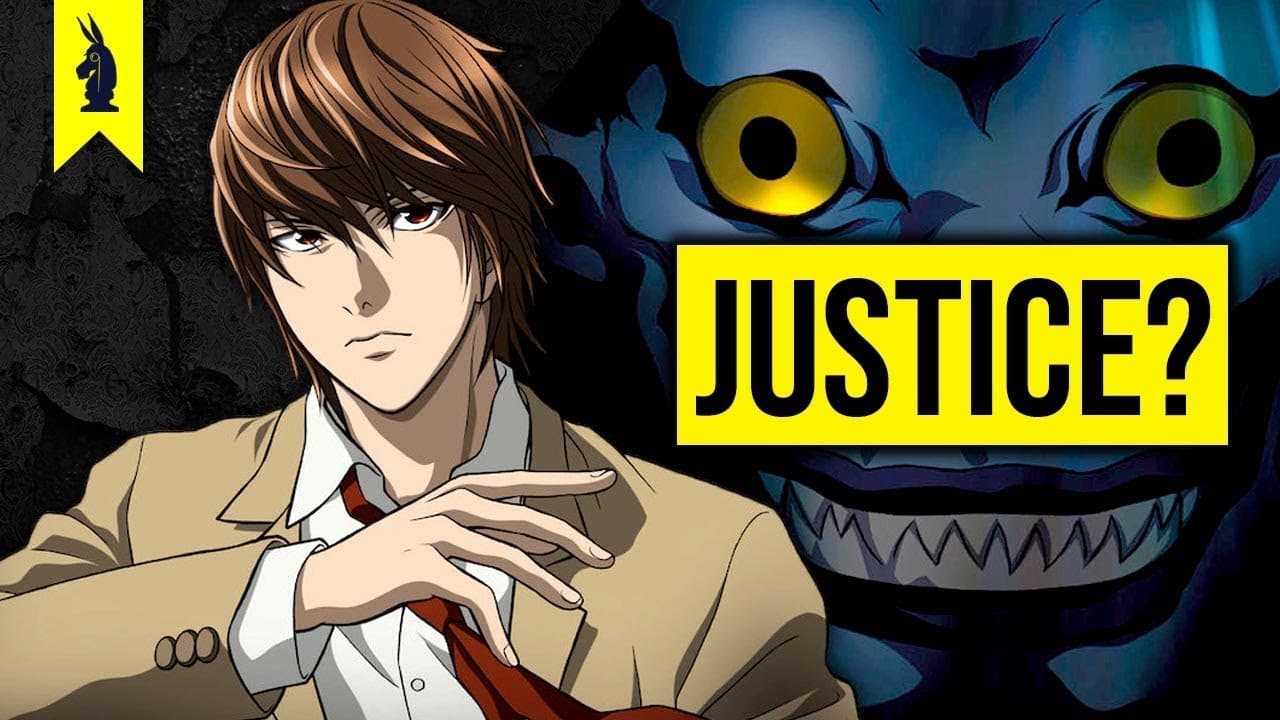
TL;DR
Death Note does not give one answer to what justice is. It uses a Socratic-style dialogue among Light, L, Misa and others, each claiming "I am justice," to test competing definitions. Light's ends-justify-the-means view, echoing Glaucon's Ring of Gyges, is challenged repeatedly throughout the series.
Transcript
Hey Wisecrack, disembodied Jared here, grab that potato chip and eat it, because we’re talking about the anime phenomenon - Death Note. While Death Note addresses a range of philosophical topics, spanning from property rights, to human nature, one of the most interesting is Justice— what is it, and how should it be applied? Justice is hardly a new ... Read More
Key Insights
- Death Note works as a modern Socratic Dialogue, because several characters propose rival definitions of justice and the show keeps challenging each one instead of settling on a single answer.
- Light Yagami's early view of justice is ends-justify-the-means, where creating a crime-free world excuses using his girlfriend to distract police and killing people who are not criminals but get in his way.
- Light's morals change when he renounces the notebook, since he loses his memories as Kira and refuses to exploit Misa's feelings, then drops that restraint once he touches the Death Note again.
- The Ring of Gyges is a Greek story of a ring that grants invisibility, and it is a likely ancestor of both Death Note and Lord of the Rings.
- Glaucon argues in Plato's Republic that justice is a social contract, and that people value it only for how it makes them look to others.
- A central question of Death Note is what justice means when nobody is looking, a theme repeated in Kira's pseudonym, the namelessness of L and N, and anonymous Kira supporters online.
- Both L and Light declare "I am justice," and in the final episode Light claims that by reducing violent crime and ending wars he has become justice itself.
- Light's quasi-utilitarian theory holds that killing criminals and making one person a god brings peace and happiness to the greatest number, and he frames himself as a martyr sacrificing his own soul.
Install to Summarize YouTube Videos and Get Transcripts
Explore YouTube Video Summarizer or Get YouTube Transcript Extractor
Questions & Answers
Q: What is the main idea of Death Note's take on justice?
Death Note does not give a clear stance on what justice is. Instead, it uses a unique method of constantly challenging different definitions of justice. Characters such as Light, L and Misa each propose their own version, and the show lets those versions collide, in the manner of a Socratic Dialogue.
Q: How does Light Yagami define justice?
Light holds an ends-justify-the-means view. He believes that a world free of crime justifies almost any action, including using his girlfriend to distract police and killing people who are not criminals but stand in his way. He also frames his approach as quasi-utilitarian, aiming at peace and happiness for the greatest number.
Q: What is the Ring of Gyges and how does it relate to Death Note?
The Ring of Gyges is an ancient Greek story about a man who finds a ring that makes him invisible. Using that anonymity, he takes the king's wife, kills the king and seizes power. The video says Death Note and Lord of the Rings are likely descendants of this story, since Light also gains power through anonymity.
Q: What does Glaucon argue about justice in Plato's Republic?
Glaucon, described as Plato's real-life older brother, uses the Ring of Gyges fable to argue that justice is just a kind of social contract that keeps people from hurting each other. He says people value justice mainly for its ability to make them look good, so once scrutiny disappears, so does their interest in justice.
Q: Why does Light's behavior change when he gives up the Death Note?
When Light renounces ownership of the notebook, he loses his memories of being Kira and his personality shifts noticeably. He refuses to exploit Misa's feelings to gain information, calling it unforgivable. Once he touches the Death Note again and regains his memories and powers, the Kira persona returns and he moves in with Misa to gain extra killing power.
Q: Why is Death Note compared to a Socratic Dialogue?
A Socratic Dialogue, like Plato's Republic, is less about offering a final theory and more about showing the process of exploring a concept through hypotheticals and varied definitions. Death Note works similarly, showing theories of justice move and evolve between and within characters, with believers like Light, Misa and Mikami challenged by skeptics.
Q: What does it mean when both L and Light say "I am justice"?
The scene, which the video calls one of the least subtle, has both L and Light declare in unison that each of them is justice, even though they are opponents. It highlights that both believe they hold true knowledge of justice, and it sets up the series-long conflict between rival claims, repeated again in the final episode.
Q: Who first challenges Light's vision of a new world?
Ryuk is Light's first real challenger. When Light explains his plan to kill the worst criminals first and let lesser ones die off, Ryuk replies that this would make Light the only bad person left. Ryuk acts out of boredom rather than moral duty, yet he notices the contradiction and begins the dialogue that lasts the show.
Summary & Key Takeaways
-
Death Note follows Light Yagami, who finds a notebook that kills anyone whose name is written in it. He wants a world without crime and becomes the public figure Kira, which brings him into conflict with law enforcement and the detective L. The show treats justice as an open question.
-
The video compares Light to the Ring of Gyges story from Plato's Republic. Glaucon claims people value justice only for their reputation, so anonymity and power lead to bad behavior. Death Note asks what justice means when nobody is watching, using anonymity and pseudonyms throughout the story.
-
Like a Socratic Dialogue, the series lets characters such as Light, L, Misa and Mikami each claim to know true justice, while skeptics test them. Ryuk begins this by pointing out a contradiction in Light's plan. Light sees himself as a martyr whose utilitarian vision demands sacrificing his own soul.
Read in Other Languages (beta)
Share This Summary 📚
Summarize YouTube Videos and Get Video Transcripts with 1-Click
Try YouTube Summary with ChatGPT & Claude or YouTube Transcript Generator