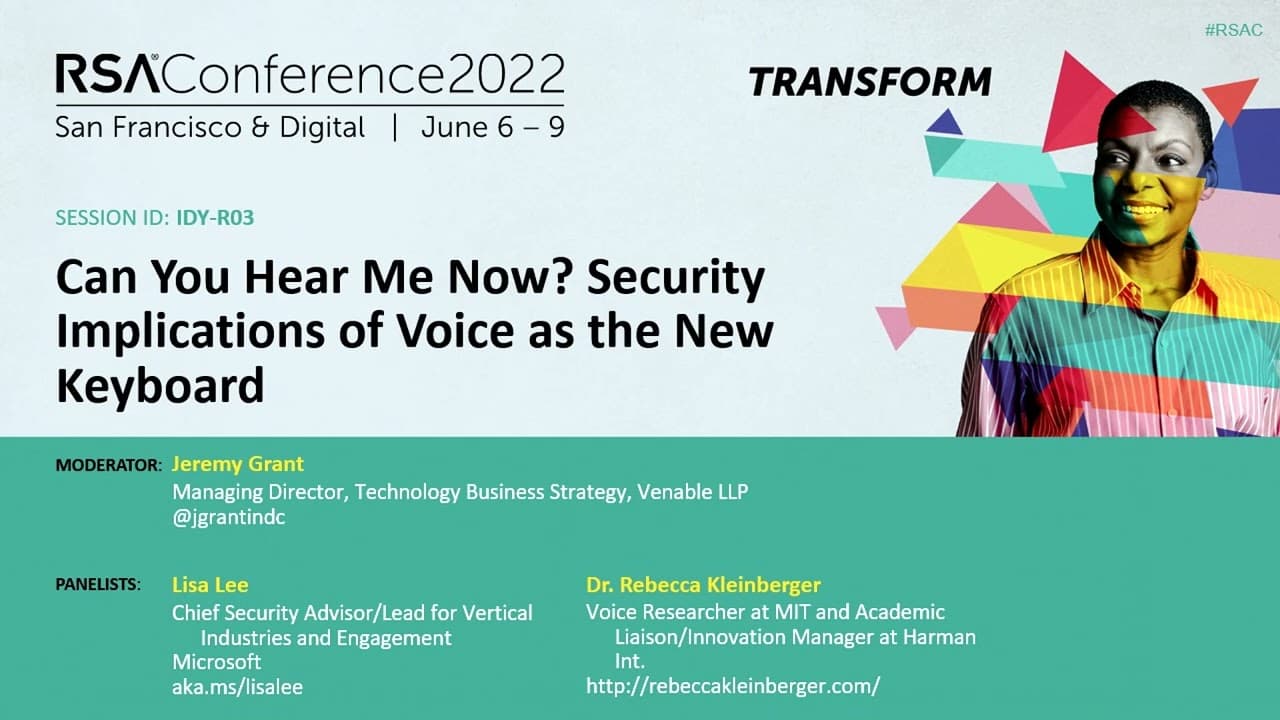
How Does Voice Technology Affect Security?
TL;DR
Voice can reduce input friction, but treating it like a keyboard or fixed biometric creates security, privacy, and reliability risks. A voice can reveal identity, physical traits, health, and mental state, while also changing across relationships, daily conditions, puberty, and aging. Security systems must therefore account for both impersonation and rejection of legitimate users.
Transcript
Great. Thank you. Good morning, everybody. Great to see you all here today. I know it's been a long week. Uh, hope you're all hanging in during RSA, maybe even enjoying it. Uh, so our panel today is entitled, uh, Can You Hear Me Now? Security Implications of Voice as the New Keyboard. I think this is gonna be a fun discussion. It's one that'll get ... Read More
Key Insights
- Voice is a highly revealing signal that can expose far more than spoken words. Listeners and analytical systems may infer identity, approximate age, hormonal identity, height, weight, facial structure, physical health, mental state, and mental health from vocal characteristics.
- Voice production is a multifactorial biological process involving the synchronized activity of up to one hundred muscles. Because the brain controls this process and tissue health affects it, neurological, hormonal, respiratory, and other physical changes can alter the resulting sound.
- Voice biometrics are not equivalent to fingerprints because a person's voice is not static. The concept of a voiceprint suggests a stable identifier, but voices can vary across life stages, daily conditions, immediate circumstances, health states, and social relationships.
- False positives are a security risk because a voice system may incorrectly conclude that an unauthorized person is the enrolled user. Adversaries can seek to exploit this weakness, making resistance to deliberate attempts at fooling recognition systems an essential design consideration.
- False negatives are an accessibility and reliability risk because a system may reject the correct person when their current voice differs from the enrolled voiceprint. Legitimate variation must therefore be represented in models rather than automatically interpreted as evidence of a different identity.
- Voice changes significantly across the human lifespan. Voices become more distinctive around puberty as hormones affect them, continue changing afterward, and may converge in certain ways during aging through biological and neurological effects associated with voice aging syndrome, or presbyphonia.
- Voice changes according to social context because people use somewhat different vocal patterns with different conversation partners. Machine learning researchers and data scientists need models that recognize this interpersonal variation when evaluating whether multiple samples belong to the same speaker.
- Voice applications require security and privacy analysis because they may use speech for input, identification, customer recognition, emotional inference, or medical insight. Faster and less frictional interactions can create new vulnerabilities when organizations collect, interpret, or retain sensitive vocal data.
Install to Summarize YouTube Videos and Get Transcripts
Explore YouTube Video Summarizer or Get YouTube Transcript Extractor
Questions & Answers
Q: What information can a person's voice reveal?
A person's voice can reveal much more than the words being spoken. The transcript states that listeners may quickly recognize someone they know and estimate an unfamiliar speaker's age and hormonal identity. Vocal characteristics may also suggest height, weight, facial structure, physical health, mental state, and mental health. Researchers continue discovering additional information encoded in voice, so the complete extent of disclosure remains uncertain.
Q: Why is voice considered a security and privacy risk?
Voice creates security and privacy risk because it can function simultaneously as an input method, biometric identifier, and source of sensitive personal information. Systems may use it to recognize customers, infer feelings, or identify possible medical conditions. Adversaries may also exploit voice technology. Any application involving voice or speech recognition must therefore consider unauthorized identification, manipulation, sensitive inference, and recognition errors.
Q: How does the human body produce a voice?
Voice results from a large cascade of biological and neurological factors rather than a single physical feature. Producing one vocal sound can require synchronization of up to one hundred muscles, all controlled by the brain. The condition of vocal tissues and the respiratory system also matters. Hormonal changes, heart disease, lung disease, and changes in the brain can consequently affect vocal characteristics.
Q: Why is a voiceprint different from a fingerprint?
A voiceprint is often treated as though it were a stable identifier like a fingerprint, but the panel challenges that assumption. A person's voice changes throughout life, across a single day, during illness, and even between conversations with different people. Because the underlying signal is dynamic, one enrolled sample may not reliably represent every legitimate future version of that person's voice.
Q: What are false positives in voice authentication?
A false positive occurs when a voice recognition system concludes that it has identified the correct person even though the speaker is someone else. This error can become a direct security vulnerability because an unauthorized individual may be accepted as a legitimate user. The risk is especially important when malicious people deliberately attempt to fool systems that rely on voiceprints for identity verification.
Q: What are false negatives in voice authentication?
A false negative occurs when the correct person speaks but the system decides that the voice is too different from the enrolled voiceprint. Natural variation can cause this outcome because voices change with age, health, daily conditions, immediate circumstances, and conversation partners. Models need awareness of these variations so legitimate users are not rejected merely because their current voice differs from an earlier recording.
Q: How does a person's voice change over a lifetime?
Human voices change substantially across life stages. Babies generally have similar voices, while puberty and its hormonal changes make individual voices more unique and distinct. Voices continue changing during adulthood. In later life, biological and neurological factors can contribute to voice aging syndrome, also called presbyphonia, which creates additional challenges for systems attempting to recognize one person consistently over time.
Q: How should organizations approach voice-based systems?
Organizations should evaluate voice systems as tools that can reduce friction while also creating vulnerabilities. Their assessments should cover adversarial attempts to fool recognition, false rejection of legitimate users, changing vocal characteristics, and the sensitive personal information that voice analysis may expose. Models should account for variation across health, age, time, and social context instead of assuming one permanent and universally reliable voiceprint.
Summary & Key Takeaways
-
Voice technology is increasingly used for data entry, biometric identification, customer recognition, emotional analysis, and possible medical assessment. These applications may accelerate input and remove friction, but they also expose sensitive information and create opportunities for adversaries. Every voice or speech recognition deployment therefore needs explicit security and privacy analysis.
-
A voice is produced through many interconnected biological and neurological factors. Producing a vocal sound can require synchronization of up to one hundred muscles, while the brain, hormones, tissues, respiratory system, and health conditions influence the result. Consequently, voice analysis may expose identity, body characteristics, health information, and mental state.
-
Voice biometrics face a fundamental reliability problem because voices are dynamic rather than fixed. Voices change throughout life, during the day, with health, and according to the person being addressed. Systems must manage false positives caused by accepting the wrong speaker and false negatives caused by rejecting a legitimate speaker whose voice has changed.
Read in Other Languages (beta)
Share This Summary 📚
Summarize YouTube Videos and Get Video Transcripts with 1-Click
Try YouTube Summary with ChatGPT & Claude or YouTube Transcript Generator
Explore More Summaries from RSAC Cybersecurity 📚




Summarize YouTube Videos and Get Video Transcripts with 1-Click
Try YouTube Summary with ChatGPT & Claude or YouTube Transcript Generator