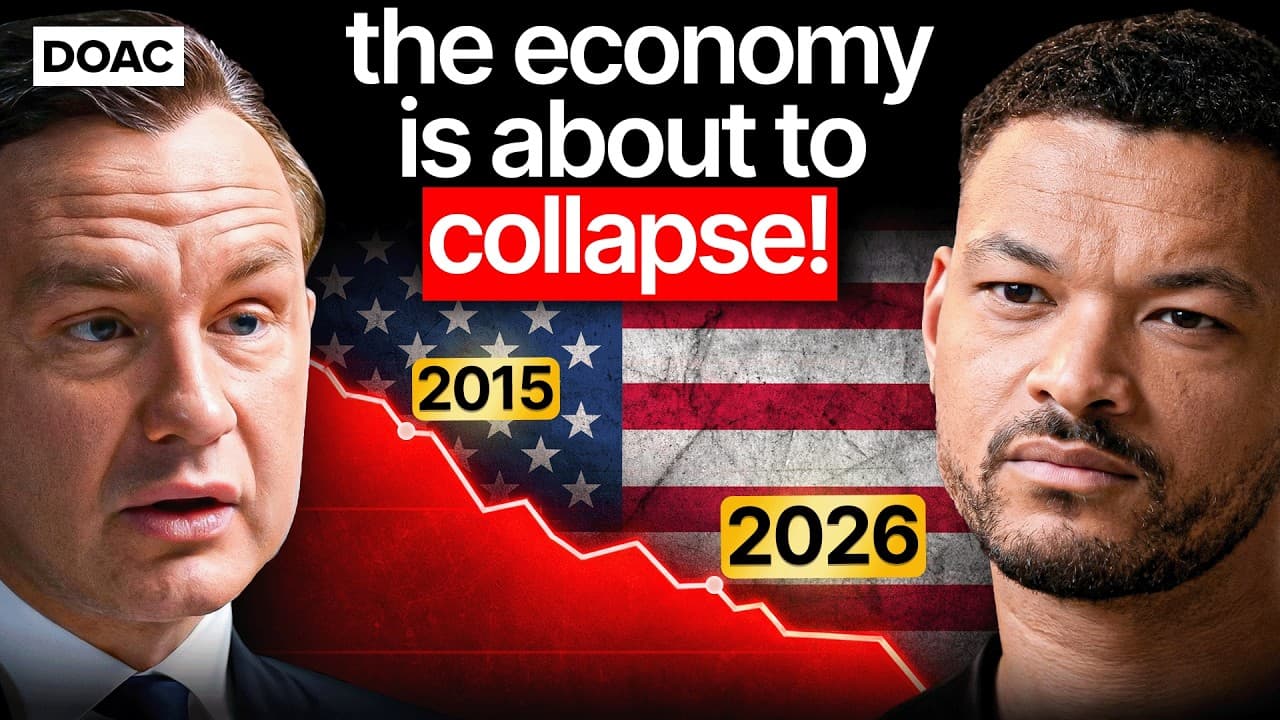
Is the Global Economy on the Brink of Collapse?
TL;DR
Pierre Poilievre discusses the potential economic collapse due to strategic mistakes by the U.S. and highlights Canada's role as a reliable partner. He emphasizes the need for free trade and resource leverage to stabilize economies and prevent geopolitical tensions. Poilievre also touches on domestic issues like housing and inflation, proposing deregulation and reduced taxes to foster economic growth.
Transcript
Trump threw the election and then thereafter said that >> Canada should honestly become our 51st state >> which is never going to happen. >> Pierre Polyv, leader of his majesty's loyal opposition. There's a significant probability that you could be Canada's next leader and your team said I can ask you whatever I want. >> Okay. >> So it appears that... Read More
Key Insights
- Pierre Poilievre argues that the U.S. is making a strategic mistake by isolating itself from allies like Canada.
- Canada has the fourth largest oil reserves, which can be a strategic asset for the U.S. if relations improve.
- The Iranian government poses a significant threat due to its nuclear ambitions and hostile actions.
- Canada faces domestic challenges like over-taxation, regulatory barriers, and a housing crisis.
- Poilievre suggests deregulating industries and reducing taxes to stimulate economic growth.
- The Canadian economy has stagnated due to resource underutilization and bureaucratic obstacles.
- Poilievre emphasizes the importance of a merit-based immigration system to optimize labor markets.
- Technological advancements like AI could disrupt job markets, requiring policy adaptations to ensure meaningful employment.
Install to Summarize YouTube Videos and Get Transcripts
Explore YouTube Video Summarizer or Get YouTube Transcript Extractor
Questions & Answers
Q: How does Pierre Poilievre view the U.S.'s current strategic decisions?
Pierre Poilievre views the U.S.'s current strategic decisions as a mistake, particularly its isolation from traditional allies like Canada. He believes this approach weakens the U.S.'s global standing and economic security. By alienating allies, the U.S. risks losing access to reliable resources and support, which could lead to economic and geopolitical instability.
Q: What role does Canada play in global energy security?
Canada plays a crucial role in global energy security with its vast oil reserves, ranking fourth globally. Poilievre argues that Canada can be a reliable energy partner for the U.S., offering stability and proximity. By fostering better trade relations, both countries could benefit from secure energy supplies and economic growth, reducing reliance on less stable regions.
Q: What are the main domestic challenges facing Canada according to Poilievre?
According to Poilievre, Canada's main domestic challenges include over-taxation, regulatory barriers, and a housing crisis. These issues hinder economic growth and affordability. He advocates for deregulation and tax cuts to stimulate the economy, create jobs, and make housing more accessible, thereby improving living standards for Canadians.
Q: How does Poilievre propose to address Canada's housing crisis?
Poilievre proposes addressing Canada's housing crisis by removing bureaucratic obstacles and reducing taxes on home building. He emphasizes the need for faster building permits and deregulation to increase housing supply. By making construction more efficient and affordable, Poilievre believes housing can become more accessible, helping to stabilize the market and reduce costs.
Q: What is Poilievre's stance on technological disruption in the job market?
Poilievre acknowledges the potential for technological disruption, particularly from AI, in the job market. He stresses the need for policies that ensure technology empowers workers rather than replaces them. By focusing on education and training, Poilievre believes workers can adapt to new roles, maintaining employment and economic stability in the face of technological advancements.
Q: How does Poilievre view the relationship between Canada and the U.S.?
Poilievre views the Canada-U.S. relationship as crucial for both nations' prosperity and security. He advocates for strengthening ties through free trade and cooperation on shared interests, such as energy security. By leveraging Canada's resources and strategic position, Poilievre believes both countries can achieve mutual benefits and address global challenges effectively.
Q: What is Poilievre's perspective on immigration policy?
Poilievre supports a merit-based immigration policy that aligns with Canada's labor market needs. He emphasizes the importance of integrating skilled immigrants into the workforce efficiently, removing barriers that prevent them from contributing fully. By optimizing immigration policy, Poilievre believes Canada can enhance its economic growth and address labor shortages effectively.
Q: What economic philosophy does Poilievre advocate for?
Poilievre advocates for an economic philosophy centered on free enterprise, deregulation, and low taxation. He believes in reducing government intervention to allow individuals and businesses to thrive independently. By fostering a competitive market environment, Poilievre argues that Canada can achieve higher economic growth, innovation, and improved living standards for its citizens.
Summary & Key Takeaways
-
Pierre Poilievre discusses the potential collapse of the global economy due to the U.S.'s strategic isolation, urging a return to alliances like those during the Cold War. He highlights Canada's vast oil reserves as a key asset for U.S. energy security, advocating for tariff-free trade between the nations.
-
Domestically, Poilievre identifies over-taxation, regulatory barriers, and a housing crisis as significant challenges for Canada. He proposes deregulation and tax cuts to stimulate economic growth and improve living standards, drawing on his personal experiences and political philosophy.
-
Poilievre addresses the impact of technological advancements, such as AI, on job markets, suggesting that policy adaptations are necessary to ensure that technology empowers rather than replaces human workers. He stresses the importance of a merit-based immigration system to fill labor gaps effectively.
Read in Other Languages (beta)
Share This Summary 📚
Summarize YouTube Videos and Get Video Transcripts with 1-Click
Try YouTube Summary with ChatGPT & Claude or YouTube Transcript Generator
Explore More Summaries from The Diary Of A CEO 📚





Summarize YouTube Videos and Get Video Transcripts with 1-Click
Try YouTube Summary with ChatGPT & Claude or YouTube Transcript Generator